Section 01
Where The Land Ethic Was Written
Wisconsin sits between two Great Lakes, with Superior on the north and Michigan on the east, and a third of the state drains to the Mississippi. Glaciers shaped nearly all of it, leaving thousands of kettle lakes, moraines, and bogs, except for the Driftless Area in the southwest, which the ice missed entirely and which consequently has steep valleys, cold spring creeks, and relict species found nowhere else in the region.
The state has an outsized place in American conservation thought. Aldo Leopold bought a worn-out farm near Baraboo in 1935 and spent the following decade planting trees and writing the essays published as A Sand County Almanac, which argued that people should regard land as a community to belong to rather than a commodity to own. The book became foundational to modern conservation, and the shack he restored still stands.
Wisconsin also runs one of the more remarkable species recoveries anywhere. Whooping cranes, reduced to fewer than 20 birds worldwide by the 1940s, are being re-established as an eastern migratory flock centred on Necedah National Wildlife Refuge. Early birds were taught a migration route by following an ultralight aircraft flown by handlers in crane costume, since cranes learn migration from their parents rather than instinctively.
Beyond that, Wisconsin holds one of the largest wolf populations in the lower 48, an enormous sandhill crane population that recovered from near-elimination, and a Great Lakes fishery permanently reshaped by invasive species.
Section 02
Wisconsin's Official State Animals
| Designation | Animal | Adopted |
|---|---|---|
| State animal | Badger Taxidea taxus | 1957 |
| State wildlife animal | White-tailed deer Odocoileus virginianus | 1957 |
| State domestic animal | Dairy cow | 1971 |
| State bird | American robin Turdus migratorius | 1949 |
| State fish | Muskellunge Esox masquinongy | 1955 |
| State insect | Honeybee Apis mellifera | 1977 |
| State symbol of peace | Mourning dove Zenaida macroura | 1971 |
The Badger State nickname is about miners, not animals. Lead miners in southwestern Wisconsin in the 1820s and 1830s dug shelters into hillsides rather than build cabins, and were nicknamed badgers for living in holes. The name attached to the state, and the badger became the state animal in 1957. Real badgers do live in Wisconsin, mostly in the west and south, but they are nocturnal, solitary, and rarely seen, so most residents of the Badger State have never encountered one.

Wisconsin also designated the mourning dove as the state symbol of peace in 1971, which effectively made hunting it politically difficult. A dove season was eventually opened in 2003 after considerable argument, and the peace designation remains on the books alongside it.
Section 03
Cranes, And Teaching Birds To Migrate
Wisconsin holds two crane stories, one a full recovery and one still in progress.
Sandhill cranes. By the early 1900s Wisconsin had perhaps 25 breeding pairs left after unregulated hunting and wetland drainage. Protection and wetland restoration turned that around completely, and the state now holds many thousands, with autumn staging concentrations at places like Crex Meadows drawing large numbers. The annual Midwest Crane Count, run by volunteers across hundreds of sites, is one of the largest citizen science wildlife surveys in the country. See sandhill crane facts.

Whooping cranes. The species fell to fewer than 20 birds worldwide in the 1940s. A single wild flock survived, migrating between Canada and Texas, and conservationists judged that one population was too fragile a basis for the species. Beginning in 2001, an eastern migratory population was established using captive-reared chicks released in Wisconsin.
The problem was that cranes do not know their migration route instinctively; they learn it from their parents. So handlers dressed in shapeless white costumes, avoiding any human cues, raised the chicks and then led them south to Florida behind an ultralight aircraft the birds had been conditioned to follow. The ultralight-led migrations ran for over a decade before the programme shifted to other rearing methods.

Where it stands: the eastern flock now numbers roughly 70 to 80 birds. Its persistent difficulty has been poor nest success in Wisconsin, with black flies harassing incubating adults off their nests being one identified factor. The flock is not yet self-sustaining and continues to require releases, which makes it a genuinely unfinished experiment rather than a completed success.
Section 04
Habitats By Region, And Who Lives In Each
Northern forest and lake country

Mixed conifer and northern hardwood with thousands of lakes and bogs. Gray wolves, black bear, bobcat, fisher, marten (state endangered and struggling despite reintroduction), moose as occasional wanderers, common loon, and boreal birds.
Lake Superior and the Apostle Islands

Cold, deep water with sandstone sea caves and 21 islands. Nesting herring gulls and cormorants, plus lake trout restoration after the sea lamprey collapse. See Apostle Islands and what lies at the bottom of Lake Superior.
Lake Michigan shore and Door County

Limestone bluffs, dunes, and boreal forest on the Niagara Escarpment. Door County holds rare land snails and the dwarf lake iris, and its cliffs support cold-air seeps with relict species. Piping plovers nest on a few Lake Michigan beaches. See Door County.
Central sand plain and wetlands

The bed of glacial Lake Wisconsin, now sandy barrens, marsh, and cranberry bogs. Necedah National Wildlife Refuge is here, holding whooping cranes, Karner blue butterflies in oak barrens, and massasauga rattlesnakes.
Driftless Area, southwest

Unglaciated country with steep coulees, cold spring creeks, and goat prairies on dry bluffs. It holds relict species including the Iowa Pleistocene snail on algific talus slopes, plus a nationally regarded wild brook and brown trout fishery and timber rattlesnakes on the bluffs.
Southern prairies and oak savanna

Once tallgrass prairie and oak savanna, now overwhelmingly farmland with fragments preserved. Greater prairie-chickens survive in the central sands on managed grassland, and Leopold's shack and the Aldo Leopold Foundation land sit in this region near Baraboo.
Section 05
Mammals Of Wisconsin
Gray wolf: extirpated by the 1950s and recolonised naturally from Minnesota, with the population now roughly 1,000 to 1,200 animals, among the largest in the lower 48. Wisconsin wolf management has been repeatedly disrupted by shifting federal listing status and court decisions, and a 2021 court-ordered February hunt that substantially overshot its quota became a national controversy.

Black bear: around 24,000, concentrated in the north but expanding south.

White-tailed deer: the state wildlife animal, well over a million animals. Chronic wasting disease was first found in Wisconsin deer in 2002 and has spread widely in the south, and it remains the state's most significant wildlife health issue.

Elk: extirpated by 1886 and reintroduced to the Clam Lake area in 1995 and the Black River area later, with animals from Michigan and Kentucky. The herds are growing slowly.

Badger: the state animal, present but nocturnal and rarely seen.

American marten: Wisconsin's only state endangered mammal, reintroduced repeatedly to the northern forest and still not securely established.

Bobcat, coyote, fisher, red and gray fox, river otter, mink, weasels, beaver, muskrat, snowshoe hare, porcupine, flying squirrels: all present. Related: what happens when beavers leave.

Bats: eight species. Wisconsin's hibernating bats have been devastated by white-nose syndrome, with little brown bat numbers in monitored hibernacula falling by well over 90 percent. See do bats hibernate.

Gone: Canada lynx as a resident, caribou, bison, and mountain lion, though dispersing cougars from the Dakotas are confirmed in the state most years.
Section 06
Birds Of Wisconsin
Around 440 species have been recorded, with the state's wetlands and northern forests doing most of the work.
- Cranes: sandhills in the many thousands and the reintroduced whooping crane flock.
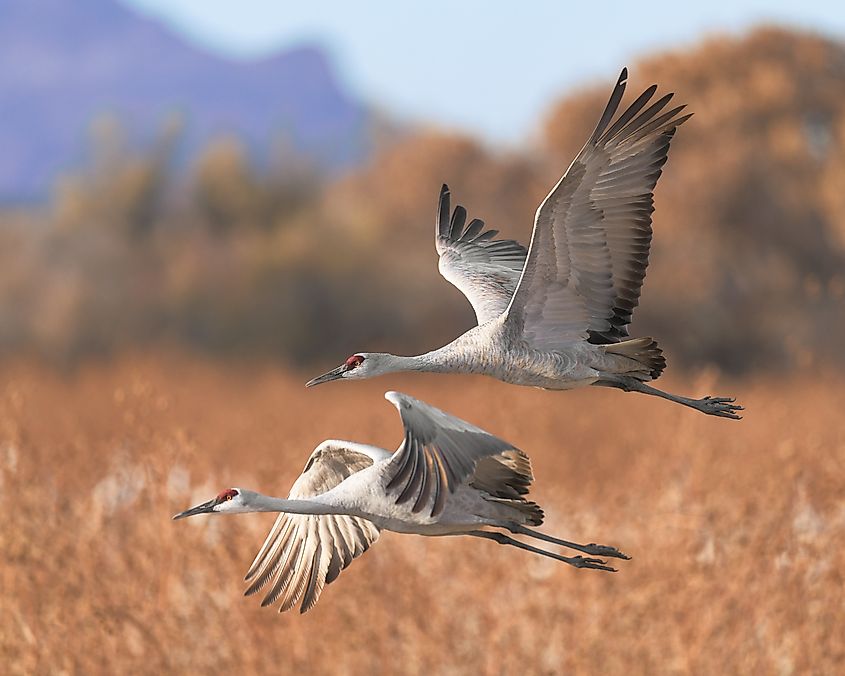
A pair of sandhill cranes - Kirtland's warbler: Wisconsin now hosts a small breeding population of this species, which for decades nested almost exclusively in Michigan jack pine. Its expansion into Wisconsin is a genuine recovery milestone.
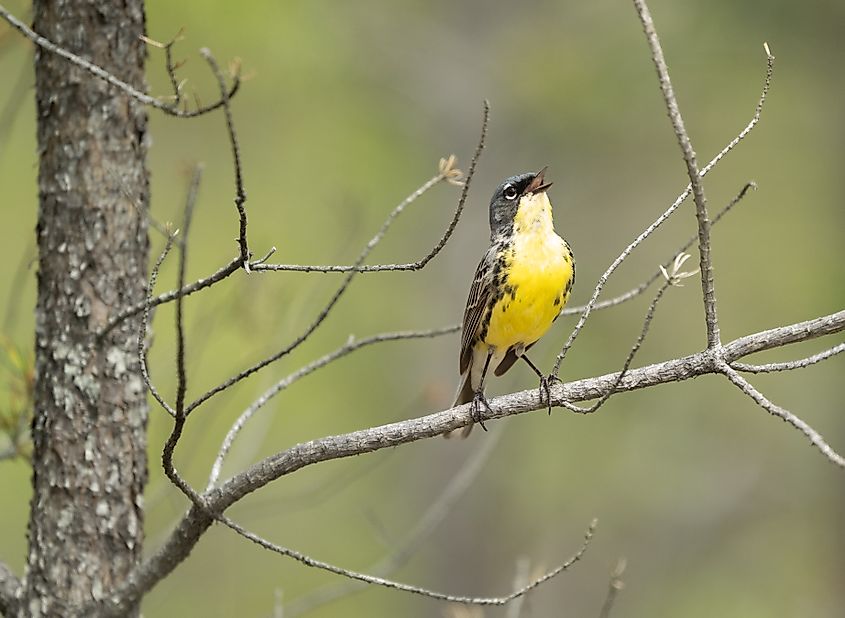
A Kirtland's warbler (Setophaga kirtlandii) - Greater prairie-chicken: reduced to a small managed population in the central sands, supported by grassland management and translocations.
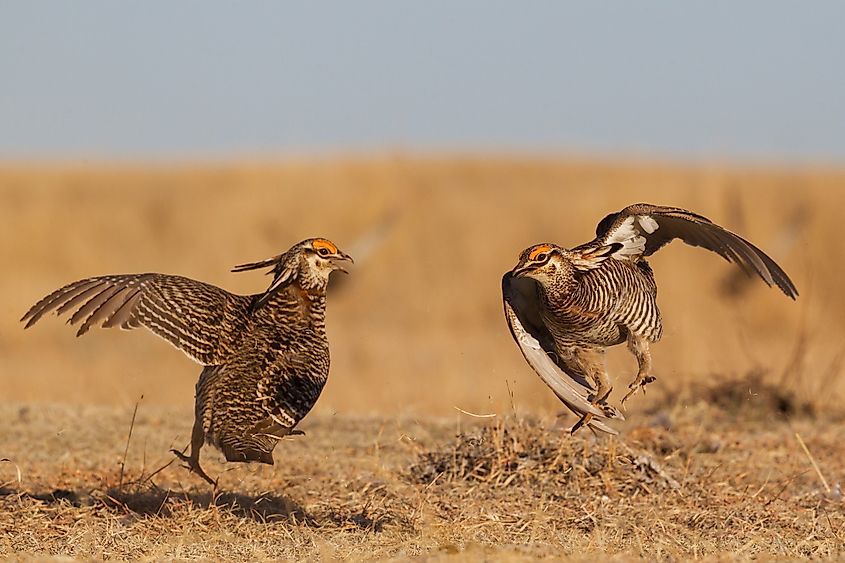
A pair of greater prairie-chickens (Tympanuchus cupido) - Common loon: nesting on hundreds of northern lakes, monitored by volunteers and vulnerable to lead tackle and shoreline development.
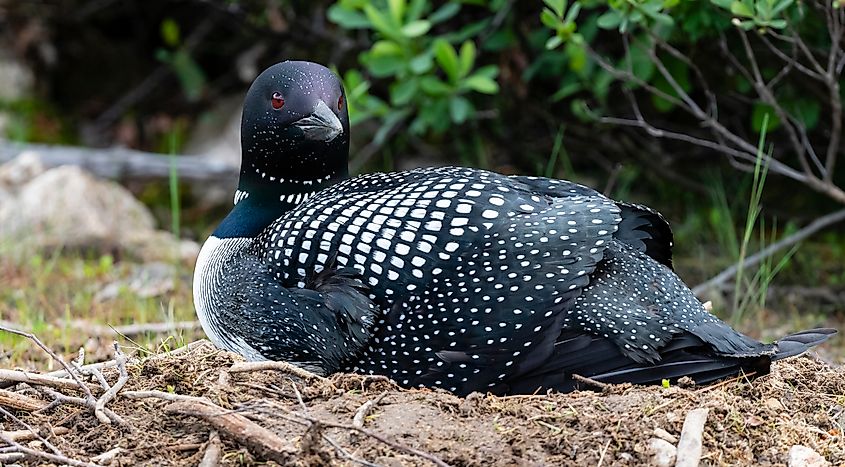
A common loon (Gavia immer) - Bald eagle: Wisconsin was one of the few states where eagles never disappeared entirely, and its remnant population helped supply birds for reintroductions elsewhere. The state now has well over a thousand nests.
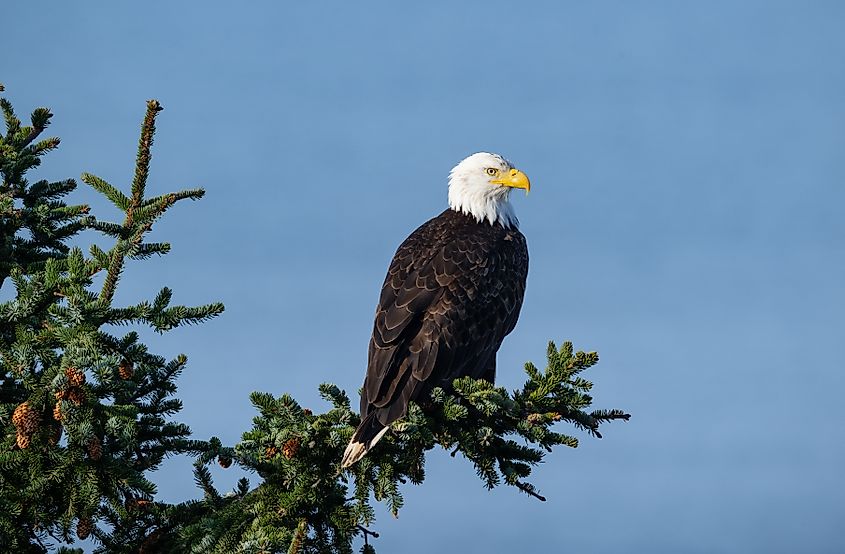
A bald eagle (Haliaeetus leucocephalus) - Forest birds: the northern forest holds high densities of warblers, and Wisconsin carries meaningful responsibility for golden-winged warbler, which has declined steeply and hybridises with the blue-winged warbler where they meet.
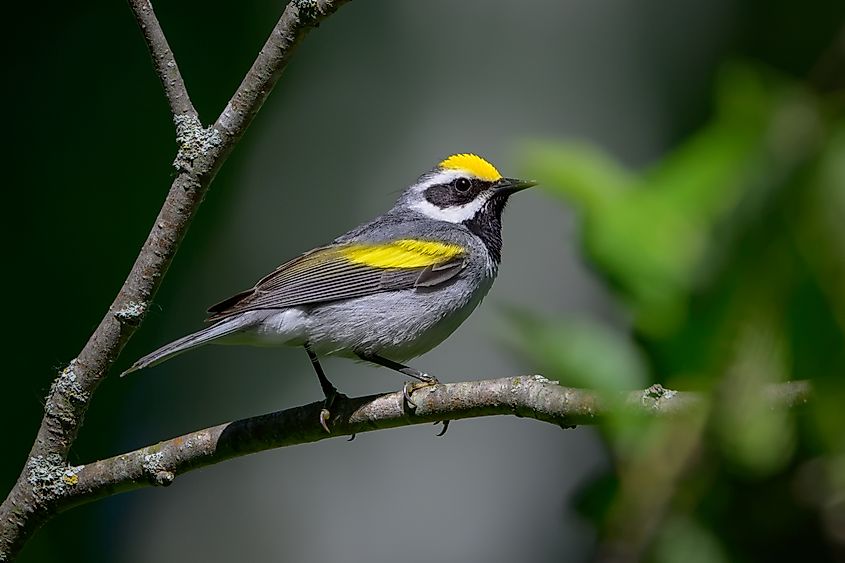
A golden-winged warbler (Vermivora chrysoptera)


Section 07
Reptiles, Amphibians, And Fish
Wisconsin has around 37 reptile and 19 amphibian species. Two snakes are venomous, both rare.
Snakes

21 species. The timber rattlesnake occurs on Driftless Area bluffs and is a species of special concern, and the eastern massasauga survives in a few wetlands and is federally threatened. Both are uncommon enough that most residents will never see one.
Turtles

Blanding's turtle, wood turtle, and ornate box turtle are all declining, plus painted, map, musk, snapping turtles, and softshells. Road mortality during June nesting is a major cause, and volunteer efforts move turtles across roads.
Amphibians

Blue-spotted, spotted, and four-toed salamanders, mudpuppy, eastern newt, plus wood frog, spring peeper, mink frog in the north, and Blanchard's cricket frog, which has declined severely and is state endangered.
Fish

The muskellunge is the state fish and Wisconsin is its centre of abundance. Lake sturgeon in the Winnebago system support one of the world's few remaining sturgeon spear fisheries, closely managed, and the Wolf River spawning run draws crowds each spring. Great Lakes fisheries were transformed by sea lamprey and then by alewives, zebra and quagga mussels, and round goby. Related: how sea lampreys nearly destroyed the Great Lakes and electric barriers and Asian carp.
Section 08
Dangerous Animals In Wisconsin
- White-tailed deer: roughly 20,000 or more reported vehicle collisions a year.
- Ticks: Wisconsin has among the highest Lyme disease incidence rates in the country, concentrated in the west and north, plus anaplasmosis and babesiosis.
- Venomous snakes: two species, both rare and both of conservation concern. Bites are exceptionally uncommon.
- Black bear: no fatal attacks in the state's recorded history. Bird feeders and garbage drive conflicts in the north.
- Wolves: no verified attack on a person in Wisconsin. Livestock and hunting dog depredation drive the conflict, and the state pays compensation for both.
- Cold and ice: falling through lake ice and hypothermia harm far more people than any Wisconsin animal.
Section 09
Endangered And Protected Species
| Species | Where | Status |
|---|---|---|
| Whooping crane | Necedah and central wetlands | ENDANGERED |
| Karner blue butterfly | Oak and pine barrens | ENDANGERED |
| Rusty patched bumblebee | Scattered, Wisconsin a stronghold | ENDANGERED |
| Northern long-eared bat | Statewide | ENDANGERED |
| Eastern massasauga | A few wetlands | THREATENED |
| Higgins eye pearlymussel | Mississippi River | ENDANGERED |
| American marten | Northern forest | STATE ENDANGERED |
| Blanchard's cricket frog | Southern wetlands | STATE ENDANGERED |
| Greater prairie-chicken | Central sands grassland | STATE THREATENED |
| Kirtland's warbler | Central jack pine | DELISTED 2019 |
Wisconsin is a stronghold for the rusty patched bumblebee, which was the first bee in the continental United States listed as endangered. It declined by roughly 90 percent across its range in a couple of decades, apparently from a pathogen spread by commercial bumblebees used in greenhouse pollination, compounded by pesticides and habitat loss. Beyond that, Wisconsin's pressures are wetland loss, grassland conversion, chronic wasting disease in deer, white-nose syndrome in bats, and Great Lakes invasive species that have permanently restructured the aquatic food web.
Section 10
Where To See Wildlife In Wisconsin
- Necedah National Wildlife Refuge: whooping cranes, Karner blue butterflies, and central sand barrens.
- Crex Meadows Wildlife Area: enormous autumn sandhill crane staging and restored wetland.
- Horicon Marsh: one of the largest freshwater cattail marshes in the US, with vast goose migrations and marsh birds.
- Apostle Islands National Lakeshore: Lake Superior islands, sea caves, and nesting birds.
- Chequamegon-Nicolet National Forest: wolves, bears, elk near Clam Lake, and northern forest birds.
- Driftless Area coulees and spring creeks: wild trout, goat prairies, and timber rattlesnake country.
- Aldo Leopold Shack and Center, near Baraboo: the restored farm where A Sand County Almanac was written, with prairie and savanna restoration.
- Wolf River at Shawano: the lake sturgeon spawning run each April, visible from shore.
Timing: April for sandhill crane arrival, the volunteer Crane Count, and the lake sturgeon spawning run on the Wolf River. May and June for warblers and Karner blue flights. September and October for crane staging at Crex Meadows and Horicon goose migration. Winter for wolf tracks in the northern forest and eagles on open water. Tick precautions are essential from April through October.
Section 11
Common Questions
- What is the state animal of Wisconsin?
- The badger, adopted in 1957. The nickname comes from 1820s lead miners who dug shelters into hillsides rather than build cabins and were nicknamed badgers. Wisconsin also names the white-tailed deer as state wildlife animal and the dairy cow as state domestic animal.
- How many wolves live in Wisconsin?
- Roughly 1,000 to 1,200, among the largest populations in the lower 48. Wolves were extirpated by the 1950s and recolonised naturally from Minnesota. Management has been repeatedly disrupted by shifting federal listing status and court decisions.
- Why were whooping cranes taught to migrate by aircraft?
- Cranes learn their migration route from their parents rather than instinctively. Captive-reared chicks had no one to follow, so handlers in shapeless white costumes raised them and led them from Wisconsin to Florida behind an ultralight aircraft the birds had been conditioned to follow.
- How many venomous snakes live in Wisconsin?
- Two, both rare: the timber rattlesnake on Driftless Area bluffs and the eastern massasauga in a few wetlands. Both are of conservation concern and bites are exceptionally uncommon.
- What is the Driftless Area?
- A region of southwestern Wisconsin and neighbouring states that the glaciers missed entirely. It has steep coulees, cold spring creeks, and relict species including the Iowa Pleistocene snail, plus a nationally regarded wild trout fishery.
- Where did Aldo Leopold write A Sand County Almanac?
- At a worn-out farm near Baraboo that he bought in 1935 and spent a decade restoring. The shack still stands, and the book's argument that land is a community to belong to rather than a commodity to own became foundational to modern conservation.
- What is the most dangerous animal in Wisconsin?
- White-tailed deer, with roughly 20,000 or more reported vehicle collisions annually. Ticks carry the greatest disease burden, with Wisconsin among the highest Lyme incidence states.
This page was last updated on October 7, 2026