Section 01
Mountains, Chesapeake, And The Barrier Islands
Virginia runs from 5,729 feet at Mount Rogers in the southwest to the Atlantic, crossing five physiographic provinces on the way. That range means the state holds Appalachian salamanders and coastal salt marsh, and its wildlife is best understood as three separate stories that happen to share a border.
The mountains are old Appalachian forest with cove hardwoods, spruce-fir remnants on the highest peaks, and one of the richest salamander faunas outside the Smokies. Shenandoah National Park protects a long strip of ridge, and its black bear density is among the highest anywhere in the East.
The middle is Piedmont and the Chesapeake tidewater, where more than half of Virginia's people live. The bay side holds tidal marsh, oyster reef, and the rivers that feed the estuary, and Virginia shares responsibility for the Chesapeake's condition with five other states.
The Eastern Shore is the outlier. Virginia's portion of the Delmarva Peninsula ends in a chain of largely undeveloped barrier islands, most owned by conservation organisations, which is nearly unique on the Atlantic coast. Those islands and the lagoons behind them form one of the longest stretches of undeveloped coastline between Maine and Florida, and they support seabird colonies, migrating shorebirds, and a seagrass restoration project that regrew an entire ecosystem people had assumed was gone for good.
Section 02
Virginia's Official State Animals
| Designation | Animal | Adopted |
|---|---|---|
| State bird | Northern cardinal Cardinalis cardinalis | 1950 |
| State dog | American foxhound | 1966 |
| State insect | Tiger swallowtail Papilio glaucus | 1991 |
| State bat | Virginia big-eared bat Corynorhinus townsendii virginianus | 2005 |
| State saltwater fish | Striped bass Morone saxatilis | 2011 |
| State freshwater fish | Brook trout Salvelinus fontinalis | 1993 |
| State shell | Eastern oyster Crassostrea virginica | 1974 |
| State snake | Eastern garter snake Thamnophis sirtalis | 2016 |
Virginia is one of very few states with an official state bat, and it chose an endangered one. The Virginia big-eared bat is a subspecies restricted to a small number of limestone caves in Virginia, West Virginia, Kentucky, and North Carolina, with a total population in the tens of thousands. It roosts and hibernates in caves year-round rather than moving to trees in summer, which makes it entirely dependent on a handful of specific sites. The 2005 designation was driven partly by a schoolchildren's campaign and partly to raise its profile as a federally endangered species.

The eastern garter snake designation in 2016 came from a similar student campaign, aimed explicitly at reducing fear of snakes. Virginia has no state mammal, and proposals have surfaced without success.
Section 03
Habitats By Region, And Who Lives In Each
Blue Ridge and the southwest highlands

Cove hardwood, hemlock ravines, and spruce-fir on the highest peaks around Mount Rogers. Black bear at high density, bobcat, timber rattlesnake, and an exceptional salamander fauna including the endemic Peaks of Otter salamander and Shenandoah salamander. See Shenandoah National Park and Appalachian Mountains.
Valley and Ridge, and the karst belt

Limestone valleys with caves, springs, and sinkholes. Virginia has thousands of caves holding the Virginia big-eared bat, Indiana bat, gray bat, and numerous cave invertebrates restricted to single systems. The Clinch and Powell rivers in the far southwest hold globally significant mussel diversity shared with Tennessee.
Piedmont

Rolling hills between the mountains and the fall line, with second-growth forest, farmland, and the Richmond and Northern Virginia development corridors. White-tailed deer at suburban densities, coyote, beaver, and bald eagles along the rivers.
Chesapeake Bay and tidewater

Tidal marsh, oyster reef, and the James, York, Rappahannock, and Potomac estuaries. The James River holds one of the densest bald eagle concentrations on the East Coast, and the bay supports blue crab, striped bass, and oysters. Related: osprey facts.
Great Dismal Swamp and southeastern lowlands

Peat swamp and bottomland at the North Carolina border, historically far larger and drained substantially. Black bear, bobcat, cottonmouth, and the northernmost range edge for several southern species. The swamp also has a significant human history as a refuge for people escaping slavery.
Eastern Shore and barrier islands

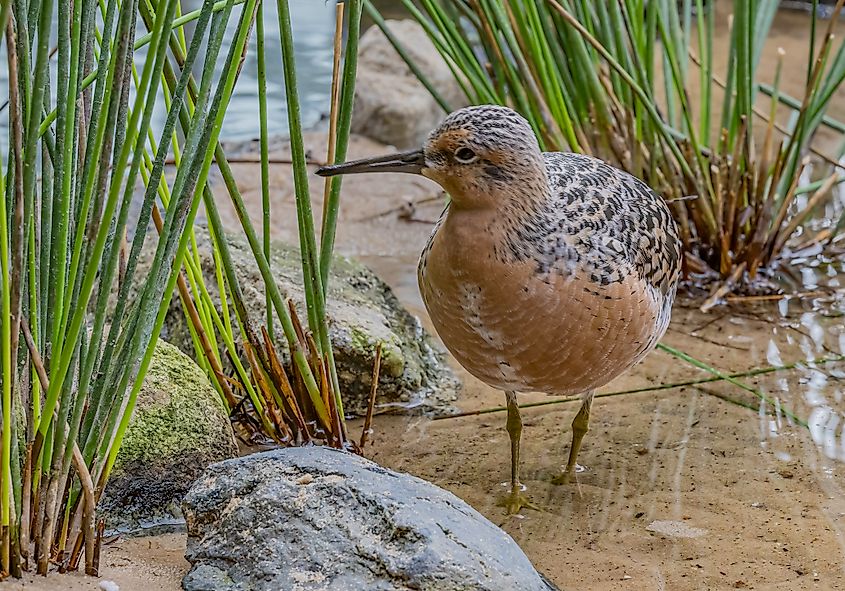
Largely undeveloped barrier islands and coastal bays, most under conservation ownership. Nesting terns, black skimmers, American oystercatchers, and piping plovers, plus enormous migrating shorebird numbers including red knots feeding on horseshoe crab eggs. See Chincoteague, where the famous wild ponies live on Assateague.
Section 04
The Seagrass That Came Back
Virginia's coastal bays behind the barrier islands were once carpeted with eelgrass. In the early 1930s a wasting disease swept the Atlantic, and a 1933 hurricane finished the job. The eelgrass disappeared entirely from Virginia's seaside bays, and the bay scallop fishery that depended on it collapsed and was declared commercially extinct.
For roughly seventy years the bays stayed bare. Then in the late 1990s researchers found small natural patches, and beginning in the early 2000s a restoration effort began broadcasting eelgrass seeds across the bare bottom, eventually spreading tens of millions of seeds over thousands of acres.
It worked on a scale few restoration projects achieve. Thousands of acres of meadow now grow where there was bare sand, and the returning grass brought back the ecosystem with it: juvenile fish, blue crabs, and eventually bay scallops, which were reintroduced and have begun reproducing. The meadows also store carbon, clarify water, and stabilise sediment.
Why it matters beyond Virginia: seagrass restoration usually fails or works only in small patches. This project demonstrated that a seed-broadcast approach at landscape scale can rebuild a coastal ecosystem that had been absent for generations, and it is now cited internationally as the largest and most successful seagrass restoration anywhere.
Section 05
Mammals Of Virginia
White-tailed deer: abundant, with very high suburban densities in northern Virginia.

Black bear: roughly 20,000 or more statewide, present in the mountains, the Dismal Swamp area, and increasingly in suburban counties.

Elk: extirpated by the 1850s and reintroduced to Buchanan County in the southwest starting in 2012 using animals from Kentucky. The herd now numbers several hundred and has become a tourism draw in a former coal region.

Bobcat, coyote, gray and red fox, river otter, mink, weasels, striped and spotted skunk, raccoon, opossum, beaver, woodchuck, squirrels: all present. Related: what happens when beavers leave.

Delmarva fox squirrel: present on Virginia's Eastern Shore, delisted in 2015 after recovery.

Bats: 17 species. The Virginia big-eared bat is the state bat and federally endangered, and Indiana and gray bats also occur. White-nose syndrome has caused catastrophic declines in tricolored and northern long-eared bats. See where bats live and do bats hibernate.

Marine mammals: bottlenose dolphins enter the Chesapeake in summer in large numbers, plus humpback whales feeding off Virginia Beach in winter and North Atlantic right whales migrating through.

Absent: gray wolf, red wolf, eastern cougar, and bison, all extirpated. Virginia's last confirmed native cougar records are from the 1800s.
Section 06
Birds Of Virginia
More than 480 species have been recorded, driven by the coast, the bay, and the mountains together.
- Bald eagle: Virginia went from roughly 30 nesting pairs in the 1970s to well over a thousand, and the James River holds one of the densest concentrations on the Atlantic coast.
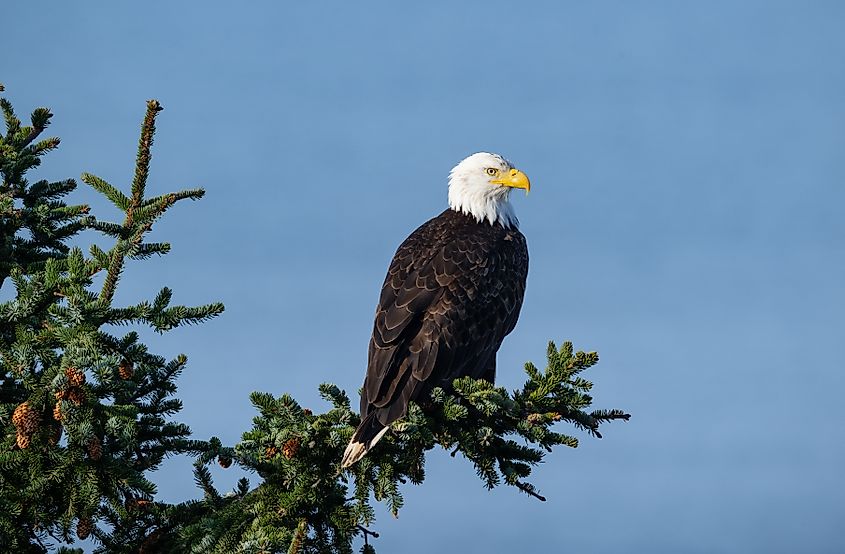
A bald eagle (Haliaeetus leucocephalus) - Shorebirds: the Eastern Shore barrier islands and coastal bays hold hemispherically significant numbers of migrating shorebirds, including red knots refueling on horseshoe crab eggs alongside the Delaware Bay populations.
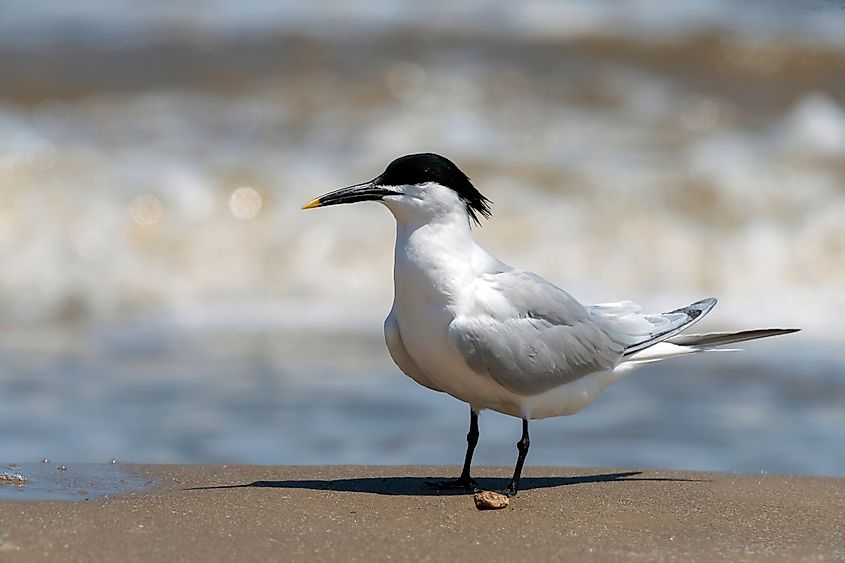
A red knot (Calidris canutus) - Seabird colonies: royal terns, sandwich terns, black skimmers, and gull-billed terns nest on island and bridge-island sites, and the Hampton Roads bridge-tunnel islands hold a colony of regional importance that has required active management.
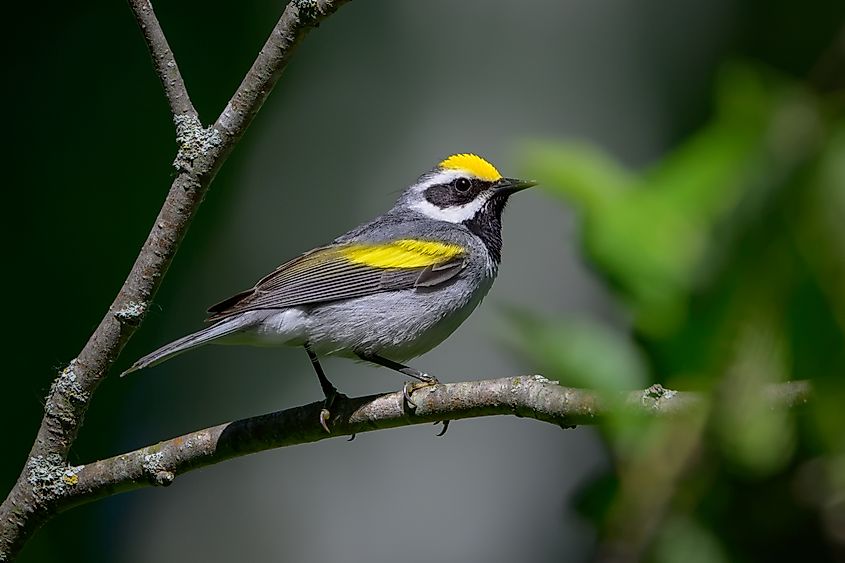
A sandwich tern (Thalasseus sandvicensis) - Mountain birds: cerulean warbler, golden-winged warbler at the southern edge of its range, and high-elevation species including winter wren and northern saw-whet owl on the highest peaks.
A golden-winged warbler (Vermivora chrysoptera) - Cape Charles and the Delmarva funnel: autumn migrants moving down the peninsula concentrate at its southern tip before crossing the bay mouth, producing heavy raptor and songbird flights.
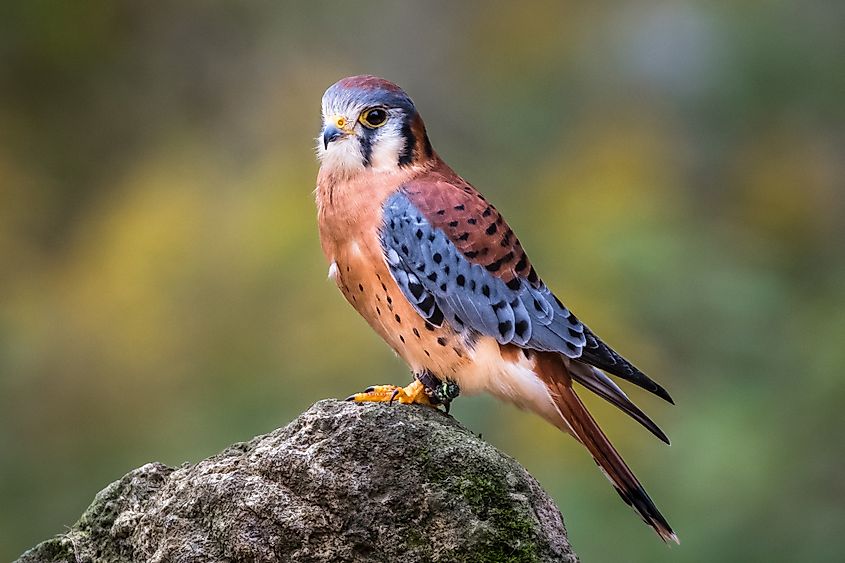
An American kestrel (Falco sparverius)


Section 07
Reptiles, Amphibians, And Fish
Virginia has around 60 reptile and 80 amphibian species, with salamanders the standout group.
Salamanders

There are more than 50 species, including several with tiny ranges. The Shenandoah salamander lives only on three mountaintops in Shenandoah National Park and is federally endangered, threatened by competition from the more widespread red-backed salamander and by warming that shrinks its high-elevation refuge. The Peaks of Otter salamander occupies a narrow band of the Blue Ridge and nowhere else.
Snakes

There are 32 species, three venomous: copperhead, which is widespread and accounts for nearly all bites, timber rattlesnake in the mountains, and cottonmouth in the southeastern corner only. The eastern garter snake is the state snake.
Turtles

Bog turtle in mountain fens (federally threatened), wood turtle, spotted turtle, eastern box turtle, diamondback terrapin in the bay, and five sea turtle species offshore. See the seven sea turtle species.
Fish and mussels

The brook trout is the state freshwater fish, and the striped bass is the saltwater fish. The Clinch and Powell rivers hold dozens of freshwater mussel species, many federally listed, and are among the most important mussel rivers on Earth. Atlantic sturgeon spawn in the James and are federally endangered, having been rediscovered spawning there after being presumed gone.
Section 08
Dangerous Animals In Virginia
- Ticks: Virginia has high Lyme disease incidence, particularly in the northern and western parts, plus Rocky Mountain spotted fever, ehrlichiosis, and alpha-gal syndrome from lone star ticks.
- White-tailed deer: tens of thousands of vehicle collisions annually.
- Copperhead: common in suburban yards and mulch beds, and responsible for nearly all venomous snakebites in the state. Painful, rarely fatal.
- Black bear: no fatal attacks recorded in Virginia. Bird feeders and unsecured trash drive nearly all conflicts.
- Sea nettles: the Chesapeake's jellyfish make bay swimming unpleasant from July into September.
- Rabies: raccoons are the main vector, with skunks, foxes, and bats also involved.
- Rip currents: these harm far more people on Virginia beaches than any animal.
Section 09
Endangered And Protected Species
| Species | Where | Status |
|---|---|---|
| Shenandoah salamander | Three mountaintops only | ENDANGERED |
| Virginia big-eared bat | A few limestone caves | ENDANGERED |
| Indiana bat | Karst caves | ENDANGERED |
| Atlantic sturgeon | James River | ENDANGERED |
| Numerous Clinch mussels | Clinch and Powell rivers | DOZENS LISTED |
| Red knot | Eastern Shore stopovers | THREATENED |
| Piping plover | Barrier island beaches | THREATENED |
| Bog turtle | Mountain fens | THREATENED |
| Northern long-eared bat | Statewide | ENDANGERED |
| Delmarva fox squirrel | Eastern Shore | DELISTED 2015 |
The Shenandoah salamander is among the most climate-exposed animals in the eastern United States. It lives on three peaks above roughly 3,000 feet, held there by competition with the red-backed salamander which outcompetes it at lower and warmer elevations. As the climate warms, the red-backed salamander moves upslope and the Shenandoah salamander has nowhere left to go. Beyond that, Virginia's pressures are development in the Piedmont and coastal corridors, Chesapeake nutrient loading, white-nose syndrome, and sedimentation in the southwestern mussel rivers.
Section 10
Where To See Wildlife In Virginia
- Chincoteague National Wildlife Refuge: wild ponies, shorebirds, waterfowl, and beach-nesting birds.
- Shenandoah National Park: black bears along Skyline Drive, salamanders after rain, and mountain birds.
- Eastern Shore of Virginia National Wildlife Refuge and Kiptopeke: autumn migration concentration at the peninsula's tip.
- Great Dismal Swamp National Wildlife Refuge: bear, bobcat, and southern swamp species.
- James River, Presquile and Hopewell area: exceptional bald eagle concentrations.
- Clinch and Powell rivers: mussel diversity, best seen with a snorkel and a guide.
- Southwest Virginia elk viewing area, Buchanan County: the reintroduced elk herd with a public viewing tower.
- Virginia Beach in winter: humpback whales feeding close to shore on boat trips.
Timing: May for horseshoe crabs and red knots on the Eastern Shore, and for warbler migration. September and October for the Kiptopeke hawk flight and the elk rut in the southwest. December through March for wintering waterfowl at Chincoteague and humpbacks off Virginia Beach. Spring rains for salamanders in the mountains, which is Virginia's most underrated wildlife experience.
Section 11
Common Questions
- What is the state animal of Virginia?
- Virginia has no state mammal. It does have a state bat, the endangered Virginia big-eared bat, plus the northern cardinal as state bird, the American foxhound as state dog, and the eastern garter snake as state snake.
- What is the Shenandoah salamander?
- A federally endangered salamander living on just three mountaintops in Shenandoah National Park. It is confined to high elevations because the red-backed salamander outcompetes it lower down, and as the climate warms that competitor moves upslope, leaving it nowhere to go.
- Are there elk in Virginia?
- Yes. Elk were extirpated by the 1850s and reintroduced to Buchanan County in southwest Virginia from 2012 using Kentucky animals. The herd now numbers several hundred and has become a tourism draw in a former coal region.
- How many venomous snakes live in Virginia?
- Three: copperhead, which is widespread and causes nearly all bites, timber rattlesnake in the mountains, and cottonmouth in the southeastern corner only.
- What happened to Virginia's seagrass?
- A wasting disease and a 1933 hurricane eliminated eelgrass from Virginia's seaside bays entirely, and the bay scallop fishery collapsed. Beginning in the early 2000s, researchers broadcast tens of millions of seeds and rebuilt thousands of acres of meadow, in what is now cited as the largest successful seagrass restoration anywhere.
- Are the Chincoteague ponies wild?
- They are feral rather than truly wild, descended from domestic stock, and they live on Assateague Island. The Virginia herd is owned by a local fire company and managed through the annual pony swim and auction, which keeps numbers within what the marsh can support.
- What is the most dangerous animal in Virginia?
- Ticks, given high rates of Lyme disease, spotted fever, and alpha-gal syndrome. Deer cause the most direct injuries through vehicle collisions, and copperhead bites are common but rarely serious.
This page was last updated on October 6, 2026