Section 01
The State That Cut Down Its Forest And Then Regrew It
Vermont has the most dramatic forest history in New England. By the mid-1800s, sheep farming had stripped the state to roughly 25 percent forest cover, with hillsides cleared to the ridgetops and stone walls running through open pasture. Photographs from the period show a landscape closer to the Scottish Highlands than to the wooded state people picture now.
When the wool market collapsed and farming moved west, the fields grew back. Vermont is now about 75 percent forested, one of the highest proportions in the country, and the stone walls that run through mature woods are the visible record of what happened. Those regrown forests brought back moose, black bear, beaver, fisher, and bobcat, all of which had been eliminated or nearly so.
Vermont is landlocked, which makes Lake Champlain its defining water body. At 120 miles long it is the sixth largest freshwater lake in the country, holds landlocked Atlantic salmon and lake trout, and supports a distinctive fish community, plus a persistent local legend about a lake monster.
The state's most notable ongoing wildlife issue is the same one facing New Hampshire and Maine: moose declining sharply because of winter ticks. Vermont's herd fell from a peak of roughly 5,000 in the mid-2000s to something on the order of 2,000 or fewer, and the state reduced hunting permits substantially in response before using limited harvest in one region specifically as a tick management tool.
Section 02
Vermont's Official State Animals
| Designation | Animal | Adopted |
|---|---|---|
| State animal | Morgan horse | 1961 |
| State bird | Hermit thrush Catharus guttatus | 1941 |
| State cold water fish | Brook trout Salvelinus fontinalis | 1978 |
| State warm water fish | Walleye Sander vitreus | 1978 |
| State insect | Honeybee Apis mellifera | 1978 |
| State butterfly | Monarch Danaus plexippus | 1987 |
| State amphibian | Northern leopard frog Lithobates pipiens | 1998 |
| State reptile | Painted turtle Chrysemys picta | 1994 |
The hermit thrush was a contested choice. When Vermont debated a state bird in the 1940s, opponents pointed out that the hermit thrush does not winter in Vermont and argued the state should pick a year-round resident. Supporters argued for its song, which is among the most admired of any North American bird, a rising spiral of flute-like phrases delivered at dusk in deep woods. The thrush won in 1941. Its song is produced by the syrinx, which lets a bird sound two notes at once, and hermit thrushes appear to select pitches related by simple harmonic ratios.

The Morgan horse is a genuine Vermont product. The breed traces to a single stallion, Figure, owned by Justin Morgan in the 1790s, whose offspring inherited his build and temperament with unusual consistency. It became one of the first American horse breeds and influenced several others.
Section 03
Habitats By Region, And Who Lives In Each
Green Mountains

The spine of the state, running north to south with northern hardwood forest giving way to spruce-fir above about 2,500 feet. Black bear, moose, bobcat, fisher, and Bicknell's thrush on the highest fir-covered summits. See Appalachian Mountains.
Northeast Kingdom

The state's wildest corner, with boreal forest, extensive bogs, and low human population. Canada lynx have been documented breeding here in recent years, at the southern edge of the species' range. Also spruce grouse, boreal chickadee, black-backed woodpecker, and the highest moose densities in the state.
Lake Champlain valley

Clay plain with farmland, floodplain forest, and the lake itself. This is the warmest and lowest part of Vermont and holds species that occur nowhere else in the state, including several reptiles at their northern limit. Bald eagles nest along the lake after returning as breeders only in the 2000s. See Lake Champlain.
Taconic Mountains and southwest

Marble and limestone bedrock producing calcium-rich soils, which supports different plants and a distinct land snail fauna. Timber rattlesnakes survive at a few den sites in the west, their only Vermont populations.
Piedmont and Connecticut River valley

Rolling farmland and forest along the New Hampshire border. Grassland birds including bobolink depend on hayfields here, and the timing of the first hay cut directly determines whether their nests succeed, which has made delayed-mowing agreements a significant conservation tool in the state.
Wetlands and beaver ponds

Beavers create and maintain much of Vermont's wetland habitat, and their ponds support moose, otters, herons, wood ducks, and amphibians. Related: what happens when beavers leave.
Section 04
Mammals Of Vermont
Moose: the state's largest animal and its most closely watched. The herd peaked around 5,000 in the mid-2000s and has fallen to roughly 2,000 or fewer. Winter ticks are the primary cause: a single calf can carry tens of thousands of ticks, and blood loss and anaemia kill a large share of calves in bad years. Vermont has used targeted hunting permits in one wildlife management unit specifically to lower moose density and reduce tick transmission, which is a counterintuitive but evidence-based approach.

Black bear: roughly 4,500 to 6,000, present across most of the state and increasing, with conflicts rising in areas where bird feeders and unsecured trash are common.

White-tailed deer: reduced to near-absence by 1875 and restocked, now well over 100,000. Deer wintering areas in mature softwood are a specific and limited habitat that Vermont manages deliberately.

Bobcat and fisher: both recovered strongly. Fishers are among the few predators that regularly kill porcupines.

Canada lynx: documented breeding in the Northeast Kingdom in recent years, federally threatened, and dependent on snowshoe hare in dense young conifer.

Coyote: arrived in the mid-20th century, larger than western coyotes with some wolf ancestry.

Beaver, river otter, mink, ermine, long-tailed weasel, striped skunk, raccoon, porcupine, snowshoe hare, red and gray squirrel, flying squirrels, muskrat, woodchuck: all common.

Bats: nine species. Vermont's hibernating bats were hit extremely hard by white-nose syndrome, with little brown bat numbers falling by more than 90 percent, and several species are now state endangered. See do bats hibernate.

Absent: gray wolf, eastern cougar, elk, and caribou, all extirpated. A cougar killed in Connecticut in 2011 had passed through the region from South Dakota, but Vermont has no resident population.
Section 05
Birds Of Vermont
Around 390 species have been recorded. Vermont's importance lies in breeding forest birds rather than in migration volume.
- Forest breeders: Vermont's regrown northern hardwood forest supports high densities of neotropical migrants including black-throated blue warbler, blackburnian warbler, ovenbird, veery, and scarlet tanager. Because so much comparable forest was lost elsewhere, the state carries meaningful responsibility for several of these populations.
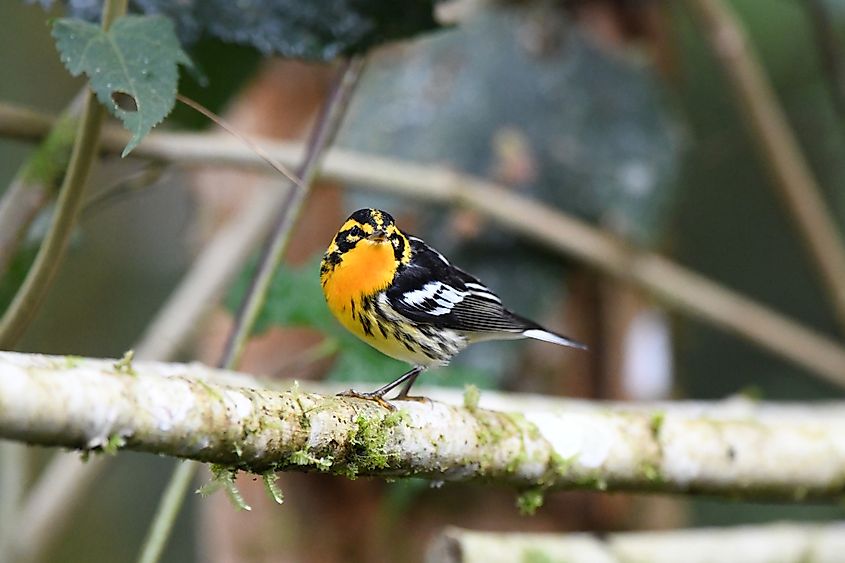
A Blackburnian warbler (Setophaga fusca) - Bicknell's thrush: breeds only in stunted high-elevation fir in the northeastern US and southeastern Canada, and Vermont's mountaintops hold a significant share. Both its breeding and Caribbean wintering ranges are small and threatened, and ski area development on summits is a direct pressure.
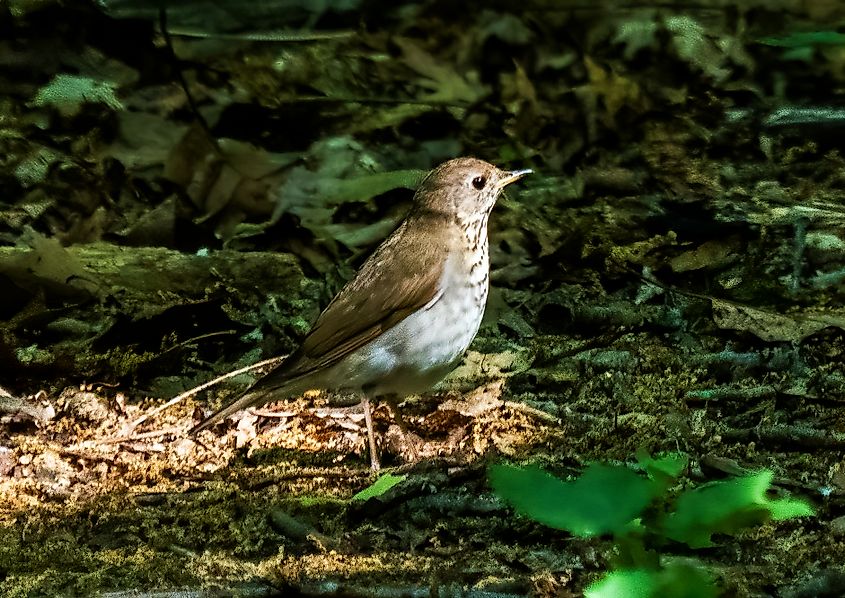
A Bicknell's thrush (Catharus bicknelli), By Rhododendrites - Own work, CC BY-SA 4.0 - Hermit thrush: the state bird, singing at dusk through the breeding season.
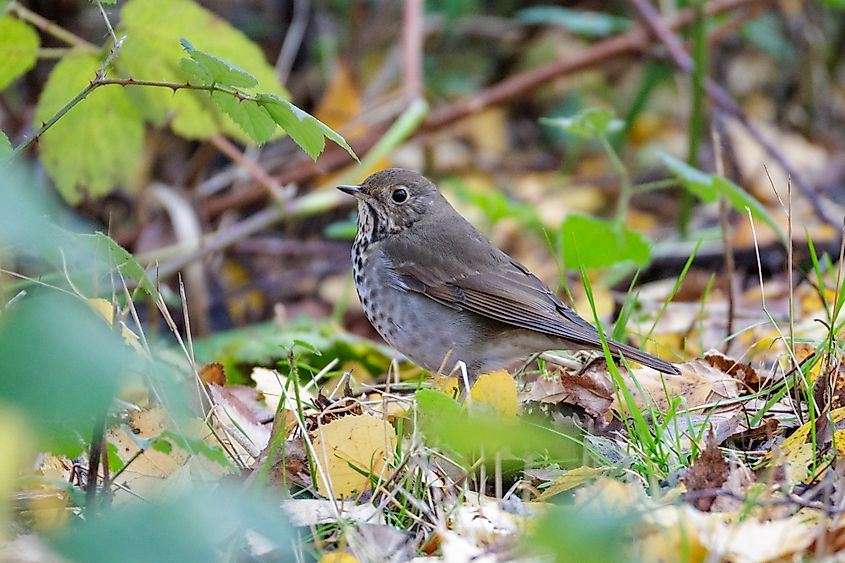
A hermit thrush (Catharus guttatus) - Grassland birds: bobolink, eastern meadowlark, and savannah sparrow nest in hayfields, and their success depends on mowing timing. Vermont has run programmes paying farmers to delay the first cut.
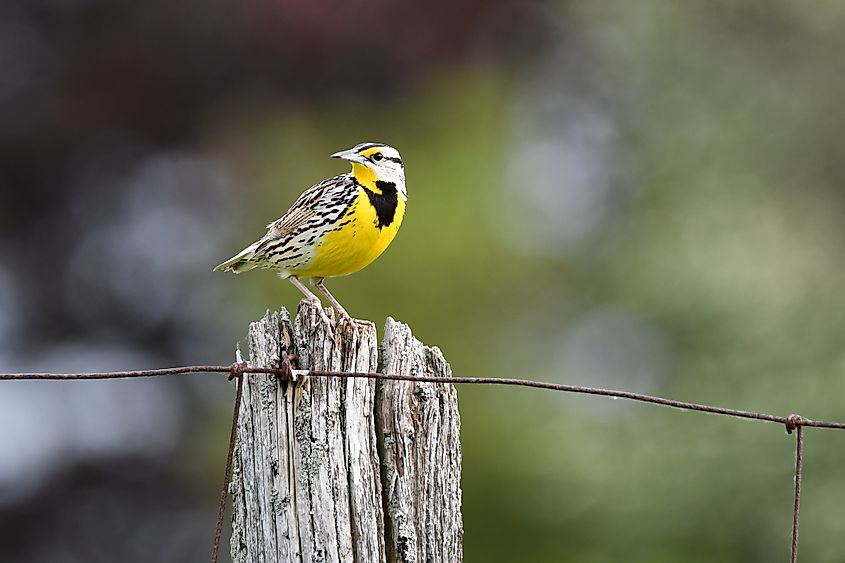
An eastern meadowlark (Sturnella magna) - Raptors: bald eagle returned as a breeder only in the 2000s and now nests along Lake Champlain and the Connecticut River, plus peregrine falcons on cliffs after reintroduction and ospreys recovered from near-absence.
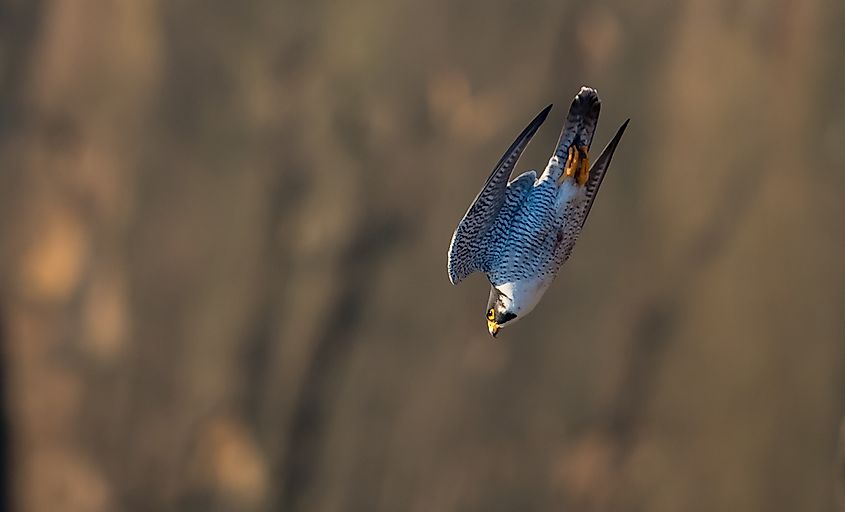
A peregrine falcon (Falco peregrinus) - Common loon: nested on only a handful of Vermont lakes by the 1980s and has recovered to over a hundred territorial pairs through nest rafts, signage, and volunteer monitoring, and it was removed from the state endangered list in 2005.
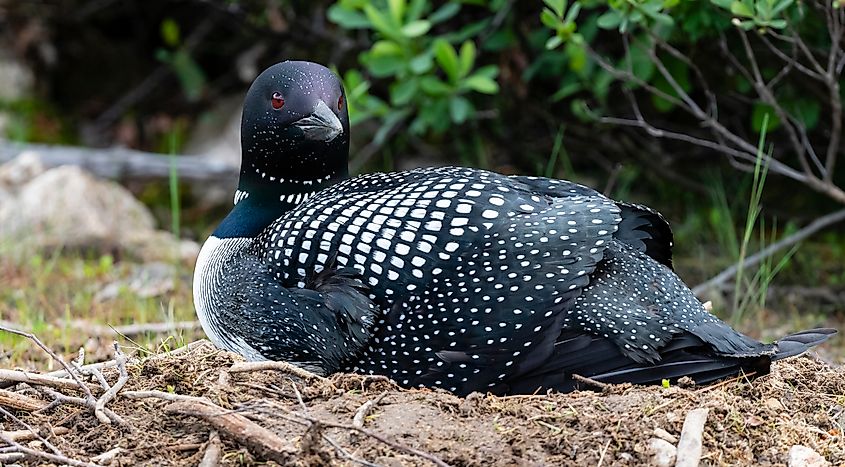
A common loon (Gavia immer)


Section 06
Reptiles, Amphibians, And Fish
Vermont has around 20 reptile and 21 amphibian species. One snake is venomous.
Snakes

11 species. The timber rattlesnake survives at a small number of den sites in the western Taconics and is state endangered, with a population estimated in the low hundreds at most. Every other Vermont snake is harmless, including the eastern ratsnake, milk snake, and common garter snake.
Turtles

The painted turtle is the state reptile. Also spiny softshell, which has an isolated Lake Champlain population of considerable conservation interest, plus wood turtle, spotted turtle, map turtle, and snapping turtle. Road mortality during nesting season is the leading threat, and volunteers move turtles across roads each June.
Amphibians

The northern leopard frog is the state amphibian. Also spotted, blue-spotted, and Jefferson salamanders, four-toed salamander, eastern newt, mudpuppy in Lake Champlain, plus wood frog, spring peeper, gray treefrog, and mink frog in the northeast. Vermont's spring salamander migrations to vernal pools on the first warm rainy nights are a well-organised volunteer event, with road crossings monitored and sometimes closed.
Fish

The brook trout is the state cold water fish and walleye the warm water fish. Lake Champlain holds lake trout, landlocked Atlantic salmon, lake sturgeon (state endangered), and an ongoing sea lamprey control programme, since lampreys reached the lake and parasitise its fish much as they did in the Great Lakes.
Section 07
Dangerous Animals In Vermont
- Moose: the most dangerous animal in the state. Moose-vehicle collisions are frequently severe because the animal's mass sits above the hood line, and most occur at dawn and dusk from May through July and in the autumn rut.
- Ticks: Vermont has among the highest Lyme disease incidence rates in the country, and blacklegged ticks have expanded steadily north as winters have moderated. Anaplasmosis is also increasing.
- White-tailed deer: vehicle collisions and the tick connection.
- Black bear: no fatal attacks recorded in Vermont. Bird feeders and unsecured trash drive nearly all conflicts, and the state urges feeder removal from April through November.
- Timber rattlesnake: a few den sites, a state endangered population, and effectively zero practical risk. The snake is far more endangered by people than the reverse.
- Cold and water: hypothermia, thin ice, and cold rivers harm more people than any Vermont animal.
Section 08
Endangered And Protected Species
| Species | Where | Status |
|---|---|---|
| Indiana bat | Hibernacula and summer forest | ENDANGERED |
| Northern long-eared bat | Statewide | ENDANGERED |
| Little brown bat | Statewide | STATE ENDANGERED |
| Canada lynx | Northeast Kingdom | THREATENED |
| Timber rattlesnake | Western Taconics | STATE ENDANGERED |
| Spiny softshell turtle | Lake Champlain | STATE THREATENED |
| Lake sturgeon | Lake Champlain tributaries | STATE ENDANGERED |
| Bicknell's thrush | High-elevation fir | STATE CONCERN |
| Rusty patched bumblebee | Historically present, now absent | ENDANGERED |
| Common loon | Lakes statewide | DELISTED 2005 |
Vermont's pressures are unusual for a state with so much forest. Warming is the dominant one: winter ticks devastating moose, blacklegged ticks expanding north, and high-elevation spruce-fir habitat being squeezed upward with nowhere to go, which directly threatens Bicknell's thrush. Beyond that: forest fragmentation from development along valley corridors, loss of hayfield grassland birds to earlier and more frequent mowing, white-nose syndrome in bats, and road mortality for turtles and amphibians.
Section 09
Where To See Wildlife In Vermont
- Northeast Kingdom, Island Pond and Victory Basin: moose, boreal birds, and the state's wildest country.
- Missisquoi National Wildlife Refuge: Lake Champlain delta marsh with waterfowl, herons, and ospreys.
- Dead Creek Wildlife Management Area: enormous snow goose staging in October, plus grassland birds.
- Mount Mansfield and Camel's Hump: Bicknell's thrush at dawn in June, requiring an early climb.
- Green Mountain National Forest: bear, bobcat, fisher, and breeding forest songbirds.
- Lake Champlain: lake trout, landlocked salmon, spiny softshells, and nesting bald eagles.
- Vernal pool crossings statewide: organised amphibian migration nights in late March and April.
Timing: the first warm rainy nights of late March and April for the amphibian migration, which volunteers organise and which is one of the most accessible wildlife events anywhere. June for Bicknell's thrush and breeding warblers at dawn. May through July for moose in wetlands and along roads at dusk. October for snow goose staging at Dead Creek and autumn colour. Bird feeders should come down from April through November because of bears.
Section 10
Common Questions
- What is the state animal of Vermont?
- The Morgan horse, adopted in 1961, a breed tracing to a single stallion owned by Justin Morgan in the 1790s. The state bird is the hermit thrush, chosen in 1941 despite objections that it does not winter in Vermont.
- Why are Vermont's moose declining?
- Winter ticks. The herd peaked around 5,000 in the mid-2000s and has fallen to roughly 2,000 or fewer. A single calf can carry tens of thousands of ticks, and blood loss and anaemia kill many calves. Vermont has used targeted hunting in one area specifically to reduce moose density and slow tick transmission.
- Are there venomous snakes in Vermont?
- One, the timber rattlesnake, surviving at a small number of den sites in the western Taconic Mountains. It is state endangered with a population in the low hundreds at most, and the other ten snake species are harmless.
- Are there lynx in Vermont?
- Yes. Canada lynx have been documented breeding in the Northeast Kingdom in recent years at the southern edge of the species' range. They are federally threatened and depend on snowshoe hare in dense young conifer forest.
- How much of Vermont is forested?
- About 75 percent, one of the highest proportions in the country. In the mid-1800s sheep farming had reduced it to roughly 25 percent, and the stone walls now running through mature woods are the record of that cleared landscape.
- What is Bicknell's thrush and why does Vermont matter?
- A songbird that breeds only in stunted high-elevation fir in the northeastern US and southeastern Canada and winters largely on Hispaniola. Both ranges are small, Vermont's mountaintops hold a significant share of the breeding population, and warming is squeezing its habitat upward.
- What is the most dangerous animal in Vermont?
- Moose, through vehicle collisions that are often severe. Ticks carry the greatest disease burden, with Vermont among the highest Lyme incidence states.
This page was last updated on October 6, 2026