Section 01
The Salamander Capital And The Most Dammed Rivers In America
Tennessee runs 440 miles east to west and crosses six distinct physiographic provinces on the way. The eastern end is the Blue Ridge, holding the Tennessee half of Great Smoky Mountains National Park, the most visited national park in the country and one of the most biodiverse temperate areas on Earth. The western end is Mississippi River bottomland and cypress swamp.
The Smokies are the biological headline. More than 30 salamander species live in the park, giving the region a genuine claim to being the salamander capital of the world. Lungless salamanders dominate, breathing entirely through skin and mouth lining, which ties them to cool damp conditions and means each mountain and cove can hold its own distinct forms.
The state's other defining feature is water, and specifically what was done to it. The Tennessee Valley Authority, created in 1933, built dozens of dams across the Tennessee River system for flood control, navigation, and power. It transformed the regional economy and it also converted hundreds of miles of shoals and free-flowing river into reservoirs, which had severe consequences for a freshwater fauna that was among the richest on the continent.
Tennessee still holds one of the most diverse mussel and fish faunas in North America, concentrated in the Duck, Clinch, and Powell rivers. It has also lost more freshwater species than almost any state, and the Duck River is now frequently described as the most biologically diverse river in North America for its length.
Section 02
Tennessee's Official State Animals
| Designation | Animal | Adopted |
|---|---|---|
| State animal | Raccoon Procyon lotor | 1971 |
| State bird | Northern mockingbird Mimus polyglottos | 1933 |
| State game bird | Bobwhite quail Colinus virginianus | 1987 |
| State reptile | Eastern box turtle Terrapene carolina | 1995 |
| State amphibian | Tennessee cave salamander Gyrinophilus palleucus | 1995 |
| State sport fish | Smallmouth bass Micropterus dolomieu | 2005 |
| State commercial fish | Channel catfish Ictalurus punctatus | 1988 |
| State insects | Firefly and ladybug | 1975 |
| State butterfly | Zebra swallowtail Eurytides marcellus | 1995 |
The Tennessee cave salamander is a fitting and unusual choice. It lives in the darkness of limestone caves, where it typically stays in its larval form for life, keeping external gills and never fully metamorphosing, a condition called neoteny. Its eyes are reduced and its body is pale pink or white. It occurs in a limited area of Tennessee, Alabama, and Georgia, restricted to specific cave streams, and its presence indicates clean groundwater.

The raccoon designation in 1971 reflects a long hunting and trapping tradition rather than any biological distinction. It sits oddly beside the cave salamander, which is one of the more scientifically interesting state symbols in the country.
Section 03
Habitats By Region, And Who Lives In Each
Blue Ridge and the Smokies

Spruce-fir on the highest ridges, cove hardwood in sheltered valleys, and heath balds on exposed ground. Elevation ranges over 5,000 feet within the park, producing the equivalent of a journey from Georgia to Canada. Black bear reach high density here, with roughly 1,900 in the park, alongside elk reintroduced to Cataloochee across the North Carolina line and now ranging into Tennessee. See Great Smoky Mountains National Park.
Ridge and Valley

Long limestone valleys and sandstone ridges with caves, springs, and the Clinch and Powell rivers. These two rivers hold one of the most diverse freshwater mussel assemblages remaining anywhere in the world, with dozens of species including many federally listed.
Cumberland Plateau

A sandstone tableland cut by gorges, with mixed mesophytic forest, rock shelters, and waterfalls. Green salamander on shaded cliff faces, timber rattlesnake, and one of the largest blocks of contiguous forest in the eastern United States. Cave systems here hold blind cavefish and cave salamanders.
Highland Rim and Nashville Basin

Karst country with limestone glades, sinkholes, and springs. The cedar glades of the Nashville Basin hold plants and invertebrates found nowhere else, adapted to thin soil over bedrock that bakes in summer and floods in winter. The Duck River flows through this region.
Western Highland Rim and Tennessee River valley

Rolling forest and farmland cut by the impounded Tennessee River. TVA reservoirs hold large sport fish populations and winter waterfowl, and bald eagles nest and winter around them in numbers.
Mississippi bottomland and Reelfoot

The far west, with cypress swamp and bottomland hardwood. Reelfoot Lake was formed by the New Madrid earthquakes of 1811 and 1812, which caused the Mississippi to flood a sunken area, and it now holds cypress, alligators at the northern edge of their range in small numbers, and one of the largest wintering bald eagle concentrations in the interior South.
Section 04
Rivers, Mussels, And What The Dams Cost
Tennessee's freshwater fauna is among the richest on Earth for a temperate region, and it has suffered accordingly.
- Mussels: Tennessee historically held well over 100 freshwater mussel species. They filter water, stabilise riverbeds, and reproduce by luring host fish to carry their larvae, with some species using elaborate lures that mimic small fish. The Clinch and Powell rivers, which escaped impoundment on their upper reaches, remain global hotspots, and dozens of Tennessee mussels are federally listed.
- Fish: roughly 320 native freshwater fish species, more than any other state. The darter fauna is exceptional, with many species restricted to single river systems.
- The Duck River: often described as the most biologically diverse river in North America for its length, holding around 50 mussel species and 150 fish species in a relatively short stretch. It is also under increasing pressure from water withdrawal for the growing Nashville region.
- The snail darter: a small fish that became one of the most consequential species in American environmental law. Its discovery in the Little Tennessee River in 1973 led to litigation that halted Tellico Dam, produced a 1978 Supreme Court decision affirming the Endangered Species Act's force, and prompted Congress to create an exemption committee. The dam was eventually completed by congressional action, and the darter was later found elsewhere and delisted in 2022 after recovery.
What impoundment does: a dam converts flowing water over gravel and shoals into still, deep, silty reservoir. Mussels and darters that need current, oxygen, and clean gravel simply cannot live there, and populations upstream and downstream are cut off from each other. Cold water released from deep in a reservoir also changes downstream temperatures in ways native species did not evolve with. Tennessee lost a great many aquatic species this way, several before they were ever described.
Section 05
Mammals Of Tennessee
White-tailed deer: reduced to a few thousand by 1900 and restocked, now abundant statewide.

Black bear: concentrated in the eastern mountains with roughly 1,900 in the Smokies alone, plus a growing population on the Cumberland Plateau after reintroduction efforts in the 1990s.

Elk: extirpated by the mid-1800s and reintroduced to the North Cumberland area beginning in 2000 with animals from Canada. The herd now numbers several hundred and supports a limited lottery hunt. Related: where to watch the elk rut.

Bobcat, coyote, gray and red fox, river otter (reintroduced and recovered), mink, weasels, striped and spotted skunk, raccoon, opossum, beaver, armadillo expanding from the southwest, swamp rabbit: all present. Raccoon is the state animal.

Mountain lion: no breeding population, but Tennessee confirmed several dispersing cougars in the 2010s, the first verified records in the state in around a century.

Bats: 16 species, and Tennessee's caves are among the most important bat hibernacula in the country. Gray bats and Indiana bats are federally endangered, and white-nose syndrome has caused catastrophic declines in tricolored and northern long-eared bats. See do bats hibernate and where bats live.

Gone: gray wolf, red wolf, and bison. A red wolf reintroduction was attempted in Great Smoky Mountains National Park in the 1990s and abandoned after the animals failed to establish, with coyote hybridisation and pup survival among the problems.
Section 06
Birds Of Tennessee
Around 420 species have been recorded. The state's forests and reservoirs both matter, and its position along the Mississippi Flyway brings large winter concentrations.
- Forest birds: the Smokies and Cumberland Plateau hold cerulean warbler, worm-eating warbler, black-throated blue warbler, wood thrush, and Acadian flycatcher. High-elevation spruce-fir holds northern species including winter wren and red crossbill, and the northern saw-whet owl breeds on a few peaks at the southern edge of its range.
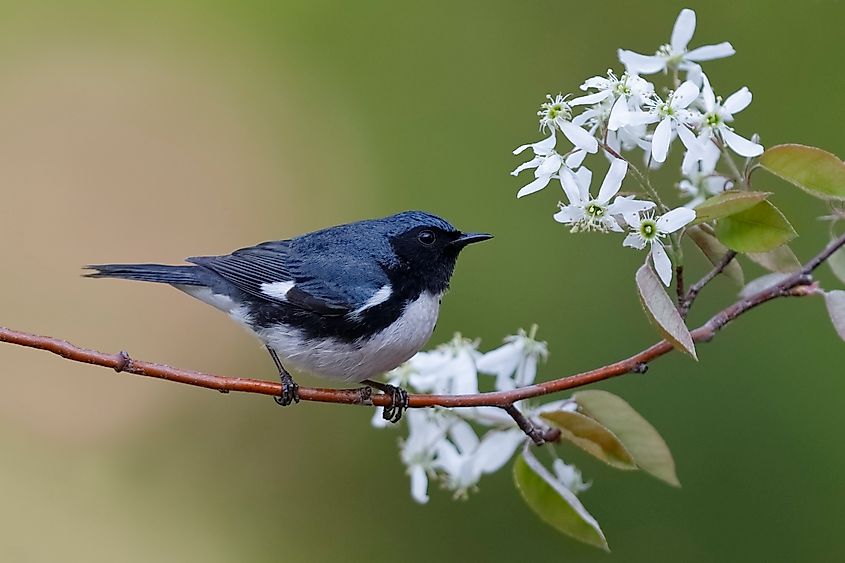
A black-throated blue warbler (Setophaga caerulescens) - Bald eagle: reintroduced through hacking towers in the 1980s after being absent as a breeder, and now nesting across the state with major winter concentrations at Reelfoot Lake and the TVA reservoirs.
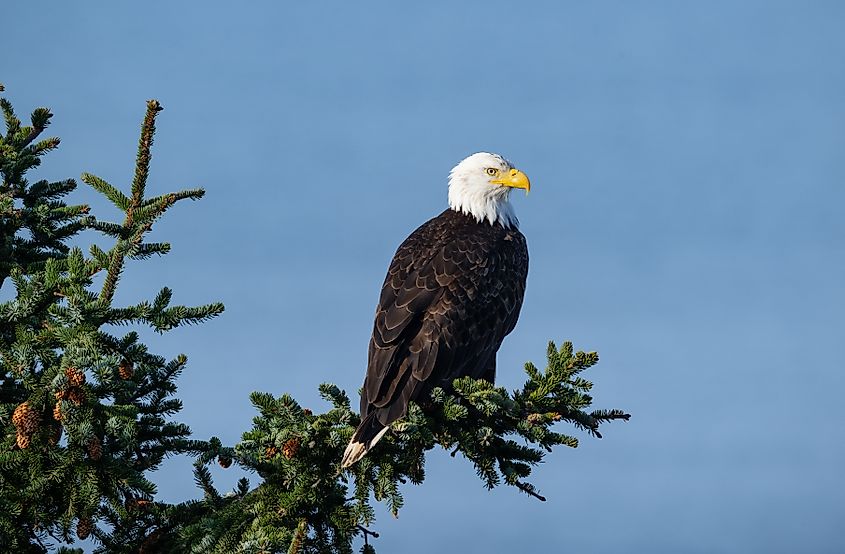
A bald eagle (Haliaeetus leucocephalus) - Sandhill cranes: the Hiwassee Wildlife Refuge near Birchwood hosts tens of thousands of sandhill cranes each winter, a concentration that grew from almost nothing in recent decades and now supports a festival and viewing platforms.
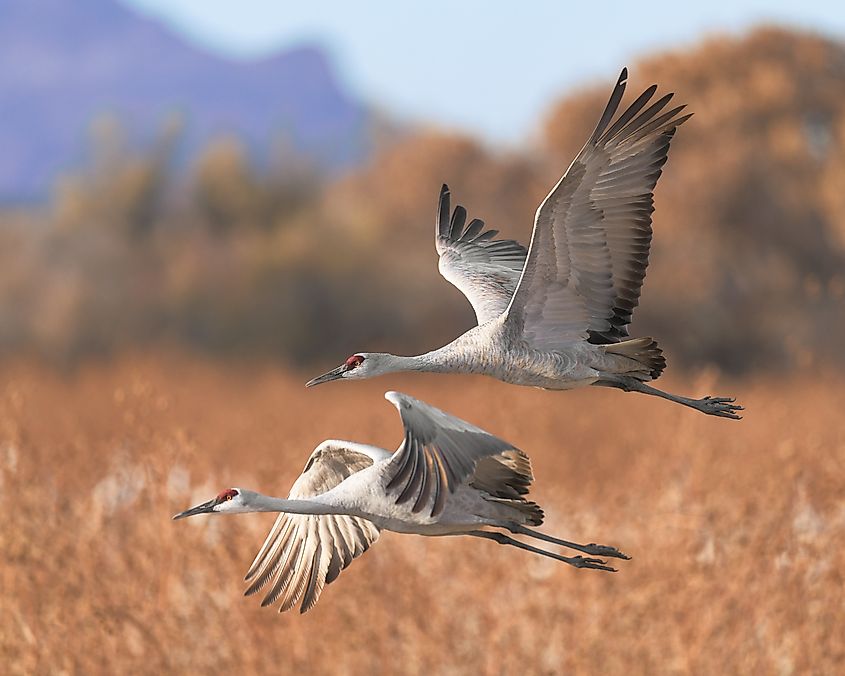
A pair of sandhill cranes flying together - Waterfowl: the western reservoirs and Reelfoot hold large duck and goose numbers, including snow geese.
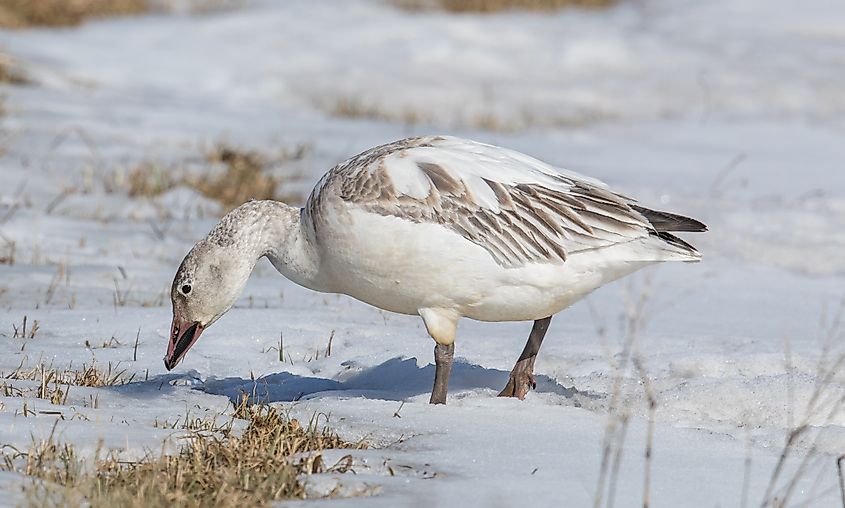
A snow goose (Anser caerulescens) - Grassland birds: bobwhite quail, the state game bird, has declined steeply across its range, along with grasshopper sparrow and eastern meadowlark.
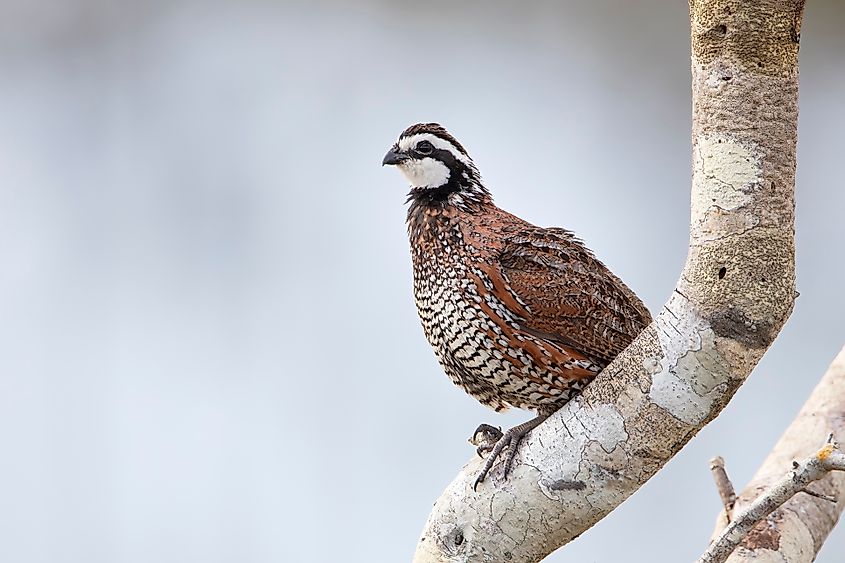
A northern bobwhite (Colinus virginianus)


Section 07
Reptiles And Amphibians
Tennessee has around 60 reptile and 80 amphibian species, and the salamander diversity is world-class.
Salamanders
More than 50 species statewide. The Smokies alone hold over 30, including the endemic-adjacent Jordan's salamander forms, the imitator salamander, and several dusky species. Hellbenders occur in cold clean rivers and are declining. The Tennessee cave salamander, the state amphibian, is neotenic and cave-restricted.
Snakes
32 species, four venomous: copperhead, which is common and accounts for most bites, timber rattlesnake in the mountains and plateau, western cottonmouth in the west, and western pygmy rattlesnake in a limited area.
Turtles
Eastern box turtle is the state reptile. Also alligator snapping turtle in western rivers, bog turtle in a few mountain fens (federally threatened), map turtles, and softshells.
Frogs
Around 21 species, including the bird-voiced treefrog in western swamps, gopher frog, and the crawfish frog. Cedar glades and vernal pools drive much of the breeding.
Section 08
Dangerous Animals In Tennessee
- White-tailed deer: vehicle collisions are the leading wildlife hazard.
- Venomous snakes: four species. Copperheads are common in suburban yards and cause most bites, which are painful and rarely fatal.
- Ticks: Tennessee reports high rates of Rocky Mountain spotted fever and ehrlichiosis, and alpha-gal syndrome from lone star ticks is common.
- Black bear: the Smokies see frequent bear-human interaction because of visitor numbers. Food storage rules are strict, and habituated bears are the main problem. Injuries occur but fatalities are very rare.
- Elk: bulls during the autumn rut are dangerous, and Tennessee's viewing areas keep visitors at distance.
- Brown recluse and black widow spiders: brown recluse is common in Tennessee homes.
- Caves: unguided cave entry causes more injuries than any Tennessee animal, and it spreads white-nose syndrome to bats.
Section 09
Endangered And Protected Species
| Species | Where | Status |
|---|---|---|
| Numerous freshwater mussels | Clinch, Powell, Duck rivers | DOZENS LISTED |
| Gray bat | Karst caves | ENDANGERED |
| Indiana bat | Karst caves | ENDANGERED |
| Northern long-eared bat | Statewide | ENDANGERED |
| Tennessee cave salamander | Limestone cave streams | STATE THREATENED |
| Eastern hellbender | Cold upland rivers | STATE CONCERN |
| Bog turtle | Mountain fens | THREATENED |
| Barrens topminnow | A few Highland Rim springs | ENDANGERED |
| Laurel dace | Cumberland Plateau streams | ENDANGERED |
| Snail darter | Tennessee River system | DELISTED 2022 |
Tennessee's pressures are overwhelmingly aquatic. Impoundment, sedimentation from development and agriculture, nutrient runoff into karst that reaches groundwater within hours, water withdrawal from rivers like the Duck for growing cities, and coal ash and mining legacies on the plateau. Above ground, white-nose syndrome, hemlock woolly adelgid killing the hemlocks that shade mountain streams, and development pressure around Nashville and Chattanooga.
Section 10
Where To See Wildlife In Tennessee
- Great Smoky Mountains National Park: bears in Cades Cove, salamanders after rain, elk on the North Carolina side, and synchronous fireflies at Elkmont in June by lottery.
- Hiwassee Wildlife Refuge: tens of thousands of sandhill cranes in winter with viewing platforms.
- Reelfoot Lake: cypress swamp, wintering bald eagles in large numbers, and boat tours.
- North Cumberland Wildlife Management Area: the state elk herd with a viewing tower, best during the September and October rut.
- Clinch and Powell rivers: mussel and darter diversity, best appreciated with a snorkel and a guide.
- Cedar glades near Nashville: endemic plants and specialised invertebrates in spring.
- Big South Fork National River: Cumberland Plateau gorges, salamanders, and forest birds.
Timing: late May and early June for Elkmont's synchronous fireflies, which require a lottery permit. September and October for the elk rut and autumn colour. December through February for sandhill cranes at Hiwassee and eagles at Reelfoot. Spring rains for salamander activity in the mountains, which is when the Smokies live up to the salamander capital name. Cades Cove is best at dawn for bears before traffic builds.
Section 11
Common Questions
- What is the state animal of Tennessee?
- The raccoon, adopted in 1971. Tennessee also names the northern mockingbird as state bird, the eastern box turtle as state reptile, and the Tennessee cave salamander as state amphibian.
- Why is Tennessee called the salamander capital?
- Great Smoky Mountains National Park alone holds more than 30 salamander species, and the state has over 50. Lungless salamanders dominate, breathing entirely through skin, which ties them to cool damp conditions and lets each mountain and cove hold distinct forms.
- How many bears are in the Smokies?
- Roughly 1,900 black bears within Great Smoky Mountains National Park, one of the densest populations in the eastern United States, plus a growing population on the Cumberland Plateau.
- What was the snail darter case?
- A small fish discovered in the Little Tennessee River in 1973 whose protection halted Tellico Dam, producing a 1978 Supreme Court decision affirming the force of the Endangered Species Act. Congress created an exemption committee in response and eventually authorised the dam. The darter was later found elsewhere and was delisted in 2022 after recovery.
- How many venomous snakes live in Tennessee?
- Four: copperhead, timber rattlesnake, western cottonmouth, and western pygmy rattlesnake. Copperheads are the most commonly encountered and cause most bites.
- Why is the Duck River important?
- It is often described as the most biologically diverse river in North America for its length, holding around 50 mussel species and 150 fish species. It is under growing pressure from water withdrawal for the expanding Nashville region.
- What is the most dangerous animal in Tennessee?
- White-tailed deer through vehicle collisions. Ticks carry the greatest disease burden, with high rates of spotted fever and alpha-gal syndrome. Copperhead bites are common but rarely serious.
This page was last updated on September 14, 2026