Section 01
Wilderness And The Largest City In America
New York contains both the biggest city in the United States and the largest publicly protected area in the contiguous states. The Adirondack Park covers roughly six million acres, larger than Yellowstone, Yosemite, Grand Canyon, Glacier, and Great Smoky Mountains combined, and about 45 percent of it is state Forest Preserve constitutionally protected as forever wild since 1894.
That constitutional protection is unusual and consequential. Article XIV of the New York State Constitution forbids selling or cutting timber on Forest Preserve land, which means large areas have been left alone for well over a century. The result is old-growth stands, intact boreal wetlands, and a wildlife community that includes moose, marten, and boreal birds at the southern edge of their range.
The rest of the state ranges widely. The Catskills and Allegheny Plateau in the south, the Great Lakes plains in the west, the Hudson Valley running down the middle, and the Long Island coastal plain with barrier beaches and salt marsh. New York touches two Great Lakes and the Atlantic Ocean, which is a combination no other state has.
New York is also where white-nose syndrome began. The fungus was first documented in a cave near Albany in 2006, and it spread from there across the continent, killing millions of bats. Some New York hibernacula that held hundreds of thousands of bats lost well over 90 percent of them within a few years.
Section 02
New York's Official State Animals
| Designation | Animal | Adopted |
|---|---|---|
| State animal | American beaver Castor canadensis | 1975 |
| State bird | Eastern bluebird Sialia sialis | 1970 |
| State fish | Brook trout Salvelinus fontinalis | 1975 |
| State saltwater fish | Striped bass Morone saxatilis | 2006 |
| State insect | Nine-spotted ladybug Coccinella novemnotata | 1989 |
| State reptile | Common snapping turtle Chelydra serpentina | 2006 |
| State shell | Bay scallop Argopecten irradians | 1988 |
The beaver is on the New York City seal, and the reason is economic history. Dutch New Amsterdam was founded as a fur trading post, and beaver pelts were the colony's principal export. That trade drove beavers to near-extinction in the state: by 1900 New York had perhaps a handful of animals left in a single Adirondack drainage. Restocking with animals from Canada and Yellowstone rebuilt the population, and New York now has tens of thousands. Naming the beaver the state animal in 1975 honored both the animal and the trade that nearly eliminated it. Related: what happens when beavers leave.

The nine-spotted ladybug is a more awkward symbol. It was named state insect in 1989 and had by then become extremely rare in New York, apparently displaced by introduced Asian and European ladybird species. It was not recorded in the state for years until citizen scientists rediscovered a population on Long Island in 2011.
Section 03
Habitats By Region, And Who Lives In Each
Adirondack Park

Six million acres of northern hardwood, spruce-fir, boreal bog, and alpine summits on the High Peaks. Moose recolonized naturally from Vermont and Canada beginning in the 1980s and now number several hundred to around a thousand. Also black bear, American marten, fisher, bobcat, spruce grouse, boreal chickadee, gray jay, Bicknell's thrush on the high summits, and common loon on hundreds of lakes.
Catskills and southern uplands

Rounded mountains with hardwood forest and cold headwater streams. This is where American fly fishing developed, and the streams still hold wild brook trout. Also black bear, timber rattlesnake at scattered den sites, and forest interior birds including cerulean warbler.
Hudson Valley and the river

The Hudson is a tidal estuary for 153 miles up to Troy, with brackish water reaching well inland. It holds Atlantic and shortnose sturgeon, striped bass spawning runs, and one of the more remarkable recovery stories in American environmental history after decades of industrial contamination. Bald eagles now winter along the river in numbers, and peregrine falcons nest on bridges. See Hudson River.
Great Lakes plains and Niagara

Lake Ontario and Lake Erie shorelines with wetlands, drumlin country, and the Niagara River. The Niagara corridor is internationally recognized for wintering gulls, with enormous concentrations and a long list of rare species drawn to the open water below the falls. See Niagara Falls. Montezuma National Wildlife Refuge in the Finger Lakes is a major waterfowl and shorebird stopover.
Long Island and the Atlantic coast

Barrier beaches, salt marsh, pine barrens, and maritime forest. Piping plover, least tern, and American oystercatcher nest on the beaches, ospreys recovered strongly after DDT, and horseshoe crabs spawn in the bays. Offshore, humpback whales now feed within sight of Rockaway and Long Beach following menhaden, and white sharks use the New York Bight as a nursery area for juveniles.
New York City

Worth its own mention. Peregrine falcons nest on skyscrapers and bridges in one of the densest urban populations anywhere. Coyotes have colonized the Bronx and Queens. Jamaica Bay Wildlife Refuge, within city limits and under the flight path of JFK, is one of the best birding sites in the Northeast, and harbor seals winter on rocks off Staten Island and the Bronx.
Section 04
Mammals Of New York
Beaver: the state animal, reduced to perhaps a handful of animals by 1900 and now numbering in the tens of thousands.

White-tailed deer: roughly a million animals, with very high densities in suburban Westchester and Long Island where hunting is restricted.

Black bear: several thousand across three main ranges in the Adirondacks, Catskills, and the Allegheny region, and expanding toward the Hudson Valley suburbs.

Moose: recolonized naturally from New England and Canada starting in the 1980s. The Adirondack population is small and its growth has been slower than expected, with brainworm from white-tailed deer a likely limiting factor.

Bobcat, fisher, American marten, coyote, red and gray fox, river otter, mink, weasels: all present. Fishers have expanded into suburban areas, and marten remain restricted to Adirondack conifer forest.

Eastern coyote: arrived in the mid-20th century, carries wolf ancestry, and now occupies every county including all five New York City boroughs.

New England cottontail: the native rabbit, now very rare and restricted to a few areas east of the Hudson.

Marsh rice rat: a wetland and coastal marsh specialist that is locally threatened in parts of its range, affected by sea level rise and habitat fragmentation.

Bats: nine species, and New York is the epicentre of the white-nose syndrome catastrophe. Little brown, northern long-eared, and tricolored bats declined by well over 90 percent. See do bats hibernate and where bats live.

Marine mammals: harbor and gray seals wintering, bottlenose dolphins in summer, humpback whales close inshore, and North Atlantic right whales migrating through the Bight.

Absent: gray wolf, eastern cougar, elk, and Canada lynx as a resident, though lynx were reintroduced to the Adirondacks in the 1980s in an attempt that failed. Occasional dispersing cougars are confirmed, including one killed in Connecticut in 2011 that had passed through New York from South Dakota.
Section 05
Birds Of New York
More than 490 species have been recorded, reflecting the state's range from the boreal forest to the ocean.
- Bald eagle: New York had a single nesting pair by the mid-1970s. A hacking program releasing young eagles from towers rebuilt the population to hundreds of pairs, and the technique developed in New York was adopted widely elsewhere.
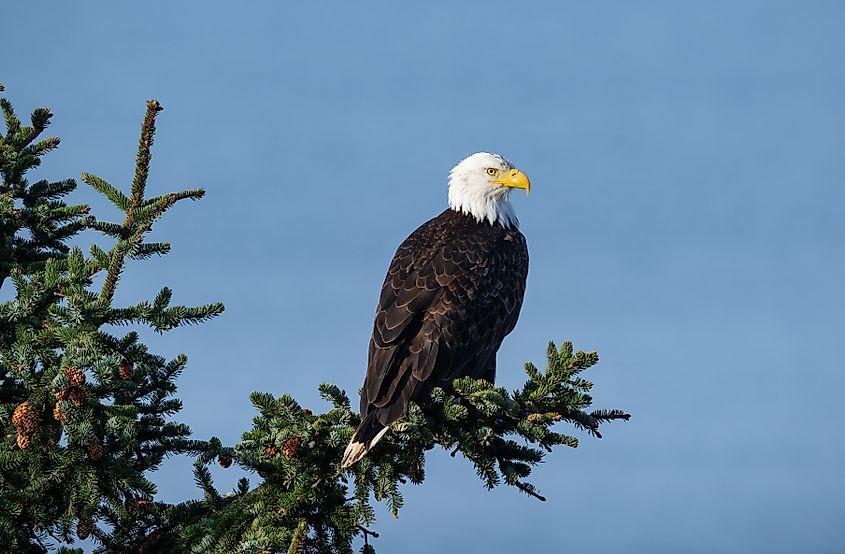
A bald eagle (Haliaeetus leucocephalus) - Peregrine falcon: extirpated from the eastern US by DDT and restored through releases, with New York City's bridges and skyscrapers now supporting one of the densest urban peregrine populations in the world. Related: peregrine falcon facts.
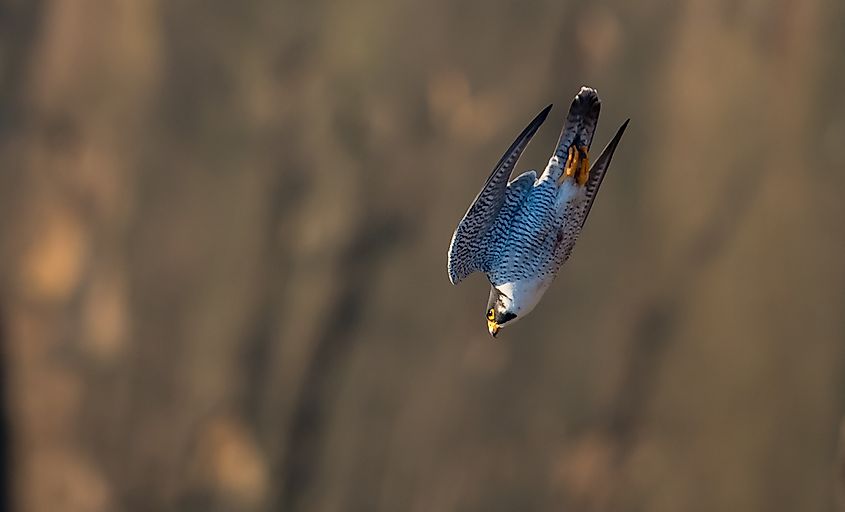
A peregrine falcon (Falco peregrinus) - Boreal specialties: spruce grouse, black-backed woodpecker, boreal chickadee, gray jay, and Bicknell's thrush on Adirondack summits, all at the southern limit of their range and all vulnerable to warming.
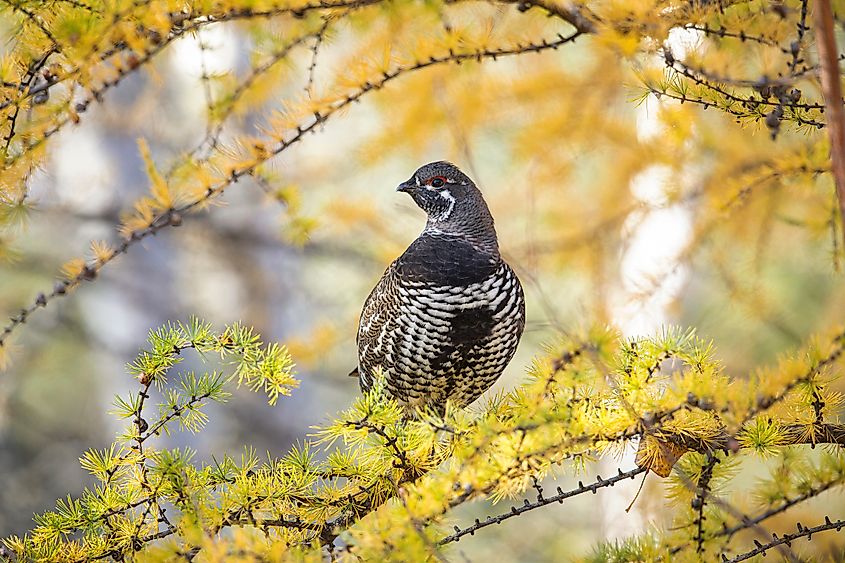
A spruce grouse (Canachites canadensis) - Niagara gulls: the Niagara River holds one of the largest gull concentrations in the world in late autumn and winter, with up to a dozen or more species including rarities from Europe and the Arctic.
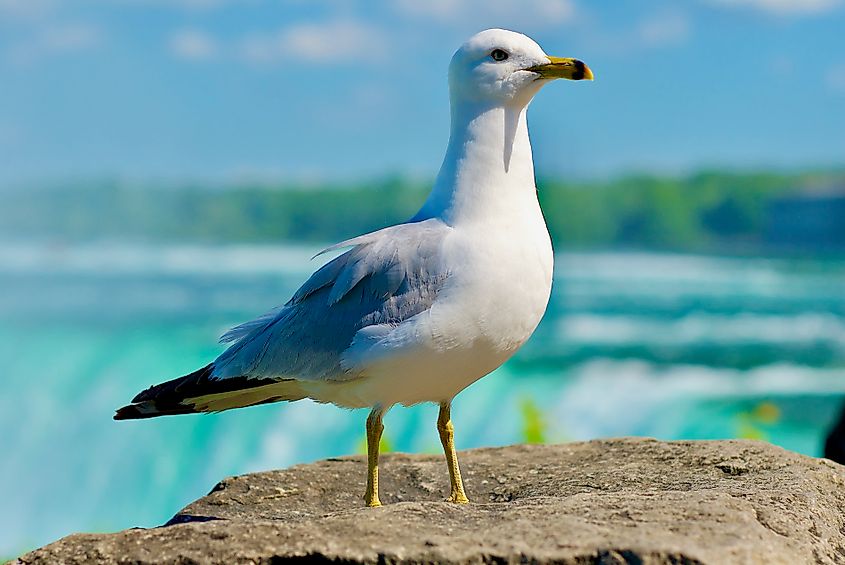
A seagull near Horseshoe Falls - Coastal and marsh birds: piping plover, least tern, saltmarsh sparrow, clapper rail, and enormous shorebird numbers at Jamaica Bay.
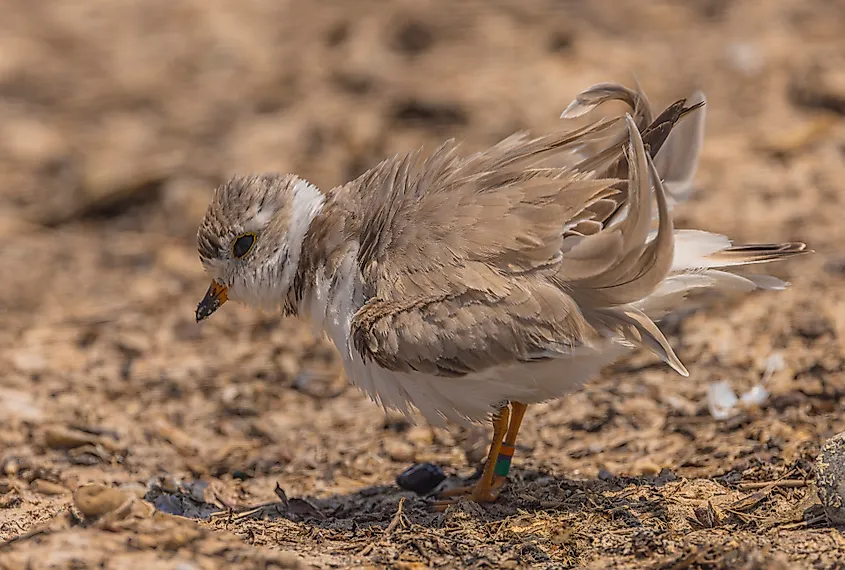
A piping plover (Charadrius melodus) - Grassland birds: bobolink, eastern meadowlark, Henslow's sparrow, and upland sandpiper, all declining as farmland is abandoned or intensified. New York's grassland bird decline is among the steepest in the Northeast.
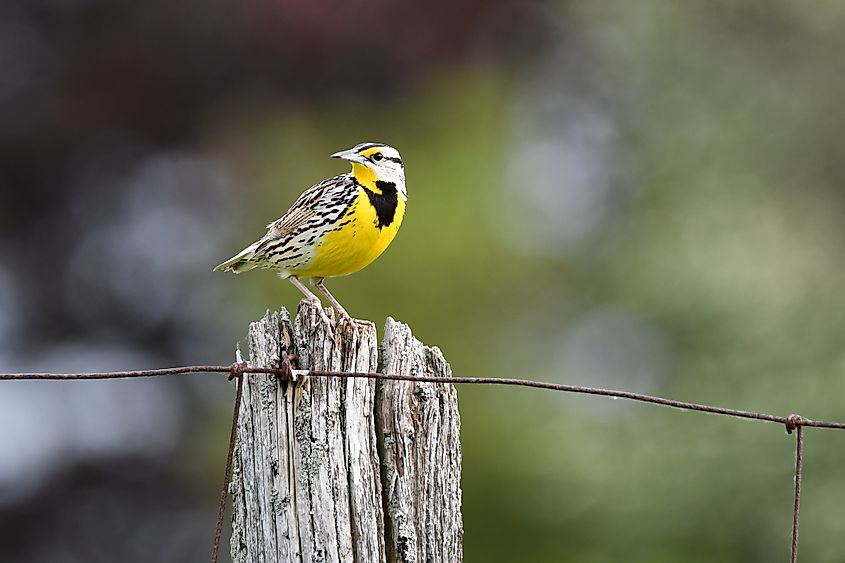
An eastern meadowlark (Sturnella magna)


Section 06
Reptiles, Amphibians, And Fish
New York has around 38 reptile and 32 amphibian species. Three snakes are venomous, all uncommon.
Snakes

17 species. The timber rattlesnake occurs at scattered den sites in the Hudson Highlands, Catskills, and southeastern hills and is state threatened. The eastern massasauga survives in only two New York wetlands and is federally threatened. The northern copperhead occupies the lower Hudson Valley and the Palisades. All three are protected.
Turtles

The common snapping turtle is the state reptile. Also bog turtle (federally threatened), Blanding's turtle, wood turtle, spotted turtle, eastern box turtle, and diamondback terrapin in Long Island bays. Sea turtles including loggerhead, green, Kemp's ridley, and leatherback occur offshore in summer, and cold-stunned turtles strand on Long Island beaches in late autumn. See the seven sea turtle species.
Amphibians

Hellbender in the Allegheny and Susquehanna drainages, plus spotted, Jefferson, blue-spotted, and marbled salamanders, eastern newt, mudpuppy, and around 14 frog and toad species. New York protects vernal pools through wetland regulation, and volunteer road crossings guard spring salamander migrations.
Fish

The brook trout is the state fish and the only native stream trout. Atlantic and shortnose sturgeon in the Hudson are both federally listed, and the Hudson's Atlantic sturgeon population is one of the largest remaining. Lake sturgeon in the Great Lakes and St. Lawrence are recovering slowly. Striped bass spawn in the Hudson and are the state saltwater fish, and American eel, alewife, and blueback herring runs are the focus of dam removal work.
Section 07
Dangerous Animals In New York
- Ticks: New York has among the highest Lyme disease burdens in the country, particularly in the Hudson Valley and on Long Island, plus anaplasmosis, babesiosis, and Powassan virus.
- White-tailed deer: tens of thousands of vehicle collisions annually and the main host for adult ticks.
- Venomous snakes: three species, all uncommon and all protected. Bites are rare.
- Black bear: no fatal attacks in recent decades. Bird feeders and improper food storage in the Catskills and Adirondacks drive nearly all conflicts, and bear canisters are required in parts of the High Peaks.
- Coyote: attacks are very rare even in New York City, where coyotes now live largely unnoticed.
- Rabies: raccoons are the main vector in the state, with skunks, foxes, and bats also involved.
- Cold water and mountain weather: Adirondack High Peaks conditions and cold Atlantic water harm far more people than New York wildlife.
Section 08
Endangered And Protected Species
| Species | Where | Status |
|---|---|---|
| Atlantic sturgeon | Hudson River | ENDANGERED |
| Shortnose sturgeon | Hudson River | ENDANGERED |
| North Atlantic right whale | New York Bight | ENDANGERED |
| Piping plover | Long Island beaches | ENDANGERED |
| Roseate tern | Long Island colonies | ENDANGERED |
| Eastern massasauga | Two wetlands only | THREATENED |
| Bog turtle | Calcareous fens | THREATENED |
| Northern long-eared bat | Statewide | ENDANGERED |
| Indiana bat | Karst caves and mines | ENDANGERED |
| Karner blue butterfly | Albany Pine Bush | ENDANGERED |
| Timber rattlesnake | Scattered den sites | STATE THREATENED |
New York's Albany Pine Bush is one of the best examples anywhere of an inland pine barrens being actively restored, with prescribed fire and lupine planting supporting one of the strongest remaining Karner blue populations. Beyond that, the state's pressures are development pressure in the Hudson Valley and Long Island, sea level rise on coastal marsh, white-nose syndrome, grassland loss, and warming that squeezes Adirondack boreal species toward summits they cannot climb past.
Section 09
Where To See Wildlife In New York
- Adirondack Park: moose along Route 30 and near Tupper Lake, boreal birds at Bloomingdale Bog, loons on nearly any lake.
- Montezuma National Wildlife Refuge: huge spring and autumn waterfowl and shorebird numbers in the Finger Lakes.
- Niagara River corridor: the winter gull concentration, among the largest in the world.
- Jamaica Bay Wildlife Refuge, Queens: shorebirds, terrapins, and waterfowl inside New York City.
- Hudson River, Croton and Newburgh areas: wintering bald eagles on the ice edges.
- Albany Pine Bush Preserve: Karner blue butterflies in late May and July on restored barrens.
- Montauk Point and the South Fork: seals in winter, seabirds, and autumn hawk migration.
- Braddock Bay, Lake Ontario: one of the largest spring hawk flights in the East.
Timing: March and April for spring hawk migration at Braddock Bay and salamander crossings on warm rainy nights. May for warbler migration, which is exceptional in Central Park and on the Lake Ontario shore. June for moose and boreal birds in the Adirondacks. Late autumn and winter for Niagara gulls, Hudson eagles, and Long Island seals and sea ducks.
Section 10
Common Questions
- What is the state animal of New York?
- The American beaver, adopted in 1975. Dutch New Amsterdam was founded as a fur trading post and beaver pelts were its main export, a trade that reduced New York's beavers to perhaps a handful by 1900 before restocking rebuilt them.
- How big is the Adirondack Park?
- Roughly six million acres, larger than Yellowstone, Yosemite, Grand Canyon, Glacier, and Great Smoky Mountains combined. About 45 percent is state Forest Preserve, constitutionally protected as forever wild since 1894.
- Are there moose in New York?
- Yes. Moose recolonised the Adirondacks naturally from New England and Canada beginning in the 1980s. The population is small, several hundred to around a thousand, and growth has been slower than expected, with brainworm carried by white-tailed deer a likely limiting factor.
- How many venomous snakes live in New York?
- Three: timber rattlesnake at scattered den sites, eastern massasauga in only two wetlands, and northern copperhead in the lower Hudson Valley. All three are protected and bites are rare.
- Did white-nose syndrome start in New York?
- Yes. The fungus was first documented in a cave near Albany in 2006 and spread across the continent from there, killing millions of bats. Some New York hibernacula lost well over 90 percent of their bats within a few years.
- Are there really peregrine falcons in New York City?
- Yes, one of the densest urban populations in the world. They nest on bridges and skyscrapers, which function much like the cliffs they use naturally, and hunt pigeons over the streets.
- What is the most dangerous animal in New York?
- Ticks, given the state's high Lyme disease burden, particularly in the Hudson Valley and Long Island. Deer cause the most direct injuries through vehicle collisions.
This page was last updated on October 7, 2026