Section 01
The Densest State, And One Of The Best Bird Sites In America
New Jersey has the highest population density of any state, around 1,300 people per square mile. It also has Cape May, which is among the finest places in the world to watch bird migration, and the Pine Barrens, a million-acre wilderness of pitch pine and cedar swamp sitting between Philadelphia and New York.
Both of those follow from geography rather than from land being spared. New Jersey sits on the Atlantic Flyway, and the state's coastline funnels southbound migrants into a peninsula that narrows to a point at Cape May. Birds reaching the tip in autumn hesitate before crossing Delaware Bay, and they pile up. On a good October morning after a cold front, the counts run to tens of thousands of raptors, songbirds, and dragonflies concentrated in a few square miles.
The Pine Barrens survived for the opposite reason to most protected land. Its sandy, acidic, nutrient-poor soil was useless for farming and its water table sits close to the surface, so it was logged and burned repeatedly but never converted. The result is a globally rare fire-dependent ecosystem covering roughly 22 percent of the state, sitting above the Kirkwood-Cohansey aquifer, which holds an enormous volume of exceptionally pure water.
New Jersey is also a horseshoe crab and shorebird state. The Delaware Bay shore on its western side hosts the same spawning and red knot refuelling event as the Delaware side, and New Jersey's beaches carry a large share of it.
Section 02
New Jersey's Official State Animals
| Designation | Animal | Adopted |
|---|---|---|
| State animal | Horse | 1977 |
| State bird | Eastern goldfinch Spinus tristis | 1935 |
| State fish | Brook trout Salvelinus fontinalis | 1992 |
| State insect | Honeybee Apis mellifera | 1974 |
| State shell | Knobbed whelk Busycon carica | 1995 |
| State dinosaur | Hadrosaurus foulkii | 1991 |
New Jersey's state dinosaur is genuinely important to science. Hadrosaurus foulkii was excavated from a marl pit in Haddonfield in 1858 and was the first reasonably complete dinosaur skeleton found anywhere in the world. Before it, dinosaurs were known mostly from scattered teeth and bones and were reconstructed as heavy quadrupeds. The Haddonfield specimen showed that some dinosaurs had short forelimbs and long hind limbs and stood bipedally, which changed the picture of the entire group. It was also the first dinosaur skeleton ever mounted for public display.

The state animal designation is a domestic horse rather than a wild species, reflecting the horse's place on the state seal since 1776. Given Cape May's global significance for birds and the state's role in horseshoe crab conservation, both are notable absences from the symbol list.
Section 03
Habitats By Region, And Who Lives In Each
Kittatinny Ridge and the northwest highlands

The state's Appalachian corner, with hardwood forest, hemlock ravines, and the Delaware Water Gap. This is black bear country, holding one of the densest black bear populations in North America, plus bobcat, timber rattlesnake, and forest interior birds. The ridge is also a major autumn raptor migration route. See Delaware Water Gap and Appalachian Mountains.
Piedmont and the urban corridor

Rolling country between the highlands and the coastal plain, containing most of the state's people. Wildlife persists in reservoir watersheds, county parks, and stream corridors: white-tailed deer at very high suburban densities, coyote, red fox, and beaver recolonising urban streams. Peregrine falcons nest on bridges and buildings.
The Pine Barrens

Roughly a million acres of pitch pine, scrub oak, and Atlantic white cedar swamp over sandy soil. Fire is essential: several plants need it to release seed, and without it the barrens close to hardwood. Species include the Pine Barrens treefrog, northern pine snake, corn snake at its northern limit, timber rattlesnake in the southern population, and a long list of rare moths and butterflies. The tea-coloured, acidic streams hold unusual fish including the banded sunfish and the swamp darter.
Delaware Bay shore

Tidal marsh and sand beach along the bay. This is horseshoe crab spawning and red knot refuelling habitat, with New Jersey beaches such as Reeds Beach and Fortescue holding major concentrations each May. Also saltmarsh sparrow, clapper rail, and northern harrier. Related: how horseshoe crabs guard our vaccines.
Atlantic coast and barrier islands

Beach, dune, and back-bay marsh from Sandy Hook to Cape May. Piping plover, least tern, black skimmer, and American oystercatcher nest on the beaches under intensive protection. Ospreys recovered from near-collapse to hundreds of nests, and bald eagles from a single nesting pair in the 1970s to hundreds today.
Offshore Atlantic

Bottlenose dolphins are common near shore in summer, humpback whales now feed within sight of the beaches following menhaden schools, and North Atlantic right whales migrate through. Loggerhead and leatherback sea turtles occur offshore in summer.
Section 04
Cape May And The Migration Funnel
Cape May's reputation rests on geography. Southbound migrants moving down the coast in autumn are pushed by northwest winds toward the shoreline, and the peninsula narrows steadily until it ends at a point with 12 miles of open water beyond. Many birds will not cross at night or in poor conditions, so they stop, feed, and wait, sometimes for days.
The Cape May Hawkwatch, running since 1976, has counted well over a million raptors across its history, with seasonal totals often exceeding 50,000 birds. Sharp-shinned and Cooper's hawks, merlins, peregrines, kestrels, and ospreys dominate, and Cape May records some of the highest peregrine and merlin counts anywhere in North America.

The songbird movement is larger still but harder to count. Morning flights after a cold front can involve tens of thousands of warblers, thrushes, and sparrows repositioning north along the bayshore after overshooting the point at night. Monarch butterflies and dragonflies, particularly green darners, funnel through on the same principle.
Spring is a different event. In May the action shifts to the Delaware Bay shore a few miles north, where horseshoe crabs spawn on the high tides around the new and full moons. Red knots arriving from South America, along with ruddy turnstones, semipalmated sandpipers, and sanderlings, feed on the eggs to build fat for the flight to the Arctic. New Jersey and Delaware together hold the great majority of this event, and harvest restrictions on horseshoe crabs in both states are the central management tool.
Section 05
Mammals Of New Jersey
White-tailed deer: extremely abundant, with suburban densities high enough to alter forest understory and drive both vehicle collisions and tick populations.

Black bear: perhaps the most striking fact about New Jersey wildlife. The northwestern counties hold one of the highest black bear densities in North America, in the most densely populated state in the country. Bears were nearly gone by the 1970s and recovered dramatically. Hunting policy has been reversed several times by successive governors, making it one of the most politically charged wildlife issues in the state.

Bobcat: reduced to near-absence, reintroduced with animals from Maine in the late 1970s and early 1980s, and now state endangered but slowly expanding in the northwest.

Coyote: arrived in the 1930s and now present in every county including suburban and urban areas.

Beaver, river otter, mink, long-tailed weasel, striped skunk, raccoon, opossum, woodchuck, gray and fox squirrel, southern flying squirrel, muskrat, eastern cottontail: all common.

New England cottontail: the native rabbit, now very rare in New Jersey and displaced by the introduced eastern cottontail.

Bats: nine species. Little brown and northern long-eared bats have declined by over 90 percent from white-nose syndrome, which was first identified in New York and spread rapidly through the region. See do bats hibernate.

Marine mammals: bottlenose dolphin, harbour and gray seals wintering, and humpback whales feeding close inshore.

Absent: gray wolf, eastern cougar, and elk, all extirpated in the colonial and early industrial periods.
Section 06
Birds Of New Jersey
More than 480 species have been recorded, a remarkably high total for a small state, driven almost entirely by migration.
- Raptors: the Cape May and Kittatinny Ridge flights, plus bald eagle recovery from a single nesting pair in the 1970s to hundreds of pairs today, one of the most emphatic recoveries in the Northeast. Peregrine falcons nest on bridges, buildings, and towers.
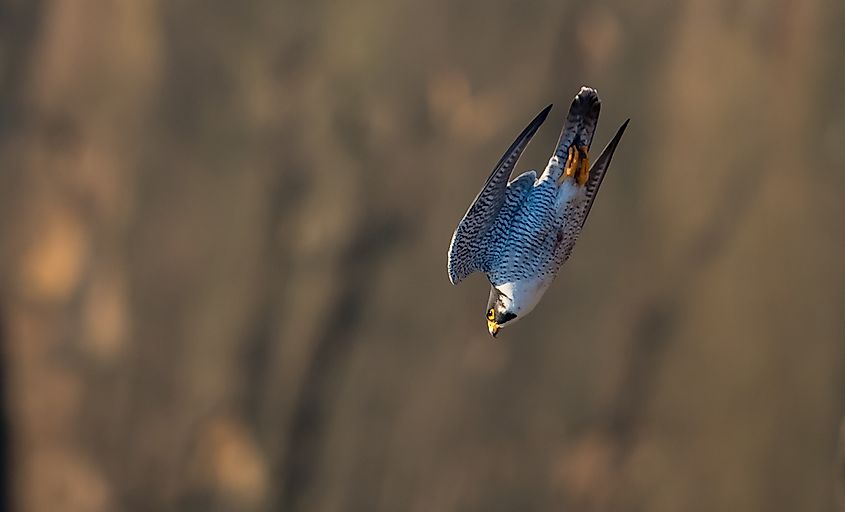
A peregrine falcon (Falco peregrinus) - Shorebirds: the Delaware Bay red knot stopover, plus piping plover, American oystercatcher, and black skimmer nesting on Atlantic beaches.
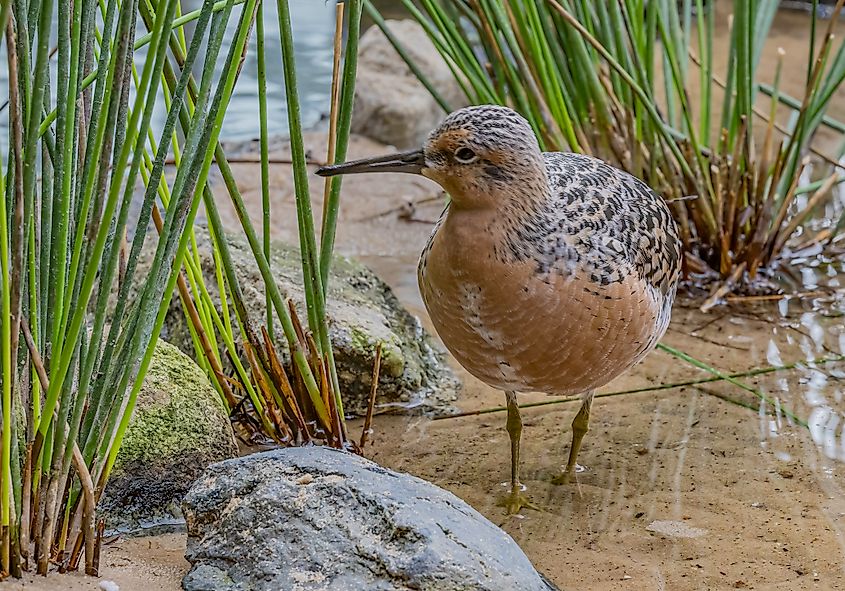
A red knot (Calidris canutus) - Marsh birds: saltmarsh sparrow, seaside sparrow, clapper rail, black rail (now nearly gone from the state), and northern harrier.
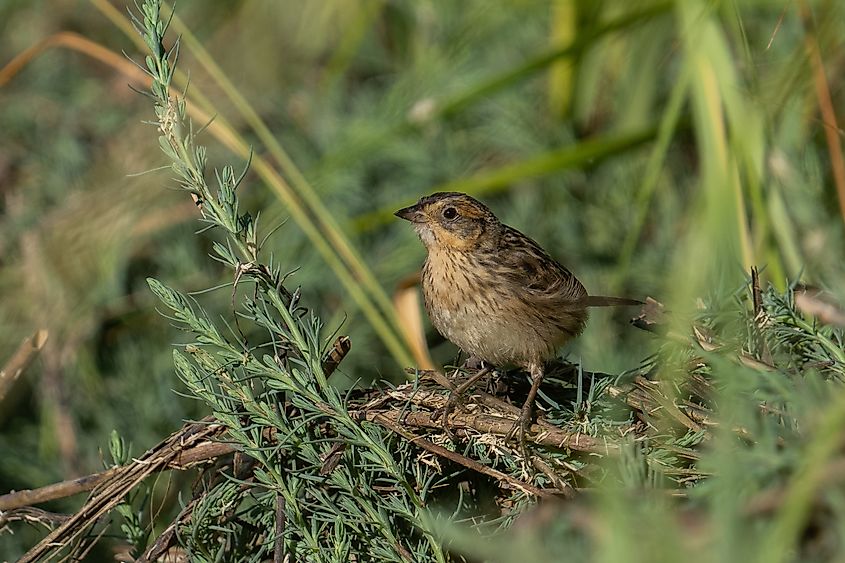
A saltmarsh sparrow (Ammospiza caudacuta) - Pine Barrens birds: prairie warbler, pine warbler, brown-headed nuthatch at the northern edge of its range, whip-poor-will, and nightjars generally, which the barrens support in unusual numbers.
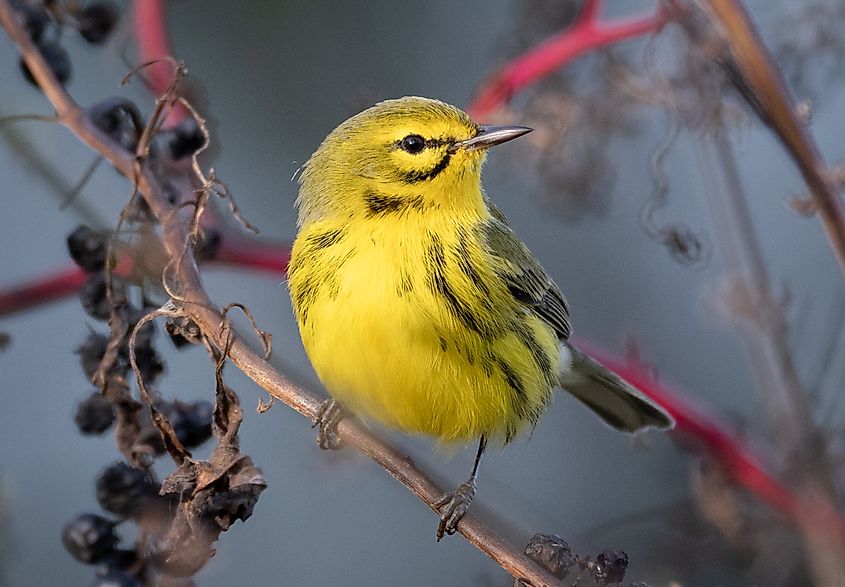
A prairie warbler (Setophaga discolor) - Rarities: Cape May's position produces a steady stream of vagrants, and the state's bird records committee reviews European and western strays regularly.
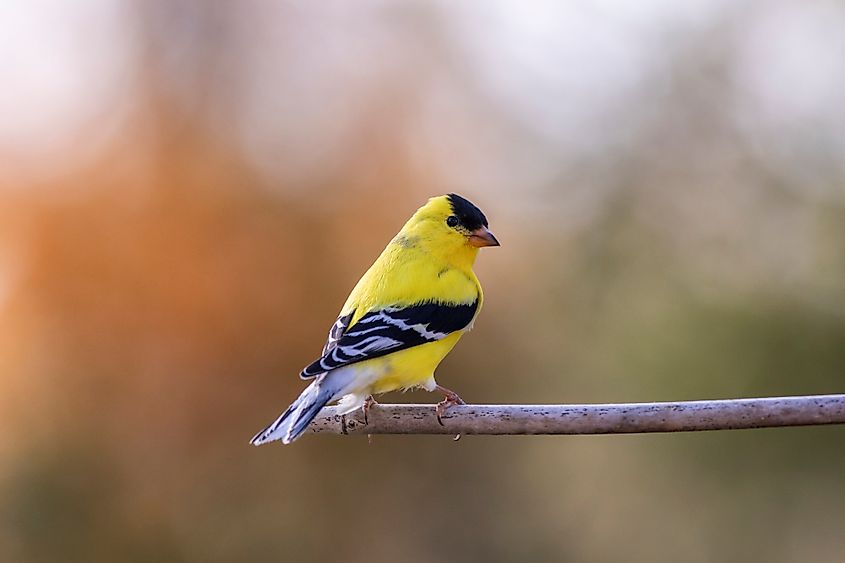
An eastern goldfinch (Spinus tristis)


Section 07
Reptiles, Amphibians, And Fish
New Jersey has around 30 reptile and 30 amphibian species. Two snakes are venomous and both are protected.
Snakes

22 species. The timber rattlesnake exists in two separate populations, one in the northwest mountains and one in the Pine Barrens, and is state endangered. The northern copperhead occurs only in the northern counties and is state threatened. Both are killed illegally often enough that den locations are kept confidential. The northern pine snake and corn snake in the barrens are also state listed.
Turtles

Bog turtle, federally threatened and found in calcareous fens, plus wood turtle, spotted turtle, eastern box turtle, diamondback terrapin in back-bay marsh, and northern red-bellied cooter. Terrapins drown in crab pots and are killed on causeways during nesting season, and volunteer patrols now move them off roads.
Amphibians

The Pine Barrens treefrog is the state's flagship amphibian, a small green frog with a purple stripe found in acidic barrens wetlands in New Jersey, the Carolinas, and the Florida panhandle and almost nowhere else. Also eastern tiger salamander (state endangered), blue-spotted salamander, marbled salamander, carpenter frog, and southern grey treefrog.
Fish

The brook trout is the state fish and persists in cold northern streams. Atlantic sturgeon in the Delaware River is federally endangered, and the Delaware population is among the most closely watched on the coast. American shad and river herring runs are the focus of dam removal work, and striped bass and summer flounder anchor the coastal fishery.
Section 08
Dangerous Animals In New Jersey
- Ticks: New Jersey has among the highest Lyme disease incidence in the country, and lone star ticks causing alpha-gal syndrome have expanded rapidly in the south.
- White-tailed deer: tens of thousands of vehicle collisions a year and the main host for adult ticks.
- Black bear: New Jersey recorded a fatal black bear attack in 2014, unusual for the species and the only such fatality in the state's recorded history. Conflicts are mostly about garbage and bird feeders.
- Timber rattlesnake and copperhead: both rare, both protected, and bites are very unusual.
- Coyote: attacks on people are extremely rare; pets are the realistic concern.
- Rip currents and cold water: these injure and kill far more people on New Jersey beaches than any animal.
Section 09
Endangered And Protected Species
| Species | Where | Status |
|---|---|---|
| Red knot (rufa) | Delaware Bay stopover | THREATENED |
| Atlantic sturgeon | Delaware River | ENDANGERED |
| North Atlantic right whale | Offshore migration | ENDANGERED |
| Piping plover | Atlantic beaches | STATE ENDANGERED |
| Bog turtle | Calcareous fens | THREATENED |
| Timber rattlesnake | Northwest and Pine Barrens | STATE ENDANGERED |
| Bobcat | Northwest highlands | STATE ENDANGERED |
| Pine Barrens treefrog | Acidic barrens wetlands | STATE THREATENED |
| Saltmarsh sparrow | Tidal marsh | STATE CONCERN |
| Northern long-eared bat | Statewide | ENDANGERED |
New Jersey's pressures are development, fragmentation, and sea level rise. Salt marsh is drowning faster than it can migrate inland because roads and development block the retreat. Beach nesting birds compete directly with recreational use on some of the most heavily visited shoreline in the country. Against that, New Jersey has one of the more active state endangered species programmes, funded partly by a voluntary tax check-off and specialty licence plates, and its bald eagle, osprey, and peregrine recoveries are among the strongest in the region.
Section 10
Where To See Wildlife In New Jersey
- Cape May Point State Park and the Hawkwatch platform: autumn raptor migration, best on northwest winds after a cold front in late September and October.
- Reeds Beach and Delaware Bay shore: horseshoe crab spawning and red knots in mid to late May, viewed from designated areas since the beaches are closed to protect feeding birds.
- Edwin B. Forsythe National Wildlife Refuge, Brigantine: an eight-mile wildlife drive through salt marsh with waterfowl, waders, and shorebirds.
- Wharton State Forest and the Pine Barrens: Pine Barrens treefrog, pine snake, cedar swamps, and tea-coloured rivers by canoe.
- Delaware Water Gap and Kittatinny Ridge: bears, autumn hawk migration, and Appalachian forest species.
- Sandy Hook, Gateway National Recreation Area: beach nesting birds, migration, and wintering seals.
- Great Swamp National Wildlife Refuge: an accessible wetland near New York City with waterfowl and amphibians.
Timing: mid to late May for horseshoe crabs and red knots on the bayshore, which is the state's most significant wildlife event. Late September and October for the Cape May raptor and songbird flights and monarch migration. March and April for amphibian breeding migrations on rainy nights, when volunteers close roads at known crossings. Winter for seals at Sandy Hook and wintering waterfowl at Forsythe.
Section 11
Common Questions
- What is the state animal of New Jersey?
- The horse, adopted in 1977, a domestic animal reflecting its place on the state seal. New Jersey also names the eastern goldfinch as state bird, brook trout as state fish, knobbed whelk as state shell, and Hadrosaurus foulkii as state dinosaur.
- Does New Jersey really have a lot of bears?
- Yes. The northwestern counties hold one of the highest black bear densities in North America despite New Jersey being the most densely populated state. Bears were nearly gone by the 1970s, and hunting policy has been reversed several times by successive governors.
- Why is Cape May so good for birds?
- Southbound autumn migrants are pushed toward the coast by northwest winds and funnelled down a narrowing peninsula that ends at open water. Many will not cross, so they concentrate. Seasonal raptor counts often exceed 50,000 birds.
- How many venomous snakes live in New Jersey?
- Two: the timber rattlesnake, which is state endangered and exists in separate northwest and Pine Barrens populations, and the northern copperhead, state threatened and found only in the north. Den locations are kept confidential to prevent illegal killing.
- What are the Pine Barrens?
- Roughly a million acres of pitch pine, scrub oak, and Atlantic white cedar swamp covering about 22 percent of the state. The sandy acidic soil was useless for farming, so it was never converted. It is fire-dependent and sits above an aquifer holding an enormous volume of very pure water.
- Why do horseshoe crabs matter in New Jersey?
- They spawn on Delaware Bay beaches each May, and their eggs feed red knots and other shorebirds arriving from South America that must double their weight before flying to the Arctic. New Jersey and Delaware together hold the great majority of this event.
- What is the most dangerous animal in New Jersey?
- Ticks, with New Jersey among the highest Lyme incidence states. Deer cause the most direct injuries through vehicle collisions. A fatal black bear attack occurred in 2014, the only one in the state's recorded history.
This page was last updated on October 7, 2026