Section 01
The Least Populated State, And The Most Complete Ecosystem
Wyoming has fewer people than any other state, roughly 585,000 across nearly 98,000 square miles, and that emptiness is the reason it holds what it does. The Greater Yellowstone Ecosystem, spanning Wyoming, Montana, and Idaho, is often described as the largest nearly intact temperate ecosystem on Earth, and it retains every large mammal that lived there before European settlement.
Yellowstone itself was the world's first national park, established in 1872, at a point when the concept did not exist anywhere. It was created for its geysers rather than its wildlife, and the wildlife protection came later and imperfectly, with wolves deliberately eliminated by the 1920s under a predator control policy the Park Service itself later repudiated.
Their return in 1995 and 1996, when wolves from Canada were released into Yellowstone, became the most studied predator reintroduction ever attempted. What followed has been argued over ever since, but the basic outcome is not disputed: wolves changed elk numbers and elk behaviour, which changed willow and aspen growth along streams, which changed beaver, songbirds, and stream structure.
Wyoming also holds the longest recorded land mammal migration in the lower 48. Pronghorn from Grand Teton travel roughly 150 miles each way along a corridor known as the Path of the Pronghorn, using a route they have followed for around 6,000 years and passing through bottlenecks only a few hundred feet wide.
Section 02
Wyoming's Official State Animals
| Designation | Animal | Adopted |
|---|---|---|
| State mammal | American bison Bison bison | 1985 |
| State bird | Western meadowlark Sturnella neglecta | 1927 |
| State fish | Cutthroat trout Oncorhynchus clarkii | 1987 |
| State reptile | Horned lizard Phrynosoma | 1993 |
| State insect | Sheridan's green hairstreak Callophrys sheridanii | 2009 |
| State dinosaur | Triceratops | 1994 |
Wyoming's bison are the only continuously wild herd in the country. When bison were reduced from tens of millions to a few hundred animals in the 1880s, a small remnant survived in the remote Pelican Valley of Yellowstone. Every other bison herd in America was rebuilt from captive stock. The Yellowstone population descends at least partly from those animals and has occupied its native range without interruption, which makes it genetically and historically distinct from every other herd. Related: why bison vanished.

The cutthroat trout designation covers several subspecies including the Yellowstone cutthroat and the Bonneville and Colorado River forms, all of which have declined through hybridisation with introduced rainbow trout and competition from non-native species. In Yellowstone Lake, illegally introduced lake trout ate their way through the cutthroat population, and the park now runs an intensive gillnetting programme that removes hundreds of thousands of lake trout annually.
Section 03
The Wolves, And What Actually Changed
Wolves were gone from Yellowstone by the mid-1920s, killed under a federal policy of eliminating predators from parks. In their absence elk numbers grew, elk browsed streamside willow and aspen heavily and without much need for vigilance, and beaver colonies declined as their food and dam material disappeared.
In 1995 and 1996, 31 wolves from Canada were released into Yellowstone, with a parallel release in central Idaho. The population grew quickly and now fluctuates around 100 or so wolves inside the park, with several hundred more across the wider Wyoming landscape.
The changes that followed have been described popularly as a trophic cascade in which wolves reshaped rivers. The reality is more measured and more interesting. Elk numbers in the northern range fell substantially, though hunting outside the park, drought, grizzly and cougar predation, and bison competition all contributed alongside wolves. Willow and aspen recovery has been real but patchy, stronger in some drainages than others, and often depending on whether beavers returned to hold water in the valley bottom.

- Scavengers gained: wolf kills feed grizzly bears, ravens, magpies, eagles, and coyotes through winter, spreading carrion availability across the season rather than concentrating it in late-winter die-offs.
- Coyotes declined: wolves kill coyotes, and coyote numbers in the northern range fell sharply, which appears to have benefited pronghorn fawns and small mammals.
- Beavers returned: colony numbers on the northern range increased substantially from a very low base.
- The lesson: ecosystems respond to predator restoration, but the response is slow, uneven, and entangled with climate, hunting, and other species. Related: surprising Yellowstone facts.
Outside the park it is contested. Wyoming's wolf management classifies wolves as predatory animals across most of the state, where they may be killed year-round by almost any means, with trophy game status only in the northwest near Yellowstone. That arrangement has been the subject of repeated litigation, and it is why wolf numbers and legal protections in Wyoming differ sharply depending on which side of a line an animal is standing.
Section 04
Habitats By Region, And Who Lives In Each
Greater Yellowstone

High volcanic plateau, geyser basins, lodgepole forest, and river valleys. Grizzly bear, gray wolf, bison, elk, moose, bighorn sheep, mountain lion, wolverine, and trumpeter swans. Thermal areas support heat-tolerant microorganisms and, unusually, provide snow-free winter foraging. See Yellowstone National Park.
Teton Range and Jackson Hole

Abrupt granite peaks above a sagebrush valley. The National Elk Refuge winters thousands of elk that migrate down from the high country, and Jackson Hole is the southern terminus of the Path of the Pronghorn. See Grand Teton National Park.
Wind River Range and Absarokas

The state's highest country, with glaciers, alpine lakes, and extensive wilderness. Bighorn sheep, mountain goat (introduced), wolverine, and Canada lynx in small numbers.
Sagebrush basins

Wyoming holds a large share of the world's remaining sagebrush, and with it the largest greater sage-grouse population of any state. Also pronghorn in enormous numbers, pygmy rabbit, sagebrush sparrow, and Brewer's sparrow. The Red Desert holds one of the largest desert elk herds in the country and a substantial wild horse population.
Black Hills, Bighorns, and eastern ranges

Isolated forested ranges rising from the plains, holding elk, deer, black bear, and bobcat, plus Devils Tower and its cliff-nesting raptors.
Eastern plains and prairie

Shortgrass and mixed-grass prairie with black-tailed prairie dog colonies, black-footed ferrets reintroduced at several sites, swift fox, mountain plover, and ferruginous hawk. The black-footed ferret was rediscovered near Meeteetse, Wyoming in 1981 after being declared extinct, and every ferret alive today descends from that discovery.
Section 05
Mammals Of Wyoming
American bison: the state mammal, with the Yellowstone herd numbering in the thousands and being the only continuously wild population in the country. Related: where bison injure the most visitors and state parks where bison still roam.
Pronghorn: Wyoming holds more pronghorn than any other state, comparable in number to its human population, and the Path of the Pronghorn is the longest recorded land migration in the lower 48 at roughly 150 miles each way.

Elk: well over 100,000, with the National Elk Refuge wintering thousands in a concentration that is both a spectacle and a disease management problem, since feeding animals densely raises brucellosis and chronic wasting disease transmission risk. See where to watch the elk rut.

Grizzly bear: roughly 1,000 in the Greater Yellowstone Ecosystem, up from perhaps 136 at listing in 1975. Delisting has been proposed and reversed by courts repeatedly. See where grizzly bears live.

Gray wolf: several hundred statewide, with legal status varying sharply by region.
Moose: Shiras moose in willow bottoms, with populations declining in parts of the state.

Bighorn sheep: Wyoming holds one of the largest populations in the country, with disease from domestic sheep the main limiting factor.

Black-footed ferret: rediscovered in Wyoming in 1981, reintroduced at several sites, and still among the most endangered mammals in North America.

Wolverine, Canada lynx, mountain lion, coyote, swift fox, badger, beaver, river otter, marten, pika: all present.

Bats: 18 species, with white-nose syndrome now confirmed in the region. See where bats live.

Section 06
Birds Of Wyoming
Around 450 species have been recorded, dominated by sagebrush, mountain, and prairie communities.
- Greater sage-grouse: Wyoming holds roughly 37 percent of the world's remaining population, more than any other state, which makes its sagebrush management decisions consequential well beyond its borders. Males gather on leks each spring to display, inflating chest sacs that produce a popping sound audible across open ground.
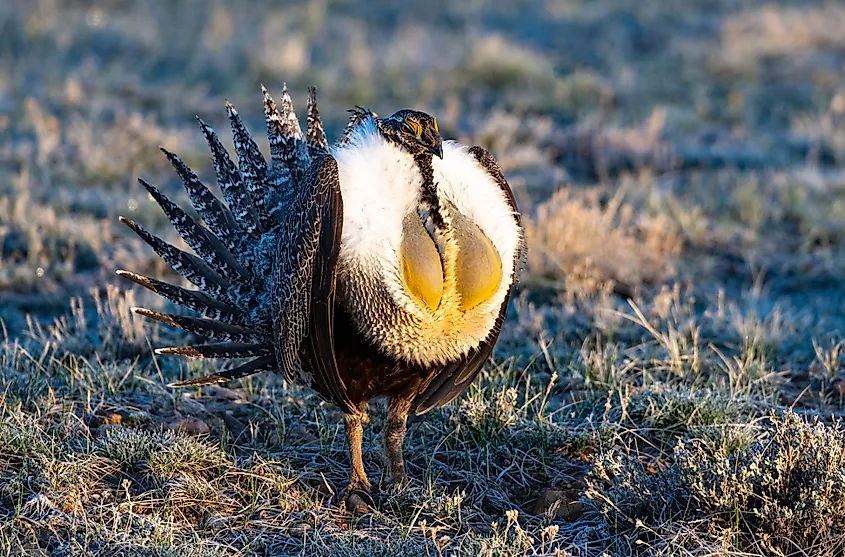
A greater sage-grouse (Centrocercus urophasianus) - Trumpeter swan: the Greater Yellowstone population was one of the last remnants when the species nearly vanished, and swans still nest on spring-fed waters that stay open through winter.
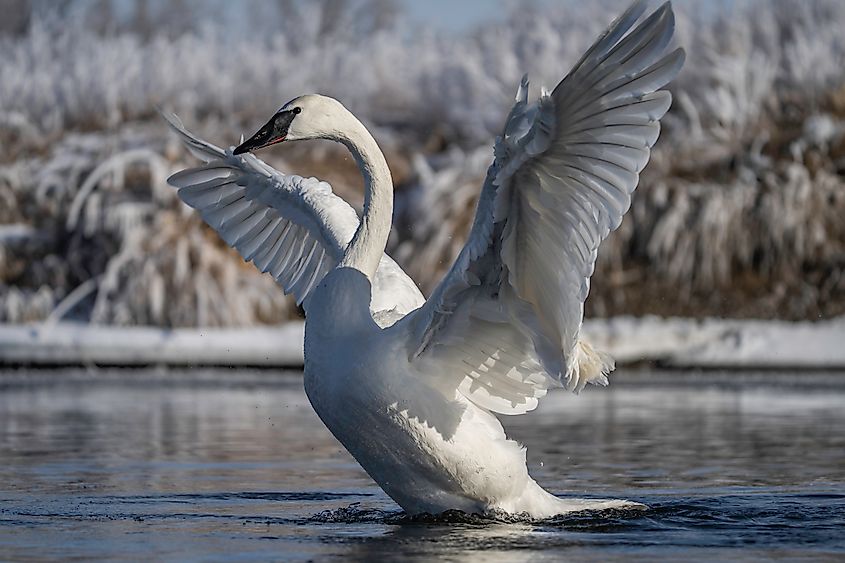
A trumpeter swan (Cygnus buccinator) - Raptors: golden eagle, ferruginous hawk, prairie falcon, peregrine falcon, and bald eagle. Wyoming's open country supports high raptor densities.
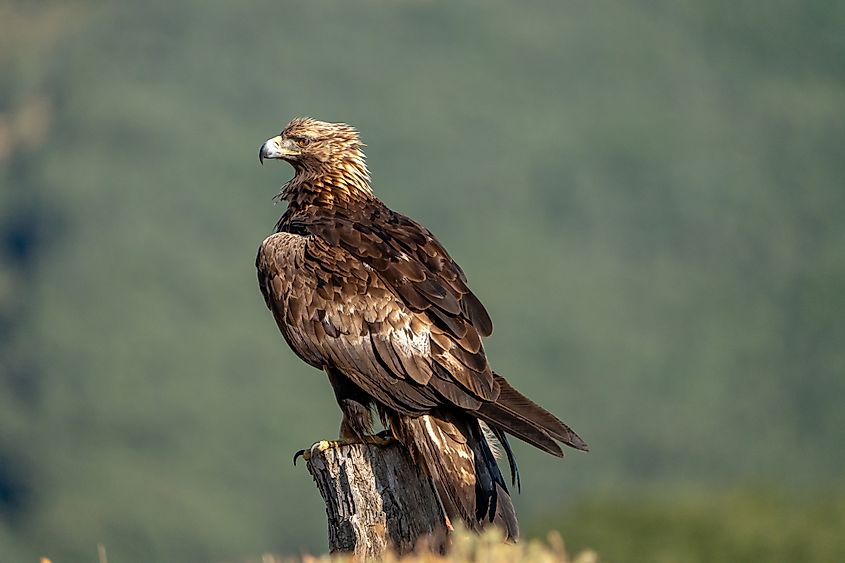
A golden eagle (Aquila chrysaetos) - Mountain birds: Clark's nutcracker, which caches whitebark pine seeds that grizzlies also depend on, plus black rosy-finch, white-tailed ptarmigan, and American dipper.
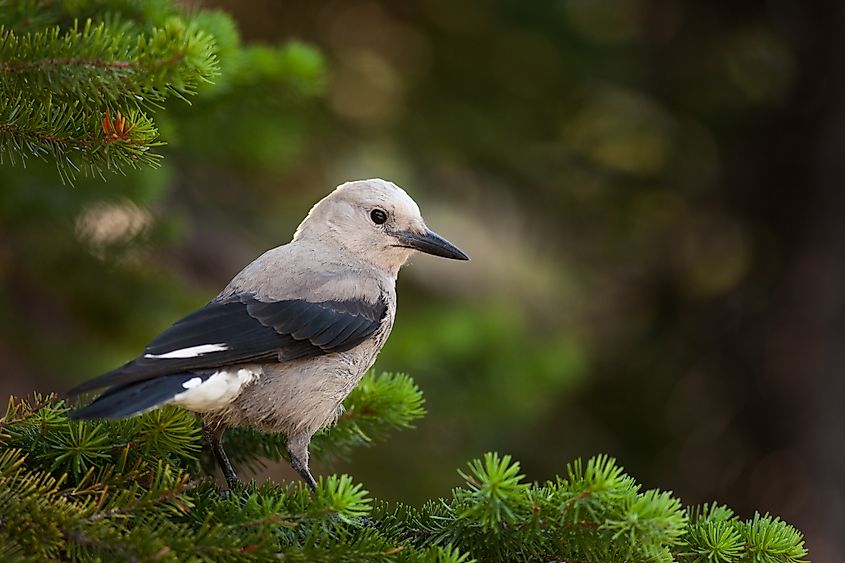
A Clark's nutcracker (Nucifraga columbiana) - Prairie birds: mountain plover, long-billed curlew, McCown's and chestnut-collared longspurs, and burrowing owl on prairie dog colonies.
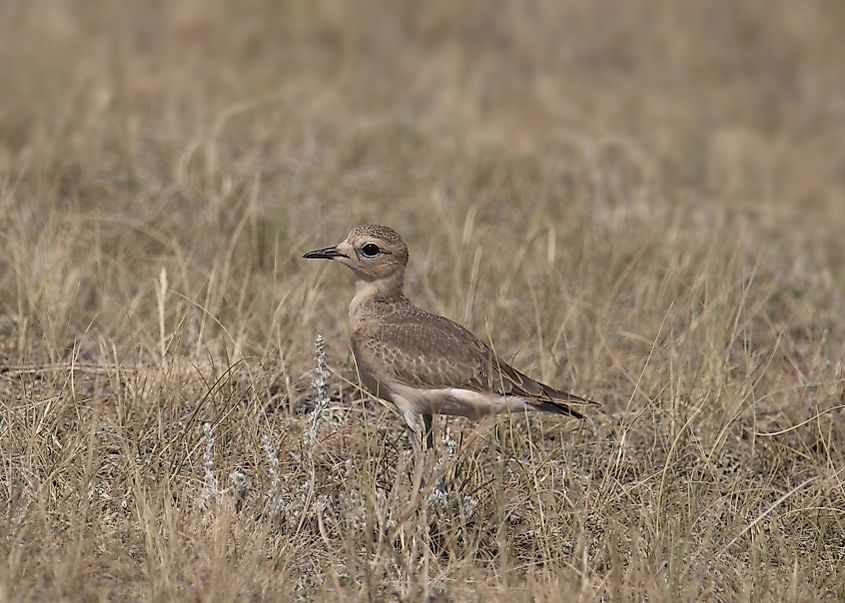
A mountain plover (Anarhynchus montanus) - Whooping crane: a small experimental flock was established at Grays Lake nearby in the 1970s using sandhill cranes as foster parents. It failed because the cross-fostered whooping cranes imprinted on sandhills and never paired with their own species, which is why later efforts used costumed handlers instead.
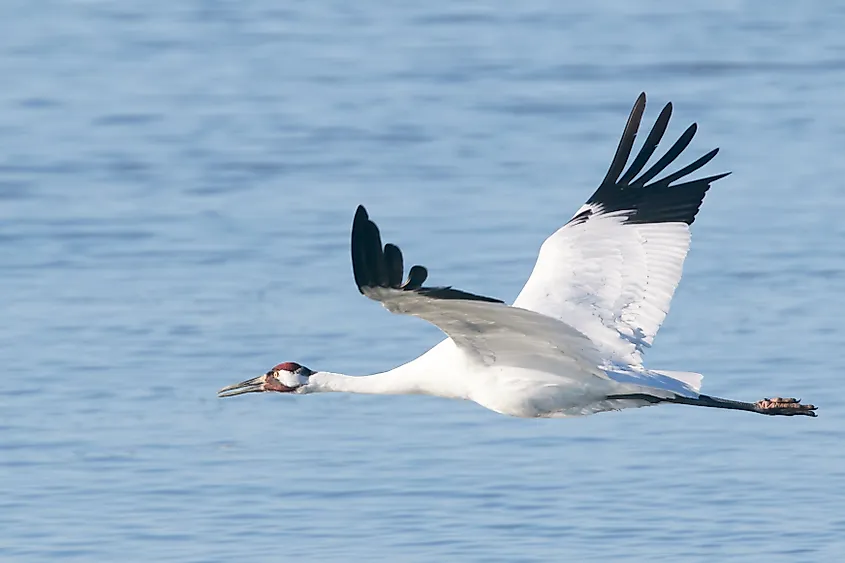
A whooping crane (Grus americana)


Section 07
Reptiles, Amphibians, And Fish
Altitude and cold keep the list short: around 22 reptile and 12 amphibian species. One snake is venomous.
Snakes

The prairie rattlesnake is the only venomous species, found in lower and drier country and absent from the high mountains. Also bullsnake, western hognose, and several garter snakes.
Lizards

The horned lizard is the state reptile, alongside sagebrush lizard, short-horned lizard, and eastern fence lizard in the east.
Amphibians
Boreal toad, Wyoming toad, tiger salamander, boreal chorus frog, Columbia spotted frog, and northern leopard frog. The Wyoming toad is one of the most endangered amphibians in North America, extinct in the wild by the 1990s and surviving only through captive breeding and release into the Laramie Basin.

Fish

The cutthroat trout is the state fish across several subspecies. Yellowstone Lake's cutthroat population collapsed after lake trout were illegally introduced, and the park's gillnetting programme removes them by the hundreds of thousands each year to protect a fish that grizzlies, otters, ospreys, and eagles all feed on. The Kendall Warm Springs dace lives in a single small spring near Pinedale and nowhere else on Earth.
Section 08
Dangerous Animals In Wyoming
- Bison: they injure more people in Yellowstone than bears do, and most incidents involve visitors approaching for photographs. Bison are fast, unpredictable, and appear placid. Stay 25 yards minimum.
- Grizzly bear: the animal that requires genuine preparation. Carry bear spray accessible on a belt or chest, make noise on blind trails, travel in groups, and store food properly. Fatalities are rare but Wyoming records them.
- Moose: aggressive when cornered and around calves, and responsible for more charges in Jackson Hole than bears.
- Elk: bulls during the September and October rut and cows with calves in spring both charge, and town elk in Mammoth and Jackson are involved in incidents most years.
- Prairie rattlesnake: the only venomous snake, in lower country. Bites are uncommon.
- Thermal features: worth stating plainly. Yellowstone's hot springs have killed more visitors than all its animals combined. Boardwalks exist for a reason.
- Weather and altitude: hypothermia, lightning above treeline, and winter driving cause the most harm overall.
Bear spray, not firearms. Studies of encounters in this ecosystem consistently find bear spray more reliable at preventing injury than firearms, largely because a spray cloud does not require precise aim under stress. Carry it where you can reach it in two seconds, not inside a pack.
Section 09
Endangered And Protected Species
| Species | Where | Status |
|---|---|---|
| Black-footed ferret | Prairie dog colonies | ENDANGERED |
| Wyoming toad | Laramie Basin only | ENDANGERED |
| Kendall Warm Springs dace | One spring near Pinedale | ENDANGERED |
| Grizzly bear | Greater Yellowstone | THREATENED |
| Canada lynx | High mountain forest | THREATENED |
| Wolverine | Alpine snowpack | THREATENED |
| Preble's meadow jumping mouse | Southeast riparian | THREATENED |
| Greater sage-grouse | Sagebrush basins | STATE CONCERN |
| Yellowstone cutthroat trout | Yellowstone drainage | STATE CONCERN |
| Black-tailed prairie dog | Eastern plains | STATE CONCERN |
Wyoming's pressures are migration and energy. The state's ungulates depend on long seasonal movements between summer and winter range, and those corridors cross highways, fences, subdivisions, and gas fields. Wyoming has become a national leader in mapping these routes and building wildlife crossings, and the Path of the Pronghorn was the first federally designated migration corridor in the country. Energy development in sagebrush basins fragments sage-grouse habitat, whitebark pine loss to blister rust and beetles removes a key grizzly food, disease moves from domestic to wild sheep, and chronic wasting disease is spreading through deer and elk herds in a state that also feeds elk in dense winter concentrations.
Section 10
Where To See Wildlife In Wyoming
- Lamar Valley, Yellowstone: the single best place in North America to see wolves and bison from a road, best at dawn and dusk.
- Hayden Valley, Yellowstone: bison herds, grizzlies on carcasses in spring, and sandhill cranes.
- National Elk Refuge, Jackson: thousands of wintering elk, viewed by sleigh ride from December through March.
- Grand Teton National Park: moose in the willow flats, pronghorn in the sage, and bears along the Moose-Wilson road.
- Path of the Pronghorn, Trapper's Point: the migration bottleneck where thousands of pronghorn funnel through each spring and autumn.
- Red Desert: desert elk, wild horses, and one of the largest unfenced areas in the lower 48.
- Seedskadee National Wildlife Refuge: Green River riparian corridor with moose, beaver, and migratory birds.
- Sage-grouse leks near Pinedale and Rawlins: dawn displays in April, viewed from a vehicle at distance.
Timing: late April through June for bears emerging, newborn ungulates, and sage-grouse leks at dawn. September and October for the elk rut, bugling, and the pronghorn migration through Trapper's Point. Winter for wolves against snow in the Lamar and elk at the National Elk Refuge. Much of Yellowstone's road network closes to cars from early November to late April, so plan around it.
Section 11
Common Questions
- What is the state animal of Wyoming?
- The American bison, adopted in 1985. Wyoming's Yellowstone herd is the only bison population in the country to have occupied its native range continuously, descending at least partly from a remnant that survived in Pelican Valley when every other herd was rebuilt from captive stock.
- What did the Yellowstone wolves actually change?
- Elk numbers on the northern range fell substantially, though hunting, drought, and other predators contributed too. Willow and aspen recovery has been real but patchy, coyote numbers dropped sharply, beaver colonies increased, and scavengers gained a year-round carrion supply. The response has been slower and more uneven than popular accounts suggest.
- How many grizzly bears are in Wyoming?
- Roughly 1,000 in the Greater Yellowstone Ecosystem, up from perhaps 136 when the species was listed in 1975. Delisting has been proposed and reversed by courts several times.
- What is the Path of the Pronghorn?
- A roughly 150-mile migration route between Grand Teton and the Green River Basin, followed for around 6,000 years and passing through bottlenecks only a few hundred feet wide. It is the longest recorded land mammal migration in the lower 48 and was the first federally designated migration corridor in the country.
- How many venomous snakes live in Wyoming?
- One, the prairie rattlesnake, found in lower and drier country and absent from the high mountains.
- Why does Wyoming matter for sage-grouse?
- The state holds roughly 37 percent of the world's remaining greater sage-grouse, more than anywhere else, which makes its sagebrush and energy development decisions consequential well beyond its borders.
- What is the most dangerous thing in Yellowstone?
- Thermal features have killed more visitors than all the park's animals combined. Among animals, bison injure the most people, usually visitors approaching for photographs. Grizzly bears warrant the most preparation, and bear spray is more reliable than a firearm at preventing injury.
This page was last updated on October 7, 2026