Section 01
Where The Plains Meet The Black Hills
South Dakota is split by the Missouri River into two states that locals call East River and West River. East of the Missouri is glaciated prairie pothole country, wetter and heavily farmed. West of it the land is unglaciated, drier, and rougher, running through mixed-grass prairie into badlands and then rising abruptly into the Black Hills.
The Black Hills are the anomaly. They are an isolated dome of ponderosa pine and spruce rising nearly 4,000 feet above the surrounding plains, close enough in character to the Rocky Mountains to hold Rocky Mountain species hundreds of miles from the nearest range. Elk, mountain goats, mountain lions, and bighorn sheep all live there, on what is effectively an island of forest.
South Dakota is also the centre of the bison story. Custer State Park holds one of the largest publicly owned herds in the world, and the state's private and tribal herds add substantially. The animals in Yellowstone, Wind Cave, and several other public herds trace part of their ancestry to a handful of Great Plains bison saved by ranchers and tribal members in the late 1800s, several of them from what is now South Dakota.
The other South Dakota distinction is underground. Wind Cave and Jewel Cave are among the longest cave systems in the world, and Wind Cave holds roughly 95 percent of the world's known boxwork, a rare honeycomb formation of thin calcite fins that occurs almost nowhere else.
Section 02
South Dakota's Official State Animals
| Designation | Animal | Adopted |
|---|---|---|
| State animal | Coyote Canis latrans | 1949 |
| State bird | Ring-necked pheasant Phasianus colchicus | 1943 |
| State fish | Walleye Sander vitreus | 1982 |
| State insect | Honeybee Apis mellifera | 1978 |
| State fossil | Triceratops | 1988 |
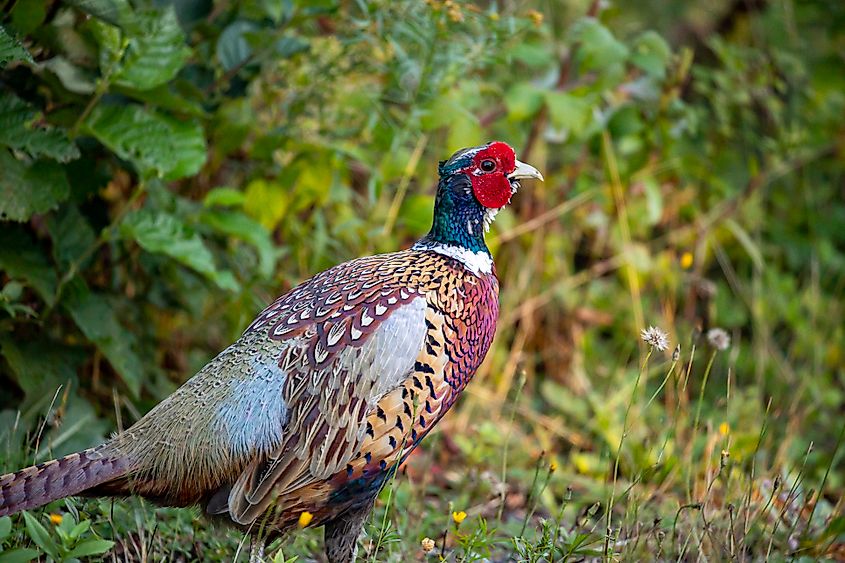
South Dakota's state bird is not native to North America. The ring-necked pheasant is an Asian species, introduced to the United States in the late 1800s and first released successfully in South Dakota around 1908. It thrived in the state's mix of grain fields and grassy cover, and pheasant hunting became a major part of the state's economy and identity, drawing tens of thousands of out-of-state hunters each autumn. South Dakota named it the state bird in 1943, making it one of the few states with an introduced species as its official bird.

The coyote designation in 1949 is also unusual, since coyotes are more often treated as vermin than honoured. South Dakota's nickname, the Coyote State, predates the designation, and the University of South Dakota's teams are the Coyotes.
Section 03
Bison, Prairie Dogs, And Ferrets
South Dakota is central to the recovery of three linked species.
Bison. By the 1880s the Great Plains herds that had numbered in the tens of millions were reduced to a few hundred animals in scattered private hands and a small wild remnant in Yellowstone. Several of the foundational private herds were assembled on the northern plains, and animals from them stocked the public herds that exist today. Custer State Park now holds roughly 1,400 bison and runs an annual roundup each September that draws large crowds, and Wind Cave National Park holds a genetically important herd free of cattle gene introgression. Related: why bison vanished and state parks where bison still roam.

Prairie dogs. Black-tailed prairie dogs once occupied enormous areas of the western plains, and their colonies are keystone habitat: their burrows shelter burrowing owls and rattlesnakes, their grazing creates the short vegetation that mountain plovers need, and they are prey for badgers, ferruginous hawks, and eagles. Poisoning campaigns and plague reduced them to a small fraction of historic extent. Related: prairie dog.

Black-footed ferrets. The ferret depends on prairie dogs almost entirely, eating them and living in their burrows, so when prairie dogs collapsed the ferret followed. It was declared extinct twice. The species was rediscovered in Wyoming in 1981, the last 18 wild animals were taken into captivity, and every black-footed ferret alive today descends from just seven that bred successfully. South Dakota's Conata Basin, adjacent to Badlands National Park, became one of the most successful reintroduction sites in the country, though sylvatic plague sweeping through prairie dog colonies has repeatedly set the population back.

Plague is the persistent problem. Sylvatic plague, caused by the same bacterium as human plague and introduced to North America around 1900, can kill more than 90 percent of a prairie dog colony in weeks. Managers dust burrows with insecticide to kill fleas and have developed an oral plague vaccine delivered in bait, but both are labour-intensive and must be repeated. Ferret recovery is therefore limited less by ferret biology than by whether prairie dog colonies can be kept alive.
Section 04
Habitats By Region, And Who Lives In Each
Eastern prairie potholes

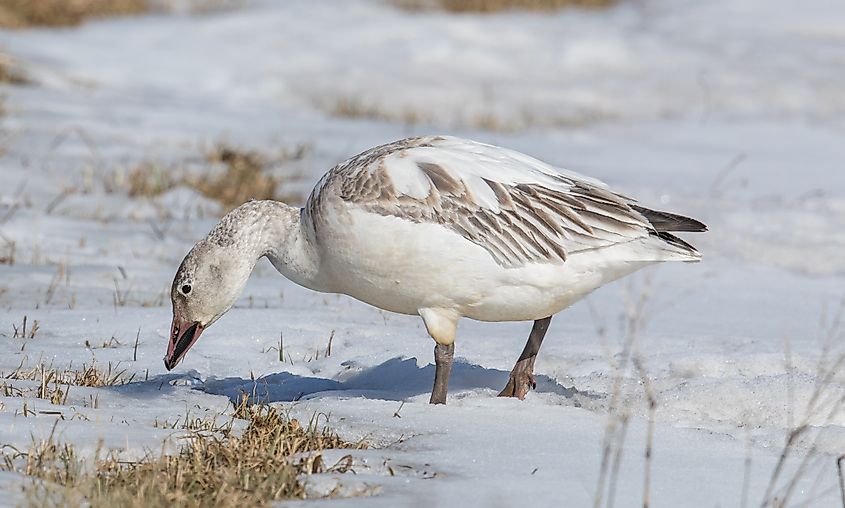
Glaciated country with thousands of shallow wetlands, part of the same duck-producing region as North Dakota. Breeding mallard, blue-winged teal, gadwall, and northern shoveler, plus sandhill cranes and huge snow goose migrations.
Missouri River and reservoirs

Four large dams turned much of the Missouri into reservoirs. The remaining free-flowing reaches hold pallid sturgeon and sandbars used by nesting piping plovers and terns. Bald eagles concentrate below the dams in winter.
Mixed-grass prairie and West River

Rolling grassland with prairie dog towns, pronghorn, sharp-tailed grouse, greater prairie-chicken, burrowing owl, and swift fox. Buffalo Gap and Fort Pierre National Grasslands hold significant tracts.
Badlands

Eroded pinnacles and prairie tables along the White River, with bison, bighorn sheep, prairie dogs, ferrets in Conata Basin, and one of the richest fossil beds in the world. See Badlands National Park.
Black Hills

An island of ponderosa pine, spruce, and aspen rising from the plains. Elk, mountain goat (introduced in 1924 and now established), bighorn sheep, mountain lion at one of the highest densities in the country, black bear as occasional wanderers, and forest birds including the black-backed woodpecker in burned stands. See Black Hills.
Caves

Wind Cave and Jewel Cave rank among the longest cave systems on Earth. They hold bat hibernacula and cave-adapted invertebrates, and Wind Cave's boxwork formations are found almost nowhere else. See Wind Cave, South Dakota.
Section 05
Mammals Of South Dakota
American bison: roughly 1,400 at Custer State Park plus herds at Wind Cave, Badlands, and on tribal lands, notably the Cheyenne River and Rosebud Sioux tribes' herds.

White-tailed and mule deer: whitetails in the east and river bottoms, mule deer in the west and badlands.

Pronghorn: on the western grasslands, with numbers that fluctuate after hard winters.

Elk: in the Black Hills and on some western prairie units, restored after extirpation.

Bighorn sheep and mountain goat: bighorn restored to the Black Hills and Badlands after the native Audubon's bighorn went extinct; mountain goats introduced to the Black Hills in 1924 from a zoo shipment that escaped.

Mountain lion: the Black Hills hold a well-studied population, and South Dakota lions are the source of most confirmed dispersers turning up across the Midwest and East, including the animal killed in Connecticut in 2011 after walking roughly 1,500 miles.

Black-footed ferret: reintroduced in Conata Basin and on tribal lands, among the most endangered mammals in North America.

Coyote, bobcat, swift fox, red fox, badger, river otter (recovering in the east), mink, beaver, muskrat, jackrabbits, thirteen-lined ground squirrel: all present.

Bats: 11 species, with the Black Hills caves holding significant hibernacula and white-nose syndrome now present. See do bats hibernate.

Gone: gray wolf and grizzly bear, both eliminated in the 19th century, plus the Audubon's bighorn subspecies, which is extinct.
Section 06
Birds Of South Dakota
More than 430 species have been recorded, mixing eastern, western, and northern plains species.
- Prairie grouse: sharp-tailed grouse and greater prairie-chicken both display on leks, and the Fort Pierre National Grassland is one of the better places in the country to see prairie-chickens from a blind.
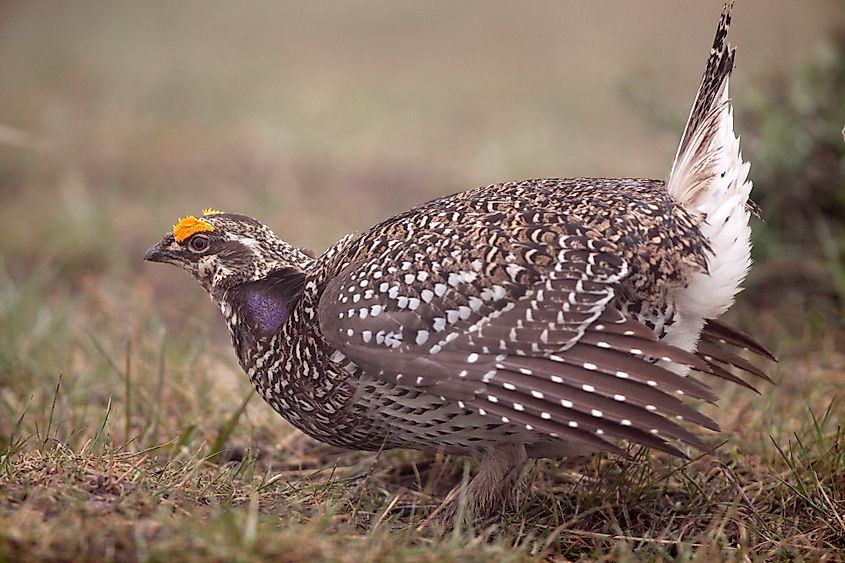
A sharp-tailed grouse (Tympanuchus phasianellus) - Ring-necked pheasant: the state bird and an introduced species, supporting a hunting economy that draws large numbers of visitors each autumn.
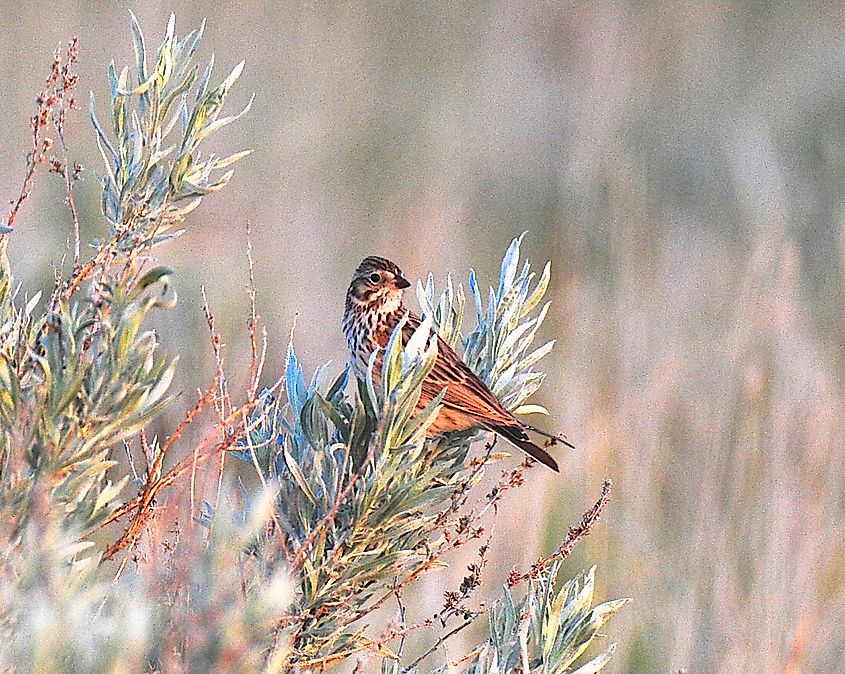
A ring-necked pheasant (Phasianus colchicus) - Grassland songbirds: Baird's sparrow, Sprague's pipit, chestnut-collared longspur, lark bunting, and Sprague's pipit all breed on northern plains grassland, and their global ranges are small.
A Baird's sparrow (Centronyx bairdii) - Waterbirds: eastern potholes breed ducks and grebes, and Sand Lake National Wildlife Refuge holds enormous migration concentrations and a large Franklin's gull colony.
A snow goose (Anser caerulescens) - Raptors: golden eagle in the badlands and Black Hills, ferruginous hawk, prairie falcon, and bald eagle wintering along the Missouri.
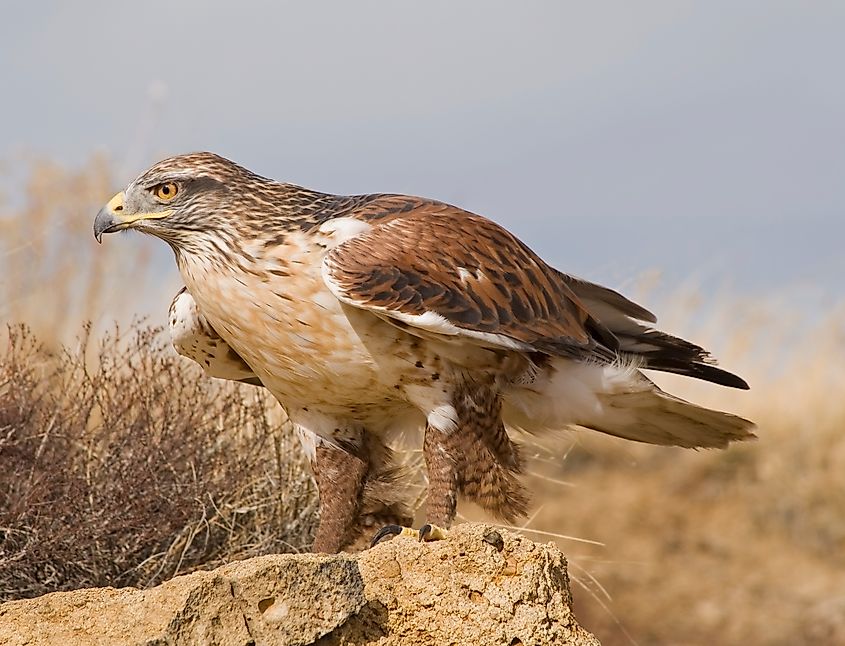
A ferruginous hawk (Buteo regalis) - Whooping crane: the Aransas-Wood Buffalo flock passes through eastern South Dakota on migration.
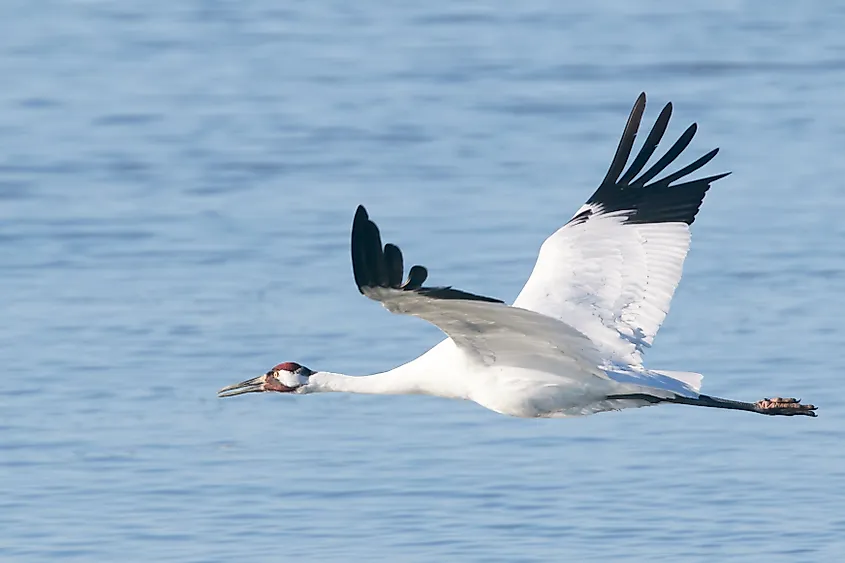
A whooping crane (Grus americana)


Section 07
Reptiles, Amphibians, And Fish
South Dakota has around 22 reptile and 13 amphibian species. One snake is venomous.
Snakes

17 species. The prairie rattlesnake is the only venomous species, found mainly west of the Missouri in badlands, prairie dog towns, and rocky breaks. Also bullsnake, western hognose, plains garter snake, and racer.
Turtles and lizards

Painted turtle, snapping turtle, spiny softshell, and the ornate box turtle in sandy prairie. Lizards include the short-horned lizard, sagebrush lizard, and prairie skink.
Amphibians

Tiger salamander, plains spadefoot, Great Plains toad, Woodhouse's toad, northern leopard frog, and boreal chorus frog. The Black Hills hold a distinct population of the northern leopard frog and the only South Dakota records for some montane amphibians.
Fish

The walleye is the state fish and the basis of a major reservoir fishery. Pallid sturgeon in the Missouri is federally endangered. The Black Hills streams hold introduced trout, and the Cheyenne and White river systems hold prairie fish adapted to turbid, fluctuating water including the sturgeon chub and sicklefin chub.
Section 08
Dangerous Animals In South Dakota
- Bison: the most dangerous animal a visitor is likely to encounter, particularly at Custer State Park and Wind Cave where they roam near roads. Bison injure more people in US parks than bears do, and they can run three times faster than a person. Related: where bison injure the most visitors.
- Deer: vehicle collisions are the leading wildlife hazard statewide.
- Prairie rattlesnake: the only venomous snake, common in prairie dog towns and rocky breaks west of the Missouri. Bites are uncommon.
- Mountain lion: the Black Hills population is substantial but attacks are essentially unrecorded in the state.
- Plague: sylvatic plague circulates in prairie dog colonies and can infect people through flea bites. Do not handle rodents or approach burrows closely.
- Ticks: Rocky Mountain spotted fever and tularemia both occur.
- Weather: blizzards, extreme cold, and severe thunderstorms cause far more harm than any South Dakota animal.
Section 09
Endangered And Protected Species
| Species | Where | Status |
|---|---|---|
| Black-footed ferret | Conata Basin, tribal lands | ENDANGERED |
| Whooping crane | Migration stopovers | ENDANGERED |
| Pallid sturgeon | Missouri River | ENDANGERED |
| Piping plover | Missouri River sandbars | THREATENED |
| Northern long-eared bat | Black Hills and east | ENDANGERED |
| Dakota skipper | Native prairie remnants | THREATENED |
| Poweshiek skipperling | Eastern prairie fens | ENDANGERED |
| Topeka shiner | Eastern prairie streams | ENDANGERED |
| Black-tailed prairie dog | Western colonies | STATE CONCERN |
| Sprague's pipit | Northern mixed-grass prairie | STATE CONCERN |
| Interior least tern | River sandbars | DELISTED 2021 |
South Dakota's pressures are grassland conversion, prairie dog control, and river alteration. Native prairie continues to be broken for row crop, particularly in the east where improved seed varieties made previously marginal land plantable. Prairie dog poisoning limits ferret and burrowing owl recovery, and plague compounds it. The Missouri dams eliminated the shifting sandbars, seasonal floods, and turbid warm water that pallid sturgeon, plovers, and terns evolved with, and managing flows for those species conflicts with navigation, power, and flood control priorities.
Section 10
Where To See Wildlife In South Dakota
- Custer State Park Wildlife Loop: bison, pronghorn, bighorn, and begging burros, with the annual bison roundup in late September.
- Wind Cave National Park: bison, elk, prairie dog towns, and the cave itself with its boxwork.
- Badlands National Park and Conata Basin: bighorn sheep, bison, prairie dogs, and the ferret reintroduction area.
- Fort Pierre National Grassland: greater prairie-chicken and sharp-tailed grouse leks from blinds in April.
- Sand Lake National Wildlife Refuge: enormous waterfowl migration and a large Franklin's gull colony.
- Black Hills, Spearfish Canyon and Custer: mountain goats, elk, and forest birds.
- Missouri River below Oahe and Fort Randall dams: wintering bald eagles in numbers.
- LaCreek National Wildlife Refuge: trumpeter swans and marsh birds in the south.
Timing: April for grouse and prairie-chicken leks at dawn from a blind. May and June for breeding ducks, grassland songbirds, and newborn bison calves, which are bright orange and easy to spot. Late September for the Custer State Park bison roundup and the elk rut. October and November for waterfowl migration. Winter for eagles below the Missouri dams and for wildlife against snow in the badlands.
Section 11
Common Questions
- What is the state animal of South Dakota?
- The coyote, adopted in 1949, which gives the state its Coyote State nickname. The state bird is the ring-necked pheasant, an Asian species introduced around 1908, making South Dakota one of the few states with a non-native official bird.
- How many bison are in South Dakota?
- Custer State Park holds roughly 1,400, one of the largest publicly owned herds in the world, with additional herds at Wind Cave and Badlands National Parks and substantial tribal herds including those of the Cheyenne River and Rosebud Sioux.
- What is the black-footed ferret and why does South Dakota matter?
- North America's most endangered mammal, dependent almost entirely on prairie dogs for food and shelter. It was declared extinct twice, rediscovered in Wyoming in 1981, and every living animal descends from seven that bred in captivity. South Dakota's Conata Basin became one of the most successful reintroduction sites, though plague repeatedly sets it back.
- Are there mountain lions in South Dakota?
- Yes, with a well-studied Black Hills population at one of the higher densities in the country. South Dakota lions are the source of most confirmed dispersers found across the Midwest and East, including one killed in Connecticut in 2011 after travelling roughly 1,500 miles.
- How many venomous snakes live in South Dakota?
- One, the prairie rattlesnake, found mainly west of the Missouri River in badlands, prairie dog towns, and rocky breaks.
- Why are the Black Hills different from the surrounding plains?
- They are an isolated dome of ponderosa pine and spruce rising nearly 4,000 feet above the prairie, close enough to Rocky Mountain conditions to hold elk, mountain goats, bighorn sheep, and mountain lions hundreds of miles from the nearest range.
- What is the most dangerous animal in South Dakota?
- Bison, for visitors, particularly at Custer State Park and Wind Cave where they roam near roads and injure people most years. Deer cause the most vehicle collisions. Weather causes far more harm than any animal.
This page was last updated on September 14, 2026