Section 01
Six Life Zones And A Bat Cave
New Mexico spans from roughly 2,800 feet in the southeast to 13,161 feet at Wheeler Peak, and that vertical range compresses six of the seven life zones recognized in North America into one state. A traveler can move from the Chihuahuan Desert to the alpine tundra in a few hours' drive, passing through desert grassland, pinyon-juniper, ponderosa pine, and spruce-fir along the way.
The state also sits at a biological crossroads. The southern Rocky Mountains end here, the Great Plains reach in from the east, the Chihuahuan Desert pushes up from Mexico, and the Colorado Plateau occupies the northwest. Species from all four meet, which is why New Mexico ranks among the top states for overall biodiversity despite its aridity.
Water is the constraint, and it is unevenly distributed. The Rio Grande runs the length of the state and its bosque, the cottonwood gallery forest along its banks, supports a share of wildlife wildly out of proportion to its area. Elsewhere, isolated springs and cienegas hold endemic fish and snails, as in Nevada.
New Mexico's most famous wildlife spectacle is underground. Carlsbad Caverns holds a summer colony of Brazilian free-tailed bats numbering in the hundreds of thousands, which pour out of the natural entrance each evening in a column that takes a long time to pass. Historically, the colony may have been in the millions, and guano mining from the cave was the reason it was first explored.
Section 02
New Mexico's Official State Animals
| Designation | Animal | Adopted |
|---|---|---|
| State animal | American black bear Ursus americanus | 1963 |
| State bird | Greater roadrunner Geococcyx californianus | 1949 |
| State fish | Rio Grande cutthroat trout Oncorhynchus clarkii virginalis | 1955 |
| State reptile | New Mexico whiptail Aspidoscelis neomexicanus | 2003 |
| State amphibian | New Mexico spadefoot toad Spea multiplicata | 2003 |
| State insect | Tarantula hawk wasp Pepsis | 1989 |
| State butterfly | Sandia hairstreak Callophrys mcfarlandi | 2003 |
The state reptile is an all-female species. The New Mexico whiptail reproduces by parthenogenesis: there are no males, and every individual is essentially a clone of its mother. The species arose from hybridization between two other whiptail species, and the resulting lizards still perform pseudo-copulation behavior with each other, which appears to stimulate egg production. It is one of the best-studied cases of unisexual vertebrate reproduction in the world, and it lives in New Mexico and adjacent areas.

The state animal designation belongs to Smokey Bear as much as to the species. In 1950 a black bear cub was found burned and clinging to a tree after a fire in the Capitan Mountains, and he became the living symbol of the fire prevention campaign, living at the National Zoo until 1976 and being buried at Capitan. New Mexico named the black bear its state animal in 1963 while Smokey was still alive.
Section 03
Habitats By Region, And Who Lives In Each
Chihuahuan Desert, south

Creosote, mesquite, and yucca across the southern third, the northern tip of the largest desert in North America. Species include greater roadrunner, kit fox, javelina, Gila monster in the southwest, several rattlesnakes, and the endemic White Sands fauna, where bleached earless lizards and pale pocket mice evolved white coloration to match gypsum dunes in only a few thousand years.
Desert grassland and plains

Shortgrass and desert grassland in the east and center. Pronghorn, black-tailed prairie dog, swift fox, burrowing owl, lesser prairie-chicken in the southeast sand sagebrush, and Aplomado falcon, reintroduced after decades of absence.
Pinyon-juniper and mid-elevation woodland

The belt covering much of the state's middle elevations. Pinyon jay, juniper titmouse, mule deer winter range, mountain lion, and bobcat.
Montane forest and the Sangre de Cristos

Ponderosa, mixed conifer, aspen, and spruce-fir up to alpine tundra in the north. Elk in large numbers, black bear, bighorn sheep including desert and Rocky Mountain forms, moose occasionally wandering from Colorado, Abert's squirrel, and Mexican spotted owl.
Rio Grande bosque and riparian corridors

Cottonwood gallery forest along the Rio Grande, plus the Gila and Pecos systems. A large share of the state's birds depend on these narrow strips. The southwestern willow flycatcher and yellow-billed cuckoo both breed here and both are federally listed. Bosque del Apache in the middle Rio Grande winters tens of thousands of snow geese and sandhill cranes.
Southwestern mountains and the Gila

The Gila and Aldo Leopold Wilderness areas, the first designated wilderness in the world, hold Madrean and Rocky Mountain species meeting. Mexican gray wolves were reintroduced to the Blue Range and Gila country beginning in 1998. Also Gila trout, Chiricahua leopard frog, and elegant trogon at the northern edge of its range.
Section 04
Mammals Of New Mexico
Black bear: the state animal, with several thousand animals in the mountain ranges.

Elk: the native Merriam's elk went extinct around 1906, and today's herds of tens of thousands descend from Rocky Mountain elk brought in from Yellowstone. The Valles Caldera and Gila herds are the largest.

Mule deer and white-tailed deer: mule deer statewide, plus the small Coues whitetail in the southwest mountains.

Pronghorn: on the eastern plains and central grasslands.

Bighorn sheep: desert bighorn in the south, restored by translocation from a low of a few hundred, and Rocky Mountain bighorn in the north.

Mexican gray wolf: the most endangered gray wolf subspecies. Extirpated from the wild by the 1970s and reintroduced starting in 1998 to the Blue Range in Arizona and New Mexico. The wild population now numbers in the high hundreds across both states, recovering slowly and remaining highly contentious with ranching interests.

Mountain lion, coyote, kit fox, swift fox, gray fox, badger, ringtail, javelina, and ocelot as an extreme rarity: the predator and mid-sized mammal set. See ocelot facts.

Black-footed ferret: reintroduced on prairie dog colonies in the northeast.

Bats: 27 species, among the highest state totals. Carlsbad Caverns holds hundreds of thousands of Brazilian free-tailed bats in summer, and New Mexico's caves and abandoned mines are critical roosts. See Carlsbad Caverns and where bats live.

Gone: grizzly bear, with the last New Mexico animal killed in the 1930s, plus jaguar as a resident and bison as free-ranging herds.
Section 05
Birds Of New Mexico
More than 540 species have been recorded, one of the highest state totals, reflecting the convergence of western, plains, and Mexican avifaunas.
- Bosque del Apache: the state's signature bird spectacle, wintering tens of thousands of snow geese and sandhill cranes in the middle Rio Grande valley, with mass dawn liftoffs.
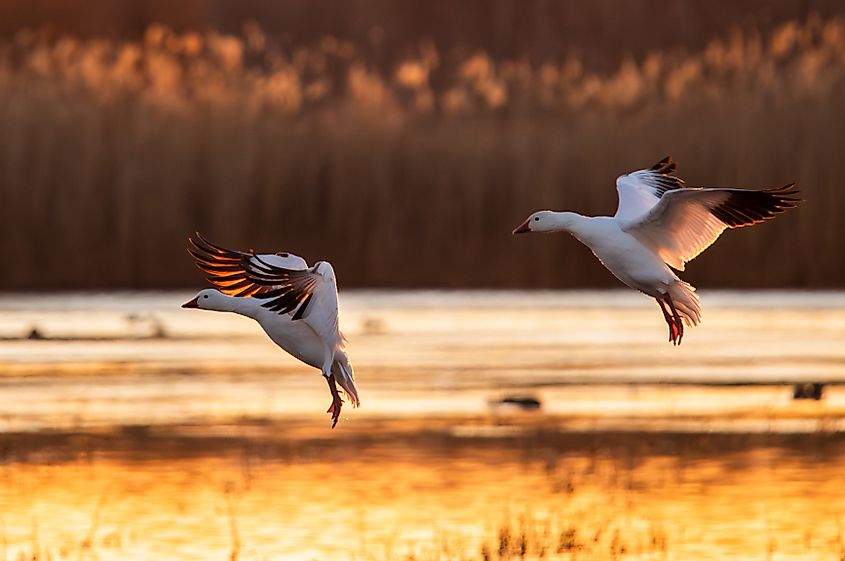
A pair of flying snow geese - Mexican specialties: the southwestern mountains and Rio Grande valley host species that barely reach the United States, including elegant trogon, Lucifer hummingbird, and various Madrean sparrows and flycatchers.
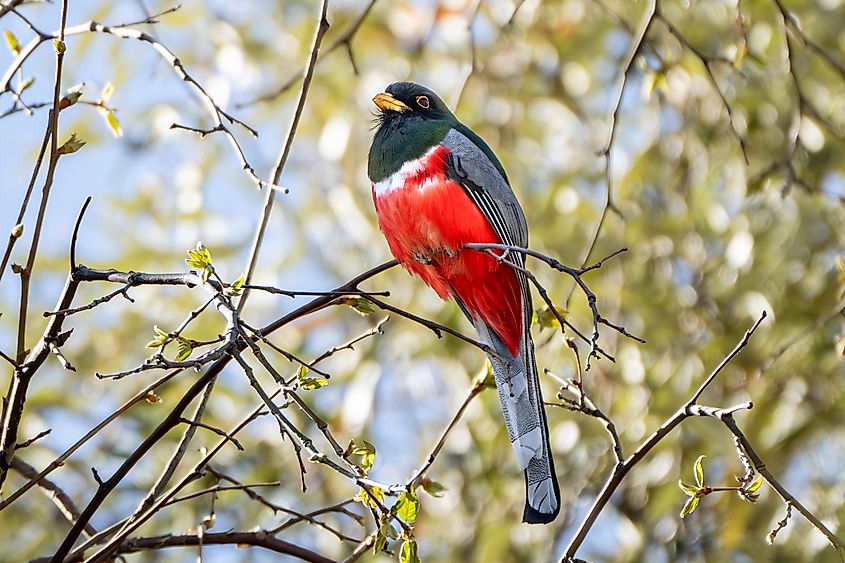
An elegant trogon (Trogon elegans) - Raptors: golden eagle, bald eagle wintering, ferruginous hawk, prairie falcon, peregrine falcon, and Aplomado falcon reintroduced to the southern grasslands after being lost from the US.
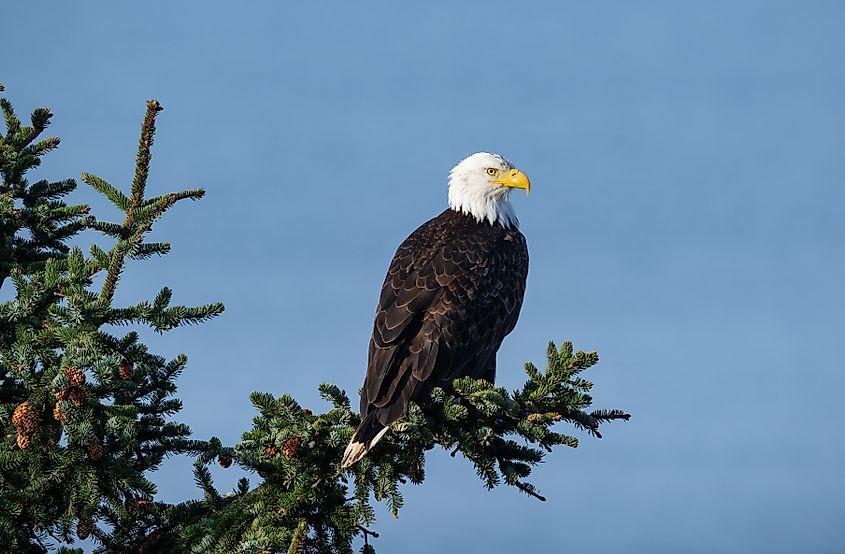
A bald eagle (Haliaeetus leucocephalus) - Grassland birds: lesser prairie-chicken, whose range has contracted severely, plus mountain plover, long-billed curlew, Cassin's sparrow, and Baird's sparrow wintering.
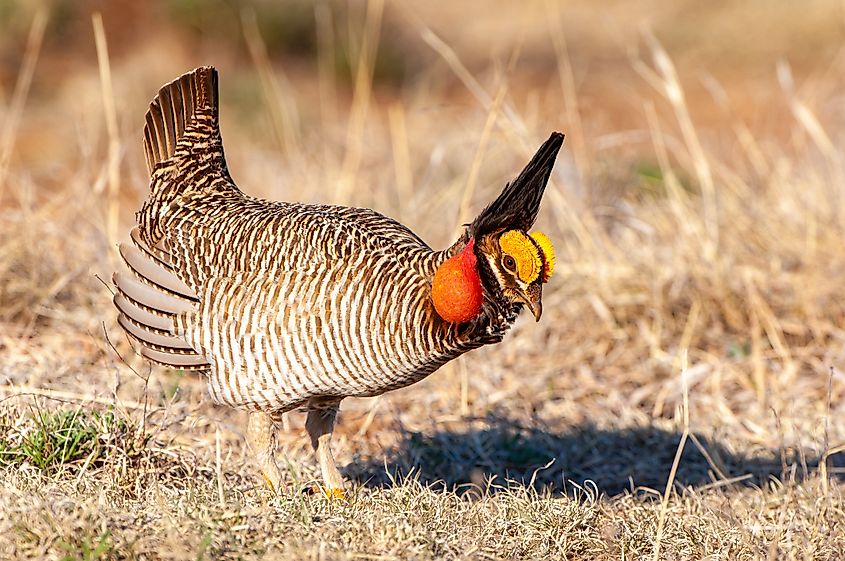
A lesser prairie-chicken (Tympanuchus pallidicinctus) - Riparian birds: southwestern willow flycatcher and yellow-billed cuckoo, both federally listed, plus summer tanager, Bell's vireo, and vermilion flycatcher.
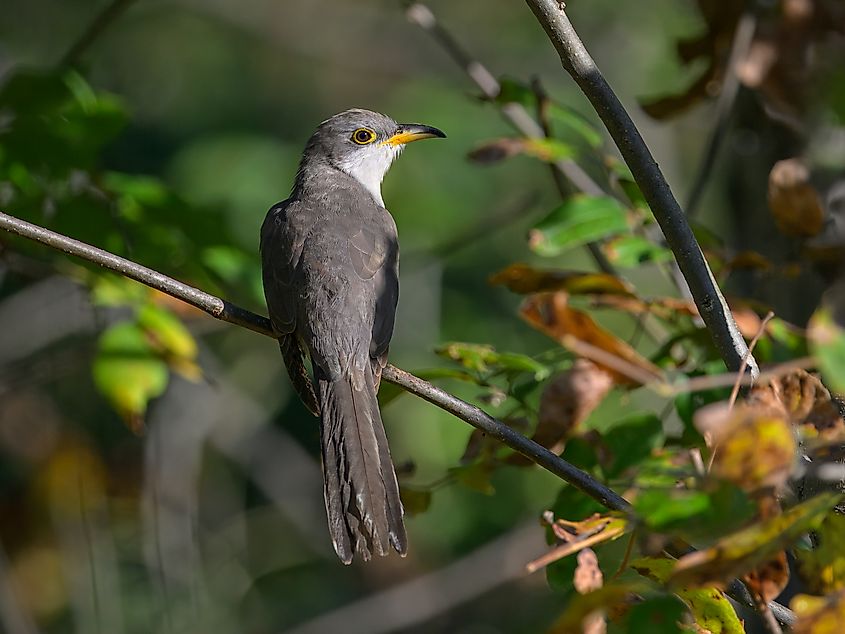
A yellow-billed cuckoo (Coccyzus americanus)


Condor connection: California condors from the Arizona and Utah flock occasionally range into northwestern New Mexico.

Section 06
Reptiles, Amphibians, And Fish
New Mexico has around 123 reptile and amphibian species combined, one of the higher totals in the country.
Reptiles

Roughly 46 lizard and 46 snake species. Eight rattlesnake species occur, including western diamondback, blacktail, rock, and the banded rock rattlesnake. Also the Gila monster in the southwest, collared lizard, horned lizards, and the New Mexico whiptail with its all-female reproduction. Related: parks with the most rattlesnakes.
Amphibians

The New Mexico spadefoot toad, the state amphibian, spends most of the year buried and emerges within hours of heavy monsoon rain, breeding in temporary pools where tadpoles must metamorphose before the water dries. Also Chiricahua leopard frog (federally threatened), Jemez Mountains salamander (federally endangered and found only in a small area of the Jemez), and tiger salamander.
Fish

New Mexico's native fish are in poor shape. The Rio Grande silvery minnow, once abundant through the entire Rio Grande, now survives in a fraction of its range and is federally endangered, dependent on managed river flows in a system where water is fully allocated. Gila trout and Rio Grande cutthroat trout both persist in headwater refuges above barriers that exclude non-native trout. Several desert springfish and pupfish are listed.
Section 07
Dangerous Animals In New Mexico
- Rattlesnakes: eight species. Western diamondbacks account for most serious bites. Bites are uncommon and rarely fatal, and roughly half occur when someone tries to handle a snake.
- Africanized honeybees: established across southern New Mexico and responsible for the most animal-related deaths through mass stinging and allergic reaction.
- Arizona bark scorpion: reaches the southwest corner and is the most medically significant scorpion in the region.
- Gila monster: rarely seen, and its bite is painful but seldom dangerous.
- Black bear and mountain lion: both present, both rarely a threat. New Mexico has recorded rare mountain lion attacks.
- Elk and deer: vehicle collisions, especially on mountain highways at dawn and dusk.
- Plague and hantavirus: New Mexico reports more human plague cases than almost any other state, carried by fleas on rodents including prairie dogs and woodrats. Hantavirus is also present in deer mice. Do not handle rodents or disturb nests and burrows.
Section 08
Endangered And Protected Species
| Species | Where | Status |
|---|---|---|
| Mexican gray wolf | Gila and Blue Range | ENDANGERED |
| Rio Grande silvery minnow | Middle Rio Grande | ENDANGERED |
| Southwestern willow flycatcher | Riparian bosque | ENDANGERED |
| Jemez Mountains salamander | Jemez Mountains only | ENDANGERED |
| Black-footed ferret | Prairie dog colonies | ENDANGERED |
| Mexican spotted owl | Canyon and montane forest | THREATENED |
| Lesser prairie-chicken | Southeast sand sagebrush | ENDANGERED |
| Chiricahua leopard frog | Southwest springs | THREATENED |
| Gila trout | Gila headwaters | THREATENED |
| Yellow-billed cuckoo | Cottonwood galleries | THREATENED |
| Rio Grande cutthroat trout | Headwater refuges | STATE CONCERN |
New Mexico's pressures are dominated by water. The Rio Grande is fully allocated between New Mexico, Texas, Colorado, and Mexico, and in dry years stretches of it go dry entirely, which is directly lethal to the silvery minnow and degrades bosque habitat. Groundwater pumping dries springs and cienegas. Beyond water: non-native trout displacing natives, larger and hotter wildfires in overstocked forests, sagebrush and grassland conversion, and border infrastructure cutting movement corridors for jaguars, ocelots, pronghorn, and bighorn.
Section 09
Where To See Wildlife In New Mexico
- Bosque del Apache National Wildlife Refuge: snow geese and sandhill cranes in the tens of thousands, best at dawn from November through February.
- Carlsbad Caverns National Park: the evening bat flight from late spring through October, with an amphitheatre at the natural entrance.
- Gila Wilderness: Mexican gray wolf country, Gila trout, and Madrean species in the first designated wilderness in the world.
- Valles Caldera National Preserve: large elk herds in a volcanic caldera grassland, best during the autumn rut.
- White Sands National Park: bleached lizards and pale rodents that evolved white colouration on gypsum dunes.
- Bitter Lake National Wildlife Refuge: wintering cranes, waterfowl, and an exceptional dragonfly fauna.
- Sandia and Sangre de Cristo Mountains: montane birds, black bear, and the Sandia hairstreak butterfly.
- Rio Grande Nature Center, Albuquerque: accessible bosque habitat with riparian birds.
Timing: November through February for cranes and snow geese at Bosque del Apache, which is the state's premier wildlife event. Late spring through October for the Carlsbad bat flight, checking the seasonal schedule since departure time shifts. July through September for the monsoon, which triggers spadefoot breeding and a second wildflower and insect flush. September and October for the elk rut at Valles Caldera. Spring for grassland birds and reptile activity before extreme heat.
Section 10
Common Questions
- What is the state animal of New Mexico?
- The American black bear, adopted in 1963 while Smokey Bear, an orphaned cub rescued from a 1950 fire in the Capitan Mountains, was still living at the National Zoo. New Mexico also names the greater roadrunner as state bird and the New Mexico whiptail as state reptile.
- What is unusual about the New Mexico whiptail?
- It is an all-female species that reproduces by parthenogenesis, with every individual essentially a clone of its mother. It arose from hybridisation between two other whiptail species and is one of the best-studied cases of unisexual vertebrate reproduction in the world.
- Are there wolves in New Mexico?
- Yes. The Mexican gray wolf, the most endangered gray wolf subspecies, was extirpated from the wild by the 1970s and reintroduced from 1998 into the Gila and Blue Range country. The wild population across New Mexico and Arizona now numbers in the high hundreds and remains contentious.
- How many bats are at Carlsbad Caverns?
- Hundreds of thousands of Brazilian free-tailed bats occupy the cave in summer, emerging each evening in a column that takes a long time to pass. Historically the colony may have numbered in the millions, and guano mining was the reason the cave was first explored.
- How many rattlesnakes live in New Mexico?
- Eight species, including western diamondback, blacktail, rock, and banded rock rattlesnakes. Western diamondbacks account for most serious bites.
- Why do animals at White Sands look bleached?
- Several species living on the gypsum dunes, including earless lizards and pocket mice, evolved pale colouration to match the white sand, in some cases within only a few thousand years. It is one of the clearest examples of rapid natural selection for camouflage anywhere.
- What is the most dangerous animal in New Mexico?
- Africanized honeybees cause the most deaths through mass stinging and allergic reaction. Fleas on rodents make New Mexico one of the leading states for human plague cases. Rattlesnake bites are uncommon and rarely fatal.
This page was last updated on October 7, 2026