Section 01
The Duck Factory Of North America
North Dakota produces more ducks than any other state, and the reason is a landscape most people drive past without noticing. The Prairie Pothole Region, formed when the last glaciers left behind millions of shallow depressions, covers roughly the eastern two thirds of the state. Those potholes fill with snowmelt each spring, warm quickly, and produce an explosion of invertebrates exactly when hens need protein for egg-laying.
The region is sometimes called the duck factory because it produces a disproportionate share of the continent's dabbling ducks. Mallard, blue-winged teal, northern pintail, gadwall, and northern shoveler all breed here in numbers that supply hunters and birders from Manitoba to Louisiana. North Dakota's wetlands matter to people who will never visit the state.
The problem is that potholes are easy to drain. Roughly half of the region's original wetlands are gone, converted to cropland through tile drainage and ditching, and the pressure intensifies whenever commodity prices rise. Federal wetland easements and the Conservation Reserve Program are the main defences, and both depend on farm policy rather than on ecology.
West of the Missouri River the state changes completely. The land rises into mixed-grass prairie and then into the badlands along the Little Missouri, where erosion has cut through soft sedimentary rock into a maze of buttes and coulees. That country holds bighorn sheep, elk, and free-ranging bison in Theodore Roosevelt National Park, plus feral horses that the park has managed as a cultural resource.
Section 02
North Dakota's Official State Animals
| Designation | Animal | Adopted |
|---|---|---|
| State bird | Western meadowlark Sturnella neglecta | 1947 |
| State fish | Northern pike Esox lucius | 1969 |
| State horse | Nokota horse | 1993 |
| State fossil | Teredo petrified wood | 1967 |
The Nokota horse designation has an unusual origin. When Theodore Roosevelt National Park fenced its boundaries in the 1950s, a number of free-roaming horses were enclosed inside. Rather than being removed entirely, some persisted, and they carried bloodlines thought to trace partly to Northern Plains Indian horses, possibly including stock from Sitting Bull's band. Two brothers began acquiring park-culled animals in the 1980s to preserve the line, and North Dakota named the Nokota its honorary state equine in 1993. Related: state parks where you can see wild horses.

North Dakota has no state mammal, reptile, amphibian, or insect. Given that the state produces more ducks than anywhere else in the country, the absence of a waterfowl symbol is striking, and the northern pike designation reflects the importance of Devils Lake and the Missouri River reservoirs to anglers rather than the state's ecological signature.
Section 03
How The Prairie Pothole Region Works
The glaciers that covered North Dakota until roughly 10,000 years ago left behind chunks of buried ice. As those melted, the ground above collapsed into shallow basins with no outlet. Millions of them now dot the landscape, ranging from puddles to small lakes.
Their productivity comes from being temporary and shallow. Water sits over dark prairie soil, warms fast in spring sun, and triggers an enormous hatch of midges, amphipods, and other invertebrates. A hen mallard needs animal protein to produce eggs, and potholes deliver it exactly when she arrives. Deeper permanent lakes hold fish, which eat those invertebrates, so the shallow fishless basins are actually the most valuable ones.
Different pothole types serve different purposes across the season, so a landscape with a mix of temporary, seasonal, and semi-permanent wetlands supports far more birds than the same water area concentrated in one big lake. That is why draining the small ones does disproportionate damage.

- Breeding ducks: mallard, blue-winged teal, northern pintail, gadwall, northern shoveler, redhead, canvasback, and lesser scaup.
- Other waterbirds: eared and western grebes, black tern, Franklin's gull, American avocet, marbled godwit, Wilson's phalarope, and Nelson's sparrow in wet meadow.
- Migration: enormous numbers of snow geese and sandhill cranes pass through in spring and autumn, and whooping cranes stop on their route between Texas and Canada.
Section 04
Habitats By Region, And Who Lives In Each
Red River Valley, far east

The flat bed of glacial Lake Agassiz, now among the most productive farmland in the world and almost entirely tilled. Remnant tallgrass prairie survives in small preserves, holding greater prairie-chicken, regal fritillary, and the endangered Dakota skipper butterfly.
Drift Prairie and pothole country

Rolling glacial till with the densest concentration of potholes. This is the core duck production area, along with sharp-tailed grouse, Richardson's ground squirrel, badger, and grassland songbirds including Baird's sparrow and Sprague's pipit, both of which have very restricted global ranges centred on the northern Great Plains.
Missouri Coteau

A hilly belt of stagnation moraine with exceptional wetland density and rougher terrain that resisted the plough. Some of the best remaining native prairie in the state is here, and it is disproportionately important for both ducks and grassland birds.
Missouri River and Lake Sakakawea

The Missouri is heavily impounded, with Garrison Dam creating Lake Sakakawea. The reservoir holds northern pike, walleye, and Chinook salmon stocked as a sport fishery, while the remaining free-flowing reaches below the dam hold pallid sturgeon and shifting sandbars used by nesting piping plovers and least terns.
Badlands and the Little Missouri

Eroded buttes, coulees, and juniper draws in the southwest. Bighorn sheep, elk, mule deer, pronghorn, bison, prairie dogs, golden eagle, and prairie rattlesnake all occur, and this is the only part of the state with genuinely rugged terrain. See Theodore Roosevelt National Park.
Turtle Mountains and northern woodlands

A forested upland straddling the Canadian border, an island of aspen and oak woodland in prairie. Moose occur here, unusual for a state most people picture as flat and treeless, along with beaver, bobcat, and forest birds at the western edge of their range.
Section 05
Mammals Of North Dakota
White-tailed and mule deer: whitetails in river bottoms and farmland, mule deer in the badlands. Related: white-tailed deer facts.

Pronghorn: on the western grasslands, with populations that fluctuate sharply after severe winters.

Elk: extirpated and reintroduced, now in the badlands and Turtle Mountains with limited hunting.

Bighorn sheep: Audubon's bighorn, the native badlands subspecies, went extinct around 1905. California bighorn were introduced in the 1950s and now number a few hundred, though a bacterial pneumonia outbreak caused severe losses in recent decades.

Bison: free-ranging herds in both units of Theodore Roosevelt National Park, plus tribal herds. Related: why bison vanished and state parks where bison still roam.

Moose: an unexpected North Dakota animal, present in the Turtle Mountains and northeastern woodlands and expanding into farmland shelterbelts.

- Black-tailed prairie dog: colonies in the west, supporting burrowing owls, badgers, and ferruginous hawks.
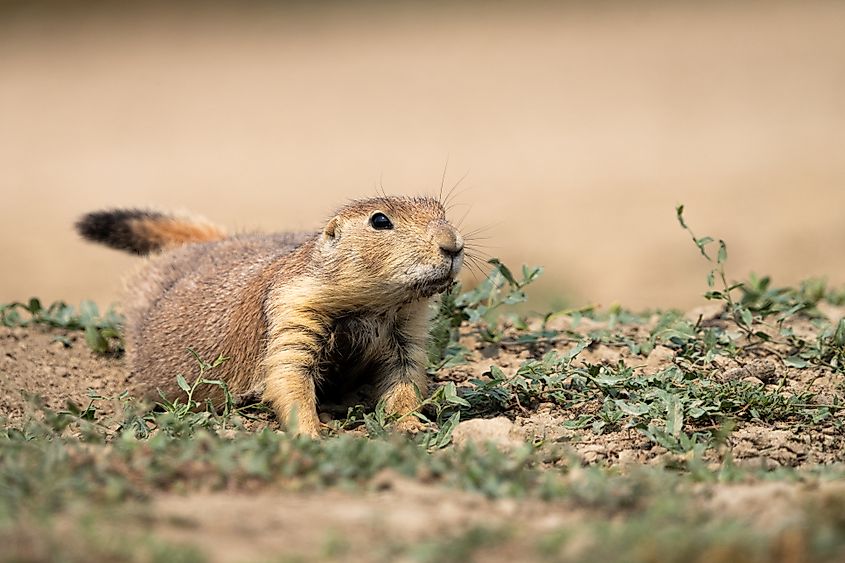
A black-tailed prairie dog (Cynomys ludovicianus)

Coyote, red and swift fox, bobcat, badger, river otter (recovering), mink, weasels, striped skunk, raccoon, beaver, muskrat, jackrabbits: all present.

Mountain lion: a small breeding population in the badlands, recolonised from the Black Hills, with a regulated season.

Bats: 11 species, with northern long-eared bat federally endangered. See where bats live.

Gone: gray wolf and grizzly bear, both eliminated in the 19th century, plus the endemic Audubon's bighorn sheep, which is extinct as a subspecies.
Section 06
Birds Of North Dakota
More than 380 species have been recorded, and the state punches far above its weight for breeding grassland and wetland birds.
Grassland specialists

Baird's sparrow, Sprague's pipit, chestnut-collared longspur, and Nelson's sparrow all have global ranges centred on the northern Great Plains, and North Dakota holds a substantial share of each. These are among the fastest-declining bird groups in North America.
Prairie grouse

Sharp-tailed grouse dance on leks across the state, and greater prairie-chickens persist in the southeast.
Waterbirds

The pothole breeding complex, plus American white pelican colonies at Chase Lake, which is one of the largest in North America, and was protected as a national wildlife refuge in 1908 by Theodore Roosevelt.
Piping plover

North Dakota's alkali lakes and Missouri River sandbars hold a significant share of the Great Plains breeding population.
Whooping crane

The Aransas-Wood Buffalo flock passes through on migration, and North Dakota is a key stopover state.
Raptors

Ferruginous hawk, Swainson's hawk, golden eagle in the badlands, and bald eagle along the Missouri.
Section 07
Reptiles, Amphibians, And Fish
Cold and dryness keep the list short: around 11 reptile and 12 amphibian species. One snake is venomous.
Snakes

Nine species. The prairie rattlesnake is the only venomous one, restricted to the badlands and southwestern breaks. Also bullsnake, western hognose, plains garter snake, and smooth green snake.
Turtles and lizards

Painted turtle, snapping turtle, spiny softshell, and the short-horned lizard in the badlands, which is North Dakota's only lizard across most of the state.
Amphibians

Tiger salamander, Great Plains toad, Canadian toad, plains spadefoot, northern leopard frog, wood frog, and boreal chorus frog. Potholes are important amphibian breeding habitat as well as duck habitat.
Fish

Northern pike is the state fish. The Missouri system holds pallid sturgeon, federally endangered and harmed by dams that eliminated the shifting sandbars and warm turbid flows it needs, plus paddlefish, which support a snagging fishery below Garrison Dam. Devils Lake, a closed basin that has risen dramatically since the 1990s and flooded surrounding farmland, now supports a large walleye and perch fishery.
Section 08
Dangerous Animals In North Dakota
- Deer: vehicle collisions are the leading wildlife hazard by a wide margin.
- Prairie rattlesnake: the only venomous snake, in the badlands and southwest. Bites are uncommon.
- Bison: relevant in Theodore Roosevelt National Park, where they roam free along roads and trails. Bison injure more people in US parks than bears do, and they are fast and unpredictable.
- Moose: aggressive when cornered and around calves, and collisions are severe.
- Mountain lion: a small badlands population, with attacks essentially unrecorded in the state.
- Ticks: Rocky Mountain spotted fever and tularemia occur, and the blacklegged tick has expanded into the east, bringing Lyme disease.
- Weather: worth stating plainly. Blizzards and extreme cold kill more people in North Dakota than every animal combined.
Section 09
Endangered And Protected Species
| Species | Where | Status |
|---|---|---|
| Whooping crane | Migration stopovers | ENDANGERED |
| Pallid sturgeon | Missouri and Yellowstone rivers | ENDANGERED |
| Piping plover | Alkali lakes, river sandbars | THREATENED |
| Dakota skipper | Native tallgrass remnants | THREATENED |
| Poweshiek skipperling | A few prairie fens | ENDANGERED |
| Northern long-eared bat | Statewide | ENDANGERED |
| Sprague's pipit | Native mixed-grass prairie | STATE CONCERN |
| Baird's sparrow | Native prairie | STATE CONCERN |
| Black-tailed prairie dog | Western colonies | STATE CONCERN |
| Interior least tern | River sandbars | DELISTED 2021 |
North Dakota's pressures are concentrated and economic. Wetland drainage and native prairie conversion accelerate when crop prices rise, and the state has lost roughly half its original wetlands and the large majority of its native prairie. The Bakken oil boom in the west brought roads, well pads, pipelines, and traffic into previously quiet badlands and grassland, fragmenting habitat and increasing disturbance. Set against that, federal wetland easements and duck stamp funding have permanently protected a meaningful acreage, and the state's remaining native prairie is disproportionately valuable to birds with nowhere else to go.
Section 10
Where To See Wildlife In North Dakota
- Theodore Roosevelt National Park: bison, elk, bighorn sheep, prairie dogs, and wild horses in badlands terrain, with a scenic drive in each unit.
- Chase Lake National Wildlife Refuge: one of the largest American white pelican colonies in North America.
- J. Clark Salyer National Wildlife Refuge: extensive marsh in the Souris River valley with breeding ducks and marsh birds.
- Lostwood National Wildlife Refuge: native mixed-grass prairie and pothole complex, excellent for Baird's sparrow and Sprague's pipit.
- Long Lake and Arrowwood refuges: waterfowl and shorebird migration in spring and autumn.
- Turtle Mountains: moose and woodland species in a prairie island of forest.
- Sheyenne National Grassland: greater prairie-chicken leks and tallgrass remnants.
- Missouri River below Garrison Dam: piping plovers, terns, and paddlefish season.
Timing: May and June for breeding ducks, grassland songbirds singing, and the highest wetland activity. April for sharp-tailed grouse and prairie-chicken leks at dawn. September and October for waterfowl and crane migration and the elk and pronghorn rut. Winter access is limited and severe, though the badlands are strikingly good for bighorn and deer against snow. Mosquitoes in pothole country in June are formidable.
Section 11
Common Questions
- What is the state animal of North Dakota?
- North Dakota has no state mammal. Its animal symbols are the western meadowlark as state bird, northern pike as state fish, and the Nokota as honorary state horse.
- Why is North Dakota called the duck factory?
- The Prairie Pothole Region covers roughly the eastern two thirds of the state with millions of shallow glacial wetlands that warm fast in spring and produce the invertebrates hens need for egg-laying. North Dakota produces more ducks than any other state.
- Are there bison in North Dakota?
- Yes, free-ranging herds in both units of Theodore Roosevelt National Park, plus tribal herds. They are managed populations rather than unbounded wild ones, but they roam freely within the park.
- Are there moose in North Dakota?
- Yes, which surprises people. Moose occupy the Turtle Mountains and northeastern woodlands and have expanded into farmland shelterbelts, an unusual habitat for the species.
- How many venomous snakes live in North Dakota?
- One, the prairie rattlesnake, restricted to the badlands and southwestern river breaks. The other eight snake species are harmless.
- What happened to Audubon's bighorn sheep?
- The native badlands subspecies went extinct around 1905 from hunting and disease. California bighorn were introduced in the 1950s and now number a few hundred, though bacterial pneumonia has caused severe losses.
- What is the most dangerous animal in North Dakota?
- Deer, through vehicle collisions. Bison injure visitors in Theodore Roosevelt National Park most years. Blizzards and extreme cold cause far more harm than any animal.
This page was last updated on September 3, 2026