Section 01
The Most Isolated Wildlife On Earth
Hawaii is roughly 2,400 miles from the nearest continent, the most remote major island chain on the planet. Almost nothing reached it under its own power. Over about 30 million years, a colonist arrived successfully perhaps once every 35,000 years on average, and each arrival that survived radiated into many species in the empty niches available.
The result is the highest rate of endemism anywhere in the United States and among the highest in the world. Roughly 90 percent of Hawaii's native terrestrial species occur nowhere else. But the founding stock was extremely narrow. No native land mammals except one bat and one seal. No native reptiles or amphibians at all. No ants, no mosquitoes, no snakes.
Those absences shaped everything. With no mammalian predators, birds evolved without defences: several became flightless, many nested on the ground, and most lost the wariness that mainland birds need. When people arrived with rats, pigs, dogs, and later cats, mongooses, and mosquitoes, that vulnerability became catastrophic.
Hawaii is often called the extinction capital of the world. It has less than one percent of the United States land area and accounts for a large share of the country's documented extinctions and around a third of its federally listed endangered species. Understanding Hawaii's animals means understanding both an extraordinary evolutionary experiment and its ongoing collapse.
Section 02
Hawaii's Official State Animals
| Designation | Animal | Adopted |
|---|---|---|
| State bird | Nene, Hawaiian goose Branta sandvicensis | 1957 |
| State mammal | Hawaiian monk seal Neomonachus schauinslandi | 2008 |
| State marine mammal | Humpback whale Megaptera novaeangliae | 1979 |
| State fish | Humuhumunukunukuapua'a, reef triggerfish Rhinecanthus rectangulus | 1985, 2006 |
| State insect | Kamehameha butterfly, Vanessa tameamea | 2009 |
Both the state bird and state mammal came back from the edge. The nene, descended from Canada geese that arrived roughly 500,000 years ago, evolved reduced webbing and stronger feet for walking on lava. It fell to about 30 birds in the 1950s. Captive breeding and predator control lifted it to a few thousand, and it was downlisted from endangered to threatened in 2019. The Hawaiian monk seal, one of only two tropical seal species on Earth and the only one native to the US, numbers roughly 1,500 animals and is slowly increasing after decades of decline.

The reef triggerfish has an odd legislative history. Its designation lapsed when Hawaii's symbol laws were codified, leaving the state without an official fish for several years until it was permanently reinstated in 2006. Its Hawaiian name refers to the pig-like grunting sound it makes.
Section 03
Habitats By Region, And Who Lives In Each
Hawaii's habitats are stacked by elevation and by rainfall rather than by latitude. The Big Island alone contains most of the world's climate zones, and windward slopes can receive over 300 inches of rain a year while leeward areas a few miles away get under 10.
Coastal and lowland dry

Beaches, dunes, anchialine pools, and dry lowland shrub. Almost entirely transformed by development and agriculture, and dominated by introduced species. Native residents include Hawaiian monk seals hauling out to rest, green sea turtles basking on beaches (unusual behaviour seen almost nowhere else), and endangered waterbirds in remaining wetlands.
Wetlands and anchialine pools

Coastal marsh, taro fields, and brackish lava pools. Four endangered endemic waterbirds depend on them: Hawaiian coot, Hawaiian gallinule, Hawaiian stilt, and Hawaiian duck. Anchialine pools hold endemic red shrimp found nowhere else.
Mesic and wet forest

Ohia lehua and koa forest on windward slopes, dripping with ferns and mosses. This is where surviving native forest birds live, and increasingly only above about 4,000 feet, where it is too cool for mosquitoes to breed. Home to most remaining honeycreepers, plus happy-face spiders, endemic tree snails, and hundreds of endemic insects.
High-elevation subalpine and alpine

Above the tree line on Mauna Kea, Mauna Loa, and Haleakala: lava, cinder, and sparse shrub. The palila, a finch-billed honeycreeper, survives only in mamane forest on Mauna Kea's slopes. Haleakala holds the endangered Hawaiian petrel, which nests in burrows on the crater rim, and the Wekiu bug lives near the Mauna Kea summit on insects blown up from below.
Reefs and ocean

Roughly 25 percent of Hawaii's reef fish are endemic, the highest rate for any reef system. Humpback whales migrate from Alaska each winter to breed and calve in the shallow channels, particularly around Maui. Spinner dolphins rest in sheltered bays by day, and monk seals, green turtles, and hawksbills use the nearshore waters. Background: coral reefs.
Papahanaumokuakea, the Northwestern Hawaiian Islands

A vast marine protected area of atolls and shoals northwest of the main islands, holding most of the world's Laysan albatross and black-footed albatross, the majority of Hawaiian monk seals, huge green turtle nesting at French Frigate Shoals, and the Laysan finch and Laysan duck, the latter of which was reduced to roughly a dozen birds in 1912.
Section 04
Birds: The Honeycreeper Story
Hawaiian honeycreepers are one of the most celebrated examples of adaptive radiation in biology, comparable to Darwin's finches but more extreme. A single finch-like ancestor arriving several million years ago gave rise to more than 50 species with bills specialised for nectar, seeds, insects, fruit, and even snails.
Most are gone. Roughly two thirds of known honeycreeper species are extinct, many before scientific description, and most survivors are endangered. Species still present include apapane and Hawaii amakihi (the two most common and most resilient), iiwi with its long curved nectar bill, akiapolaau which uses a straight lower bill to chisel and a curved upper bill to probe, palila, akikiki, akekee, and Maui parrotbill or kiwikiu.

Why they are dying: mosquitoes. Hawaii had no mosquitoes until 1826, when they arrived in a ship's water barrels. They brought avian malaria and avian pox, to which honeycreepers have almost no resistance. A single infected bite can kill an iiwi. Mosquitoes historically could not breed above roughly 4,000 to 5,000 feet because of cold, creating a disease-free refuge, and that is where nearly all surviving forest birds now live. As temperatures rise the mosquito line is climbing the mountains, and on Kauai, whose highest point is under 5,250 feet, there is almost no refuge left. Several Kauai honeycreepers are now down to a handful of individuals.
Other native birds: nene, Hawaiian hawk or io, Hawaiian short-eared owl or pueo, Hawaiian crow or alala (extinct in the wild, with captive-bred birds being reintroduced), Hawaiian petrel, Newell's shearwater, wedge-tailed shearwater, white and brown boobies, great frigatebird, and both albatross species. The Laysan albatross returns to the same nest site for decades, and one banded female known as Wisdom has been breeding on Midway since the 1950s.
Section 05
Mammals And Marine Life
Hawaii has exactly two native land or coastal mammals. Everything else with fur was brought by people.
- Hawaiian hoary bat, opeapea Lasiurus semotus: the only native land mammal, descended from North American hoary bats that made the ocean crossing. Endangered, solitary, and roosting in trees rather than caves.
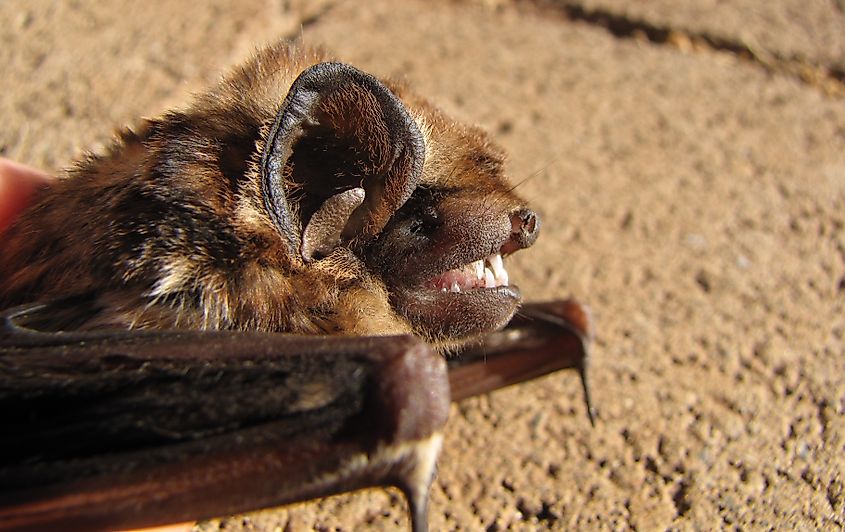
A Hawaiian hoary bat (Lasiurus semotus), By Forest & Kim Starr, CC BY 3.0 us - Hawaiian monk seal, ilioholoikauaua: roughly 1,500 animals, most in Papahanaumokuakea, with a slowly growing subpopulation in the main islands. Threats include entanglement, shark predation on pups, human disturbance, and habitat loss from sea level rise on low atolls.
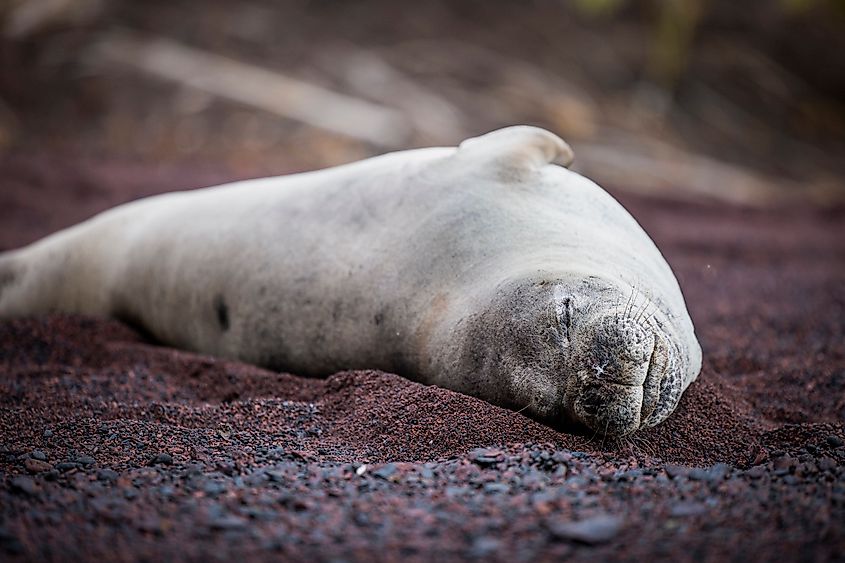
A Hawaiian monk seal (Neomonachus schauinslandi) - Humpback whale: the state marine mammal. Several thousand migrate from Alaskan feeding grounds each winter to breed. Males sing complex songs that change over a season and are shared across the population.
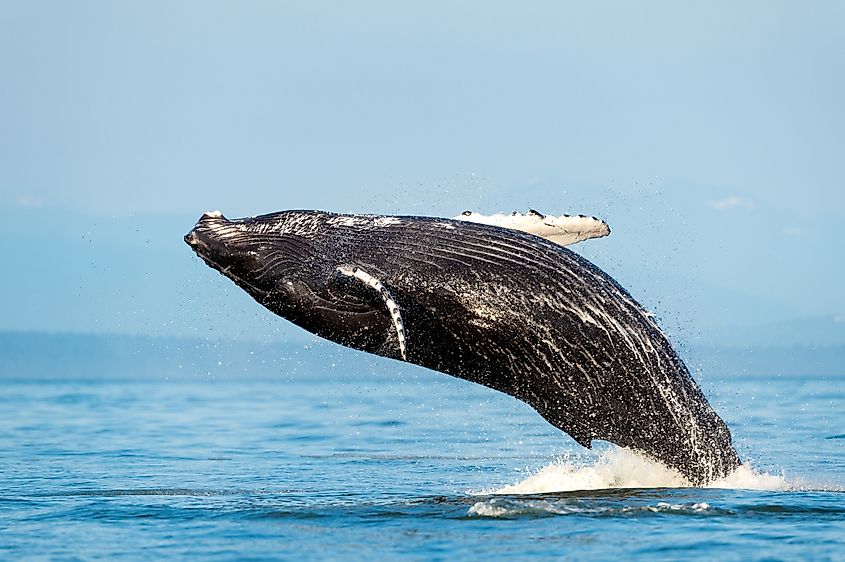
A humpback whale (Megaptera novaeangliae) - Other cetaceans: spinner dolphin, bottlenose dolphin, spotted dolphin, false killer whale (the main Hawaiian islands population is endangered, with roughly 150 animals), short-finned pilot whale, and beaked whales.
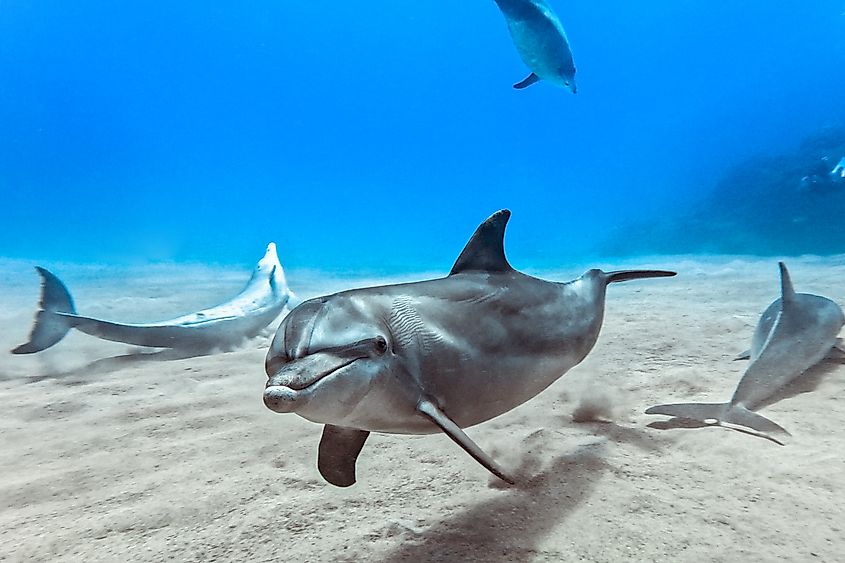
A bottlenose dolphin (Tursiops truncatus) - Sea turtles: green sea turtle or honu, recovered strongly since protection and now common, plus the far rarer hawksbill or honuea, with only a few dozen nesting females statewide.
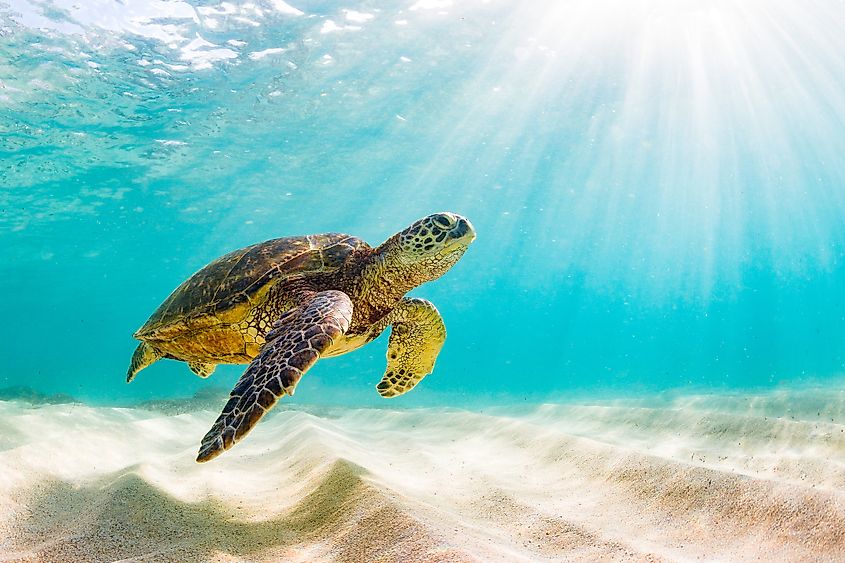
A green sea turtle (Chelonia mydas) - Reef life: around 25 percent of reef fish are endemic, including the Hawaiian cleaner wrasse and bandit angelfish. Also manta rays, whitetip and blacktip reef sharks, tiger sharks, and endemic urchins and corals.
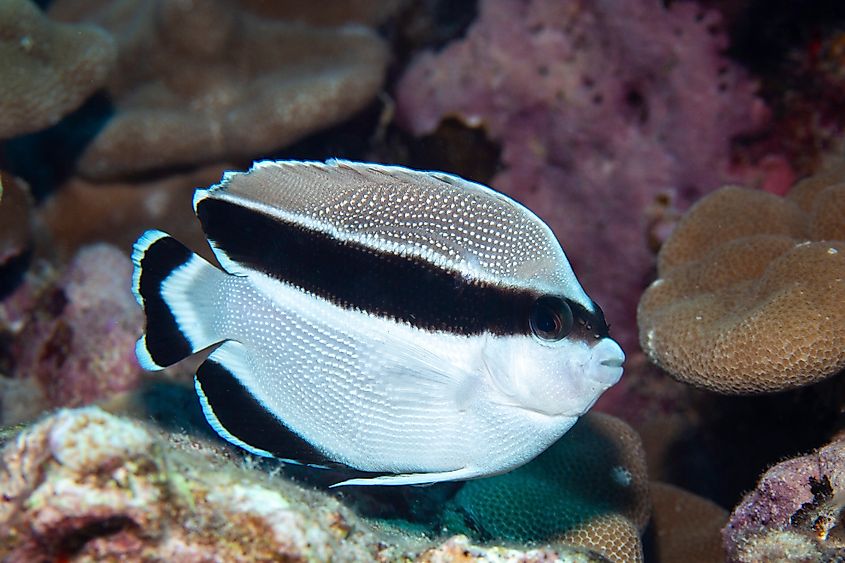
A banded angelfish (Apolemichthys arcuatus)


Section 06
Invertebrates: The Hidden Majority
Hawaii's most spectacular radiations are in animals most visitors never notice. Around 5,000 to 6,000 native insect species are estimated, the great majority endemic, from perhaps 350 to 400 original colonists.

- Tree snails: the Achatinella genus of Oahu once had over 40 species, brilliantly banded and prized by collectors. Nearly all are extinct or reduced to captive populations, killed by shell collecting, rats, and the introduced rosy wolfsnail brought in to control another invasive snail.
- Drosophila: roughly 1,000 endemic picture-wing and related fly species, one of the largest radiations of any animal genus anywhere, and a major research system in evolutionary genetics.
- Happy-face spider: a tiny forest spider with variable markings on its abdomen that resemble a smiling face.
- Carnivorous caterpillars: Hawaiian Eupithecia moth caterpillars ambush and grab flies, behaviour unknown in caterpillars anywhere else in the world.
- Kamehameha butterfly: the state insect and one of only two butterflies native to Hawaii.
- Cave arthropods: lava tubes hold blind, pigmentless crickets, spiders, and planthoppers that evolved in the dark.
- Yellow-faced bees: the genus Hylaeus radiated into dozens of Hawaiian species, several of which became the first bees in the United States to receive federal endangered species protection.
Section 07
Invasive Species: The Central Threat
In most states invasive species are one problem among many. In Hawaii they are the problem, because native animals evolved with no defences against them.

- Mosquitoes: introduced 1826, carrying avian malaria and pox. The single greatest cause of native bird loss. Managers are now releasing Wolbachia-infected male mosquitoes to suppress populations in forest bird habitat, an approach that offers the first realistic hope in two centuries.
- Rats: three species, eating eggs, chicks, snails, and seeds. Predator-proof fencing and island eradications are the main tools.
- Small Indian mongoose: introduced in 1883 to control rats in sugarcane. It is diurnal and rats are nocturnal, so it largely ignored them and ate ground-nesting birds and turtle eggs instead. It is absent from Kauai and Lanai, which is why those islands retain more ground-nesting seabirds.
- Feral pigs and goats: pigs root up forest floor, spread weed seeds, and create wallows that breed mosquitoes. Goats strip vegetation from dry slopes. Fencing and removal are the core of native forest management.
- Feral cats: major predators of seabirds and also spread toxoplasmosis, which has killed monk seals.
- Coqui frog: a Puerto Rican treefrog now extremely abundant on the Big Island, notable for noise and for consuming native invertebrates.
- Rosy wolfsnail, Jackson's chameleon, veiled chameleon, and axis deer: all established and damaging.
- Brown tree snake: not established, and keeping it out is the highest-priority biosecurity task in the state after what it did to Guam's birds.
Section 08
Dangerous Animals In Hawaii
Hawaii has no snakes, no scorpions, no venomous land animals of consequence, and no large land predators. Nearly every risk is in the water.

- Sharks: tiger sharks are the species involved in most serious incidents. Bites average a handful per year across enormous numbers of ocean users. Avoid murky water, river mouths after rain, dawn and dusk, and areas where fish are being cleaned.
- Box jellyfish and Portuguese man o' war: box jellyfish arrive on south-facing shores roughly eight to twelve days after a full moon. Man o' war strand with onshore winds. Both cause severe stings.
- Cone snails and sea urchins: cone snails have venomous harpoons; never pick up cone shells. Wana urchin spines break off in the skin.
- Moray eels and scorpionfish: injuries come from reaching into holes or stepping on camouflaged fish.
- Centipedes: the introduced Vietnamese centipede delivers a very painful bite and is common in gardens and homes.
- Ocean conditions: worth stating plainly, because drowning and shore-break injuries harm far more visitors than every Hawaiian animal combined. Rip currents and unpredictable surf are the real hazard.
Section 09
Endangered And Protected Species
| Species | Where | Status |
|---|---|---|
| Akikiki | Kauai, Alakai Plateau | ENDANGERED |
| Kiwikiu, Maui parrotbill | East Maui | ENDANGERED |
| Palila | Mauna Kea mamane forest | ENDANGERED |
| Alala, Hawaiian crow | Captive, being reintroduced | EXTINCT IN WILD |
| Hawaiian monk seal | Papahanaumokuakea, main islands | ENDANGERED |
| Hawaiian hoary bat | All main islands | ENDANGERED |
| False killer whale, main islands | Nearshore waters | ENDANGERED |
| Hawaiian petrel | Haleakala, high slopes | ENDANGERED |
| Newell's shearwater | Kauai mainly | THREATENED |
| Hawksbill sea turtle | Big Island beaches | ENDANGERED |
| Oahu tree snails | Oahu, mostly captive | ENDANGERED |
| Nene | Kauai, Maui, Big Island | THREATENED |
Hawaii accounts for a disproportionate share of US extinctions and listed species. The recoveries are real but hard-won: the nene from about 30 birds, the Laysan duck from roughly a dozen, the green turtle to abundance, and the monk seal now slowly rising. The losses continue: the po'ouli was last seen in 2004, and several Kauai honeycreepers are functionally at the end of their range.
Section 10
Where To See Wildlife In Hawaii
- Hakalau Forest National Wildlife Refuge, Big Island: the best place in the state for native forest birds, with limited access.
- Hosmer Grove and Haleakala National Park, Maui: accessible native birds plus nene and petrel habitat.
- Kilauea Point National Wildlife Refuge, Kauai: Laysan albatross, red-footed boobies, tropicbirds, and shearwaters from a clifftop.
- Kealia Pond and Hanalei NWR: the four endangered endemic waterbirds.
- Aulani to Maalaea and the Auau Channel, Maui: humpback whales from shore or boat in winter.
- Molokini Crater and Honaunau Bay: endemic reef fish and turtles by snorkel.
- Kaena Point Natural Area Reserve, Oahu: inside a predator-proof fence, with albatross, shearwaters, and monk seals hauling out.
- Alakai Swamp, Kauai: high-elevation rainforest and the last refuge for several honeycreepers.
Timing: humpback whales from roughly December through April, peaking in February. Albatross nest at Kilauea Point from November to July. Native forest birds are most active and vocal early in the morning. Box jellyfish risk peaks eight to twelve days after a full moon on south shores. Stay well back from monk seals and turtles, which is required by law: 50 feet for seals and more for mothers with pups.
Section 11
Common Questions
- What is the state animal of Hawaii?
- The Hawaiian monk seal is the state mammal, adopted in 2008, and the humpback whale is the state marine mammal. The state bird is the nene, or Hawaiian goose.
- Are there snakes in Hawaii?
- No native snakes. The tiny brahminy blind snake is established and harmless, and occasional escaped pets are found. Keeping the brown tree snake out is a top biosecurity priority after the damage it did to Guam's birds.
- What native mammals does Hawaii have?
- Two: the Hawaiian hoary bat, the only native land mammal, and the Hawaiian monk seal. Every other mammal in Hawaii was introduced by people.
- Why are Hawaii's birds going extinct?
- Chiefly avian malaria carried by mosquitoes introduced in 1826, against which honeycreepers have almost no resistance, combined with rats, cats, and mongooses eating eggs and chicks, and habitat loss. Surviving forest birds persist mainly above the elevation where mosquitoes can breed, and that line is rising as the climate warms.
- What is the most dangerous animal in Hawaii?
- In the water, tiger sharks and box jellyfish, though both cause few injuries relative to the number of ocean users. On land there is essentially nothing dangerous. Ocean conditions such as rip currents and shore break injure far more people than any animal.
- Why does Hawaii have so many endangered species?
- Extreme isolation produced a fauna of highly specialised endemic species with small ranges and no defences against introduced predators or diseases. Hawaii has under one percent of US land area and roughly a third of its listed endangered species.
- Is Hawaii included in the EPA ecoregion system?
- Not in the CEC Level I framework used for North America, which covers the continent. EPA maps Hawaii separately, which is why this page shows no Level I region.
This page was last updated on October 12, 2026